How to Pre-Round: The VELCRO Framework
A simple pre-rounding checklist for medical students and interns. VELCRO: Vitals, Exam, Labs, Consultants, Radiology, Other, plus how it connects to the RIME framework.
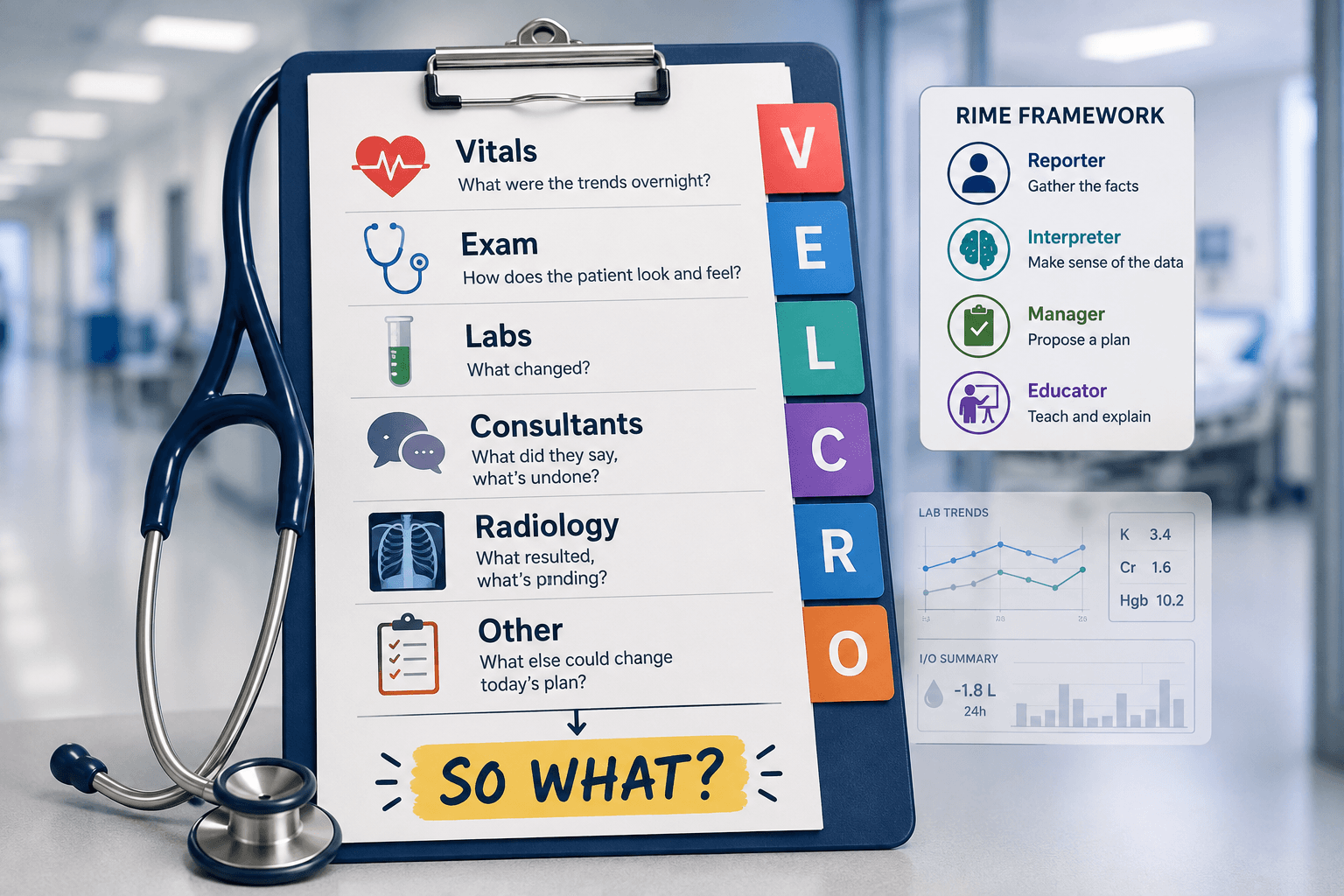
Pre-rounding is the work you do before rounds to figure out what changed with your patient overnight. VELCRO is a six-step checklist for doing it consistently: Vitals, Exam, Labs, Consultants, Radiology, Other.
Printable resource: Download the VELCRO Pre-Rounding Worksheet PDF. It is meant to be used on the wards as a quick structure for chart review, patient check-in, and presenting the overnight story.
Why pre-rounding is harder than it looks
Pre-rounding can feel surprisingly difficult when you first start on the wards. There is a tremendous amount of information in the chart, and one of the first skills you have to develop is simply figuring out what matters.
That is not a trivial skill.
Dozens of labs, imaging studies, consultant notes, nursing observations, medication changes, and overnight events compete for your attention. Add sleep deprivation and several patients to review before rounds, and relying on memory alone is not a particularly good system.
Even experienced clinicians forget things. The value of a checklist is that it does not depend on how much you slept.
The six steps
V: Vitals
Start with the vital signs, but do not just memorize the most recent numbers. Look at the trend.
What was the blood pressure overnight? Was the patient febrile? Has the oxygen requirement changed? Was there persistent tachycardia, or one isolated measurement at 4 AM when someone moved them?
Depending on the patient, this may also include intake and output, urine output, daily weights, or telemetry.
The question is not "What are the vitals?" It is what happened physiologically since I last saw this patient?
E: Exam
See the patient.
Your exam does not need to reproduce an entire admission physical every morning. It should be directed at the active problems. How is their breathing? Are they more or less edematous? Is their mental status different? How do they look compared with yesterday?
And ask the patient what happened overnight. The chart will tell you many things. It will not always tell you that they were awake all night coughing, developed new pain at 3 AM, or feel dramatically better after yesterday's intervention.
This is the step most likely to get skipped when you are behind. It is also the one your senior will notice you skipped.
L: Labs
Review the relevant labs, and again, focus on trends.
Do not report "creatinine is 1.6." Know whether it was 1.0 yesterday.
Look at the labs that matter for that patient's problems: hemoglobin, creatinine, sodium, potassium, liver enzymes, inflammatory markers, cultures, drug levels, or something else entirely. You do not need to memorize every number in the chart. You do need to recognize meaningful changes.
C: Consultants
Check what your consultants recommended. This is one of the easiest things to miss on a busy morning.
Did cardiology recommend a medication change? Did ID specify an antibiotic duration? Did surgery want the patient NPO? Did a consultant leave a question your team needs to answer?
Also check whether recommendations from yesterday are still outstanding. Consultant notes are not just documentation; they frequently contain tasks that determine what your team does today.
R: Radiology
Review new imaging. That includes the formal report, but when appropriate, look at the images yourself.
Was the chest X-ray improved? Did the CT show something unexpected? Has the ultrasound resulted? Is there imaging ordered yesterday that still has not happened?
Develop the habit early of knowing both what resulted and what is still pending. "It is ordered" and "it is back" are very different answers on rounds.
O: Other
There is always an "other." That is why the mnemonic needs one.
This may include microbiology, pathology, procedures, telemetry events, nursing concerns, medication changes, overnight cross-cover notes, bowel movements, glucose trends, anticoagulation, or disposition barriers.
"Other" is your final sweep: what happened that does not fit neatly above but could matter today?
A worked example
Say you are pre-rounding on a patient admitted two days ago with acute decompensated heart failure, diuresed yesterday.
- V: Net negative 1.8 L overnight. Weight down 2 kg. Heart rate 90s, up from 70s. Blood pressure soft at 98/60, previously 120s.
- E: Breathing more comfortably, speaking full sentences. Edema improved from 3+ to 1+. Reports feeling lightheaded when standing to use the bathroom.
- L: Creatinine 1.0 to 1.6. Potassium 3.4, down from 4.0.
- C: Cardiology recommended continuing the current diuretic dose and starting an ACE inhibitor when renal function permits.
- R: Repeat chest X-ray shows improved pulmonary edema.
- O: Nursing noted two episodes of orthostatic symptoms overnight. Home medication reconciliation still incomplete.
So what? The patient is decongesting well by symptoms, exam, and imaging, but the rising creatinine, falling blood pressure, and orthostatic symptoms together suggest they may be approaching the limit of what this diuretic dose should do. The potassium needs repletion, and the ACE inhibitor probably should not start today.
That paragraph is the whole point. Everything above it was gathering; that was thinking.
Where this fits: the RIME framework
One useful way to think about clinical training is RIME: Reporter, Interpreter, Manager, Educator.
Early in medical school, much of your responsibility is learning to be a reliable reporter: gathering relevant information, distinguishing signal from noise, and communicating clearly. As you progress, you are increasingly expected to interpret that information, propose a management plan, and eventually educate others.
It is easy to want to skip ahead. Medical students often feel they should immediately have sophisticated assessments. New interns feel pressure to already know exactly what to do.
But being a good reporter is itself a clinical skill. Before you can interpret a patient's course, you need to know what happened. Before you can manage the patient, you need to reliably identify what changed overnight.
Here is the same creatinine finding at each rung:
- Reporter: "The creatinine increased from 1.0 to 1.6."
- Interpreter: "This occurred after diuresis yesterday and may represent either expected hemoconcentration or developing kidney injury."
- Manager: "I would reassess volume status this morning and decide whether to continue the current diuretic dose."
- Educator: "Worth noting that a modest creatinine rise during decongestion does not reliably predict worse outcomes in acute heart failure, which is why we look at the whole picture rather than the number alone."
You do not need to reach all four stages on every patient every morning. Particularly as a student, or as an intern starting an unfamiliar rotation, it is completely appropriate to focus first on becoming an excellent reporter.
VELCRO is how you gather. RIME is how far you take it.
Quick reference
Before rounds, run through:
V: Vitals        What were the trends overnight?
E: Exam          How does the patient look and feel?
L: Labs          What changed?
C: Consultants   What did they say, what's undone?
R: Radiology     What resulted, what's pending?
O: Other         What else could change today's plan?
                 ↓
               So what?
You can also download the printable VELCRO pre-rounding worksheet and use it as a one-page guide before rounds.
When you are early in training, you may need to consciously run every letter. Eventually you stop thinking about the mnemonic and it becomes reflexive.
That is exactly the point. Good clinical habits are usually built by deliberately using structure until the structure disappears.
Frequently asked questions
What does VELCRO stand for in pre-rounding?
Vitals, Exam, Labs, Consultants, Radiology, Other: a six-step checklist for reviewing what changed with a patient overnight before rounds.
How long should pre-rounding take?
It varies enormously by service, patient complexity, and where you are in training. Students carrying one or two patients often have 30 to 45 minutes; interns carrying eight or more have far less per patient. Early on it will take longer than you want. Speed comes from the checklist becoming automatic, not from skipping steps.
What is the difference between pre-rounding and rounding?
Pre-rounding is the independent work you do beforehand: reviewing the chart, seeing the patient, and figuring out what changed. Rounds are when the team discusses the patient together and makes decisions.
Should I pre-round on patients I am not presenting?
If you are carrying them, yes. If your team is small enough that you can skim the others, it makes rounds far more useful because you will follow the discussion instead of waiting for your turn.
What is the RIME framework?
Reporter, Interpreter, Manager, Educator: a widely used model describing how clinical responsibility develops during training, and a common basis for evaluating students and residents on rotations.
Pre-rounding gets much easier when you stop treating the chart as an enormous pile of information and start working through it the same way every time.
Become a reliable reporter first. Interpretation and management follow.
And until it is second nature, use a little VELCRO to hold everything together.

Mendel Jacobs, MD, MPH
Menachem "Mendel" Jacobs, MD, MPH is an Internal Medicine Resident at Yale School of Medicine pursuing academic cardiology. He publishes under Menachem Jacobs.
Connect on LinkedInRelated Articles
Best Sketchy Pathology Anki Deck: Conaanaa's SALT Deck
How to use Conaanaa's SketchyPath SALT deck with Sketchy Pathology, Anki, UWorld, and pathology review without drowning in cards.
Sketchy Medical With Anki: The Best Pepper Deck Workflow for Sketchy Micro and Pharm
A practical guide to using Sketchy Medical with Anki, including what Sketchy means, how to use Sketchy Micro and Sketchy Pharm, and when to use the Pepper decks.
The SLARP Framework: A Practical Approach to Undifferentiated Acute Hypoxemia
A bedside framework for approaching acute hypoxemic respiratory failure when the diagnosis is not yet clear.