Sketchy Medical With Anki: The Best Pepper Deck Workflow for Sketchy Micro and Pharm
A practical guide to using Sketchy Medical with Anki, including what Sketchy means, how to use Sketchy Micro and Sketchy Pharm, and when to use the Pepper decks.
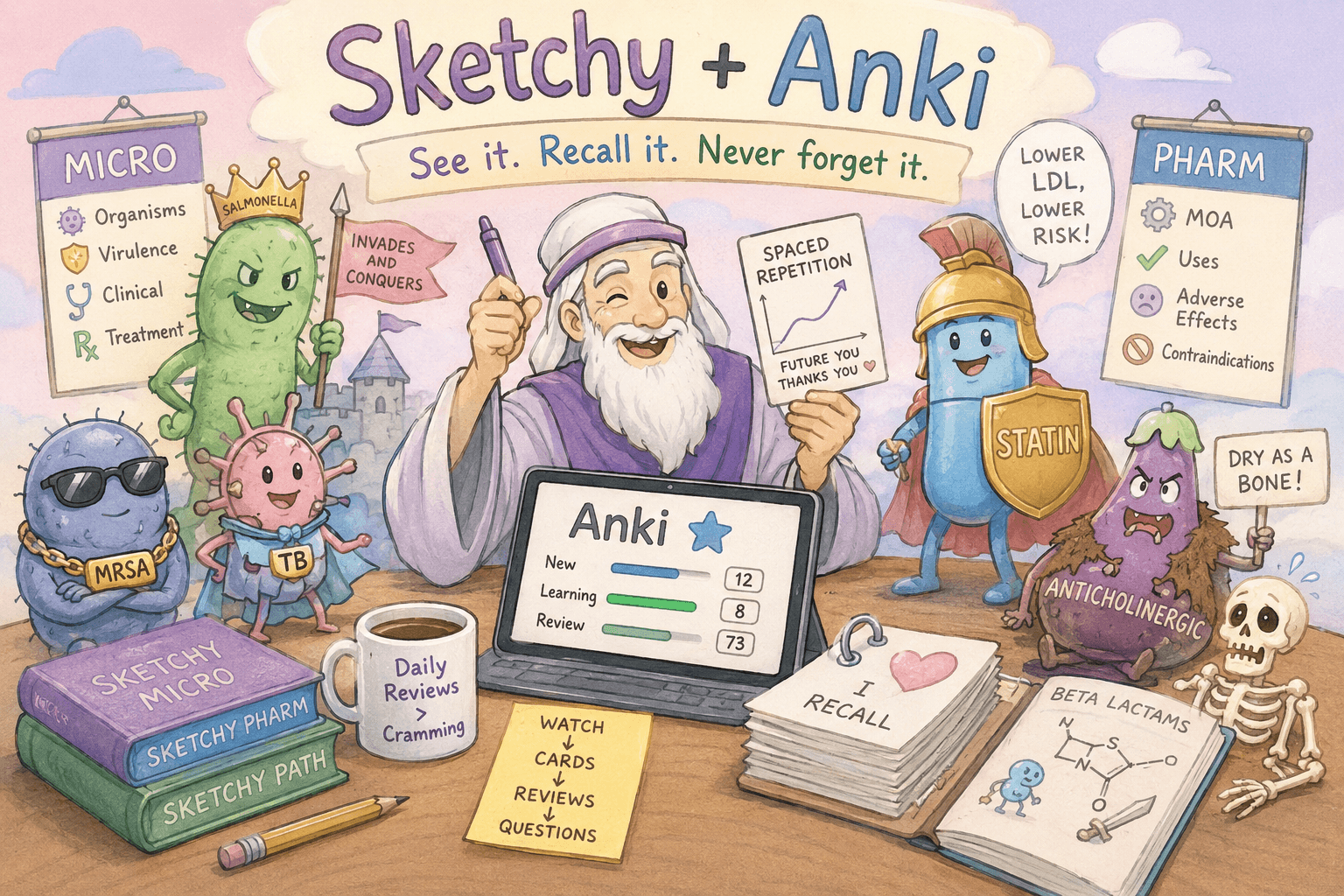
Sketchy Medical works because medicine is weirdly visual.
Microbiology and pharmacology are full of facts that do not naturally stick: mechanisms, organisms, virulence factors, adverse effects, contraindications, and the clue in the stem that tells you what matters. Sketchy gives those facts a scene. Anki makes you retrieve the scene until it stays.
That is the value of using Sketchy with Anki: see it once, recall it repeatedly, then apply it in questions.
What Does Sketchy Mean in Medical School?
In regular English, "sketchy" can mean suspicious or incomplete. In medical school, Sketchy usually means Sketchy Medical, the visual learning platform that teaches topics through stories and drawings.
Sketchy Micro uses memorable scenes for organisms, diseases, virulence factors, and treatments. Sketchy Pharm does the same for mechanisms of action, clinical uses, adverse effects, and contraindications. The pictures feel silly until they save you on a question.
The Best Simple Workflow
The best Sketchy Medical workflow is not complicated:
- Watch one Sketchy video.
- Review the matching Anki cards the same day.
- Keep up with daily reviews.
- Use questions to find what still does not stick.
Watching gives you exposure. Anki gives you retrieval. Questions tell you whether the fact survives inside a clinical vignette.
That is also the mistake most students make: they watch Sketchy passively, feel productive, and never force recall. If you do not retrieve the image later, you mostly just watched a cartoon.
Pepper Decks for Sketchy Micro and Sketchy Pharm
For Sketchy, the most useful companion decks are the Pepper decks. They are narrower than giant board-review decks, which is exactly the point.
Sketchy Micro Pepper Deck
The Pepper Deck for Sketchy Micro is built around Sketchy Micro.
Use it if you want cards that track closely with the videos and reinforce organisms, virulence factors, clinical clues, and treatments. The older version I used had about 990 cards aligned with roughly 100 Sketchy Micro videos. Your version may differ, but the workflow is the same: watch the video, then do the matching cards.
Sketchy Pharm Pepper Deck
The Pepper Deck for Sketchy Pharm does the same thing for pharmacology.
Use it for drug mechanisms, uses, side effects, contraindications, and high-yield associations. The version I used had about 1,333 cards and covered the major Sketchy Pharm videos. It is especially helpful if pharmacology tables make your eyes glaze over.
Sketchy Pathology SALT Deck
For pathology, I would separate the conversation from Pepper. The companion deck I would look at first is Conaanaa's SketchyPath SALT deck, which is built around Sketchy Path rather than Micro or Pharm.
Use it more selectively than the Pepper decks. Pathology needs mechanisms, not just image recall. SALT is strongest after you understand the disease and want the Sketchy Path scene to stick.
Pepper vs. AnKing and Bigger Decks
AnKing and older broad decks like Zanki can be excellent, but they are a different tool. They are comprehensive. Pepper is focused.
| Use Pepper when... | Use AnKing or a larger deck when... |
|---|---|
| You are watching Sketchy Micro or Sketchy Pharm and want matching cards. | You want one broad deck across organ systems and board review. |
| You want visual reinforcement without a massive daily card burden. | You are willing to keep up with a much larger review load. |
| You need help specifically with micro or pharm. | You want coverage beyond Sketchy. |
Bigger is not automatically better. The right deck is the one you can actually keep up with.
How Much Time Does Sketchy Take?
The exact Sketchy library changes over time, but the older breakdown I used was roughly:
| Sketchy resource | Approximate time |
|---|---|
| Sketchy Micro | 13.7 hours |
| Sketchy Pharm | 27 hours |
| Sketchy Path | 47 hours |
| Total | 87.7 hours |
Do not binge it. Make it small and repeatable: one video, matching cards, daily reviews, then questions.
Common Mistakes
Doing too many new cards. Tomorrow-you has to review what today-you unsuspends. If your review pile is exploding, add fewer new cards.
Treating premade cards as sacred. Edit confusing cards. Suspend low-yield cards. Add one clue from lecture if it helps.
Skipping questions. Sketchy and Anki help you remember facts, but question banks teach you how those facts are tested.
Using every resource because someone online mentioned it. Resource collecting feels productive. It usually is not.
My Recommendation
If I were starting again, I would keep the system simple:
- Use Sketchy Micro with the Pepper Micro deck.
- Use Sketchy Pharm with the Pepper Pharm deck.
- Use the SALT deck selectively for Sketchy Pathology.
- Keep reviews daily, even if you slow down new cards.
- Add questions early enough to test whether the facts are usable.
That is enough for most students. You can always add a broader deck later, but you do not need to turn the first week of medical school into a card-hoarding event.
For Step 2-style studying, the same principle applies: content is only useful if it survives contact with a question stem. I wrote more about that in my Step 2 CK study guide.
FAQs
What is Sketchy Medical?
Sketchy Medical is a visual learning platform that uses stories and drawings to teach medicine, especially microbiology and pharmacology.
What is Sketchy Micro?
Sketchy Micro is the microbiology portion of Sketchy Medical. It teaches organisms, diseases, virulence factors, and treatments through visual scenes.
What is the Pepper Deck?
The Pepper Deck is a premade Anki deck designed to pair with Sketchy videos. The Micro and Pharm decks reinforce the same visual cues used in Sketchy.
Can I use Pepper without Sketchy?
You can, but it is not ideal. The cards work best after you have watched the visual scene.
Is Pepper better than AnKing?
Not exactly. Pepper is narrower and easier to use as a Sketchy companion. AnKing is broader and more comprehensive.

Mendel Jacobs, MD, MPH
Menachem "Mendel" Jacobs, MD, MPH is an Internal Medicine Resident at Yale School of Medicine pursuing academic cardiology. He publishes under Menachem Jacobs.
Connect on LinkedInRelated Articles
Best Sketchy Pathology Anki Deck: Conaanaa's SALT Deck
How to use Conaanaa's SketchyPath SALT deck with Sketchy Pathology, Anki, UWorld, and pathology review without drowning in cards.
The SLARP Framework: A Practical Approach to Undifferentiated Acute Hypoxemia
A bedside framework for approaching acute hypoxemic respiratory failure when the diagnosis is not yet clear.
How to Pre-Round: The VELCRO Framework
A simple pre-rounding checklist for medical students and interns. VELCRO: Vitals, Exam, Labs, Consultants, Radiology, Other, plus how it connects to the RIME framework.