Best Sketchy Pathology Anki Deck: Conaanaa's SALT Deck
How to use Conaanaa's SketchyPath SALT deck with Sketchy Pathology, Anki, UWorld, and pathology review without drowning in cards.
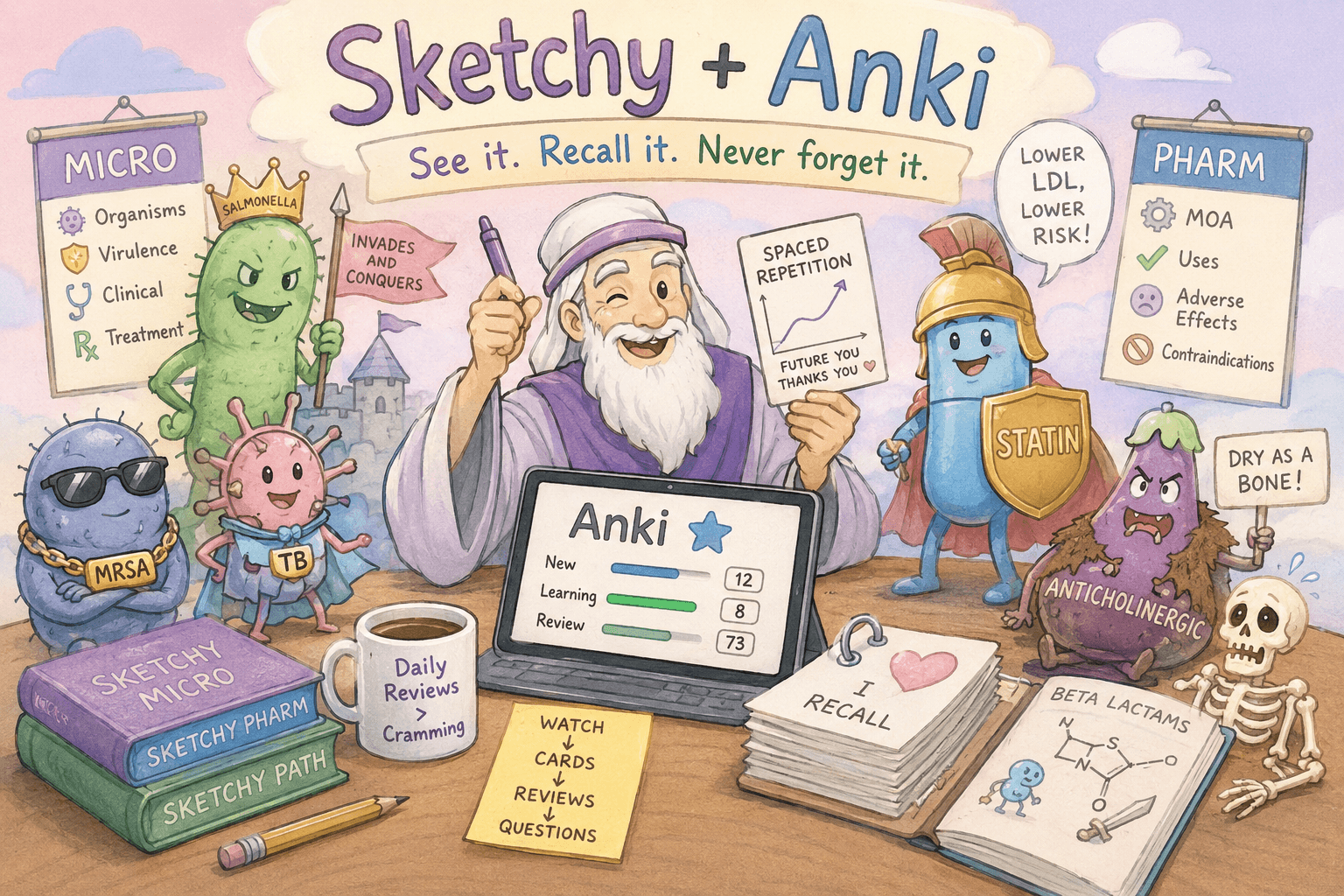
Sketchy Pathology is useful for the same reason Sketchy Micro and Pharm are useful: medicine is easier to remember when the facts are attached to an image.
But pathology is a little different. You are not just memorizing that a drug causes a side effect or that an organism has a virulence factor. You are trying to understand mechanisms, organ systems, histology, labs, complications, and how the disease shows up in a question stem.
That is where the Conaanaa SketchyPath SALT deck can help. It turns Sketchy Pathology into a retrieval system: watch the scene, do the matching Anki cards, keep up with reviews, then prove the knowledge in questions.
The last step matters. A beautiful memory palace that cannot survive UWorld is expensive wallpaper.
The Short Answer
For a Sketchy Pathology-centered workflow, Conaanaa's SALT deck is the Sketchy Path Anki deck I would look at first.
It is useful if you:
- Already use Sketchy Medical, especially Sketchy Pathology
- Want premade cards that reinforce the visual hooks from the videos
- Learn better from images than from another wall of text
- Need a system that pairs with Anki spaced repetition
It is less useful if you:
- Have not watched the Sketchy Path video first
- Are already drowning in a larger deck
- Need pathology mechanisms taught from scratch
- Are trying to replace practice questions with flashcards
The version of the deck that has circulated from the older community folder is usually described as having roughly 3,300 cards. Community decks change over time, so confirm the card count and organization after import.
Why SALT Works Best After The Video
The SALT deck is not magic. It works because it forces retrieval from a visual source you have already seen.
That order matters:
- Watch the Sketchy Pathology video.
- Understand the basic disease mechanism from your main resource.
- Unsuspend or review the matching SALT cards.
- Use questions to find what still does not transfer.
If you skip the video, the cards become a collection of disconnected image clues. If you skip the questions, you may know the image but miss the diagnosis when the stem says it in a different way.
For Sketchy Micro and Pharm, I wrote a separate guide on using Sketchy Medical with Anki and the Pepper decks. The idea is similar. The risk is bigger with pathology because the videos are longer and the card burden can creep up quickly.
Where The SALT Deck Fits
Think of each resource as having one main job.
| Resource | Best job | Do not ask it to do this |
|---|---|---|
| Sketchy Pathology | Create a memorable visual map for diseases, clues, and associations. | Replace a real explanation of pathophysiology. |
| Conaanaa's SALT deck | Make you retrieve the Sketchy Path visuals repeatedly. | Teach the disease from zero. |
| Pathoma, lecture, or another core path resource | Build the mechanism and organ-system logic. | Handle all long-term recall by itself. |
| UWorld or NBME questions | Show whether the facts work inside a board-style vignette. | Be your first exposure to every disease. |
That is the whole system. Learn the disease. Attach it to an image. Retrieve it. Test it.
SALT vs AnKing vs Making Your Own Cards
AnKing and other large decks are excellent if you want one broad system for board review. SALT is narrower. That is a feature, not a defect.
| Deck choice | Why you might use it | Main downside |
|---|---|---|
| Conaanaa's SketchyPath SALT deck | You want cards built around Sketchy Pathology images. | It is only as useful as your Sketchy Path workflow. |
| AnKing | You want broader board coverage and mature tagging. | The review load can become a second job. |
| Your own cards | You want to target exactly what you miss. | Making high-quality cards takes time and judgment. |
My usual answer: use the smallest deck that solves the problem you actually have. If the problem is "I watched Sketchy Path and forgot the scene two weeks later," SALT makes sense. If the problem is "I do not understand nephritic versus nephrotic syndrome," start with the mechanism first.
A Practical Workflow
This is how I would use the deck without letting it take over your life.
- Back up Anki before importing a large community deck.
- Import the SALT deck and look at the tags before unsuspending anything.
- Watch one Sketchy Pathology video for the topic you are actually studying.
- Unsuspend only the cards tied to that video or system.
- Do the first pass the same day.
- Keep the reviews daily, even if you slow down new cards.
- Do practice questions within a few days.
- Suspend cards that are too easy, too obscure, or not helping you.
The key move is restraint. Do not import 3,300 cards and immediately declare war on your future self.
Common Mistakes
Using SALT before learning the disease. The image helps you remember. It does not replace understanding.
Unsuspending too much. Anki is honest. Every card you add today comes back later with interest.
Treating the deck as sacred. Edit confusing cards. Suspend low-yield cards. Add one sentence from your lecture if it makes the card actually usable.
Skipping practice questions. Flashcards tell you whether you recognize a fact. Questions tell you whether you can use it.
Using every deck at once. SALT plus AnKing plus homemade cards can work, but only if you can keep up. Most students cannot brute-force their way through infinite reviews.
How To Download And Start
You can find Conaanaa's SketchyPath SALT deck here:
Download Conaanaa's SketchyPath SALT deck
I would treat any community deck as a starting point, not a guarantee. Check the cards, make sure the organization fits your version of Sketchy Pathology, and use community materials in a way that respects Sketchy's terms and the original deck authors.
Who Should Use It?
Preclinical students: probably the best fit. Use SALT alongside Sketchy Pathology while you are learning organ systems.
Dedicated Step 1 students: use it selectively. If you are close to the exam, do not start thousands of new cards unless you have a very specific reason.
Clinical students: use it only for weak areas. At that point, question banks and clinical pattern recognition should be doing more of the work.
FAQs
Is Conaanaa's SALT deck the best Sketchy Pathology Anki deck?
For a Sketchy Pathology-centered workflow, it is the deck I would look at first. It is focused on reinforcing Sketchy Path visuals rather than trying to be a complete pathology curriculum.
How many cards are in the SALT deck?
The commonly circulated version is usually described as roughly 3,300 cards, but community decks change. Check the actual file after you import it.
Can I use the SALT deck without Sketchy Pathology?
You can, but I would not recommend it. The cards work best after you have seen the corresponding visual scene.
Is Sketchy Pathology enough for pathology?
Not by itself. Sketchy is strongest for memory. You still need a core explanation of disease mechanisms and board-style questions to learn how the facts are tested.
Should I use SALT with AnKing?
You can, but be careful. If the combined review load makes you inconsistent, the plan is too large. A smaller deck done daily beats a perfect deck abandoned by Friday.

Mendel Jacobs, MD, MPH
Menachem "Mendel" Jacobs, MD, MPH is an Internal Medicine Resident at Yale School of Medicine pursuing academic cardiology. He publishes under Menachem Jacobs.
Connect on LinkedInRelated Articles
Sketchy Medical With Anki: The Best Pepper Deck Workflow for Sketchy Micro and Pharm
A practical guide to using Sketchy Medical with Anki, including what Sketchy means, how to use Sketchy Micro and Sketchy Pharm, and when to use the Pepper decks.
The SLARP Framework: A Practical Approach to Undifferentiated Acute Hypoxemia
A bedside framework for approaching acute hypoxemic respiratory failure when the diagnosis is not yet clear.
How to Pre-Round: The VELCRO Framework
A simple pre-rounding checklist for medical students and interns. VELCRO: Vitals, Exam, Labs, Consultants, Radiology, Other, plus how it connects to the RIME framework.