Before Your First ICU Rotation
A PGY-3's guide to feeling less overwhelmed before stepping into the ICU.
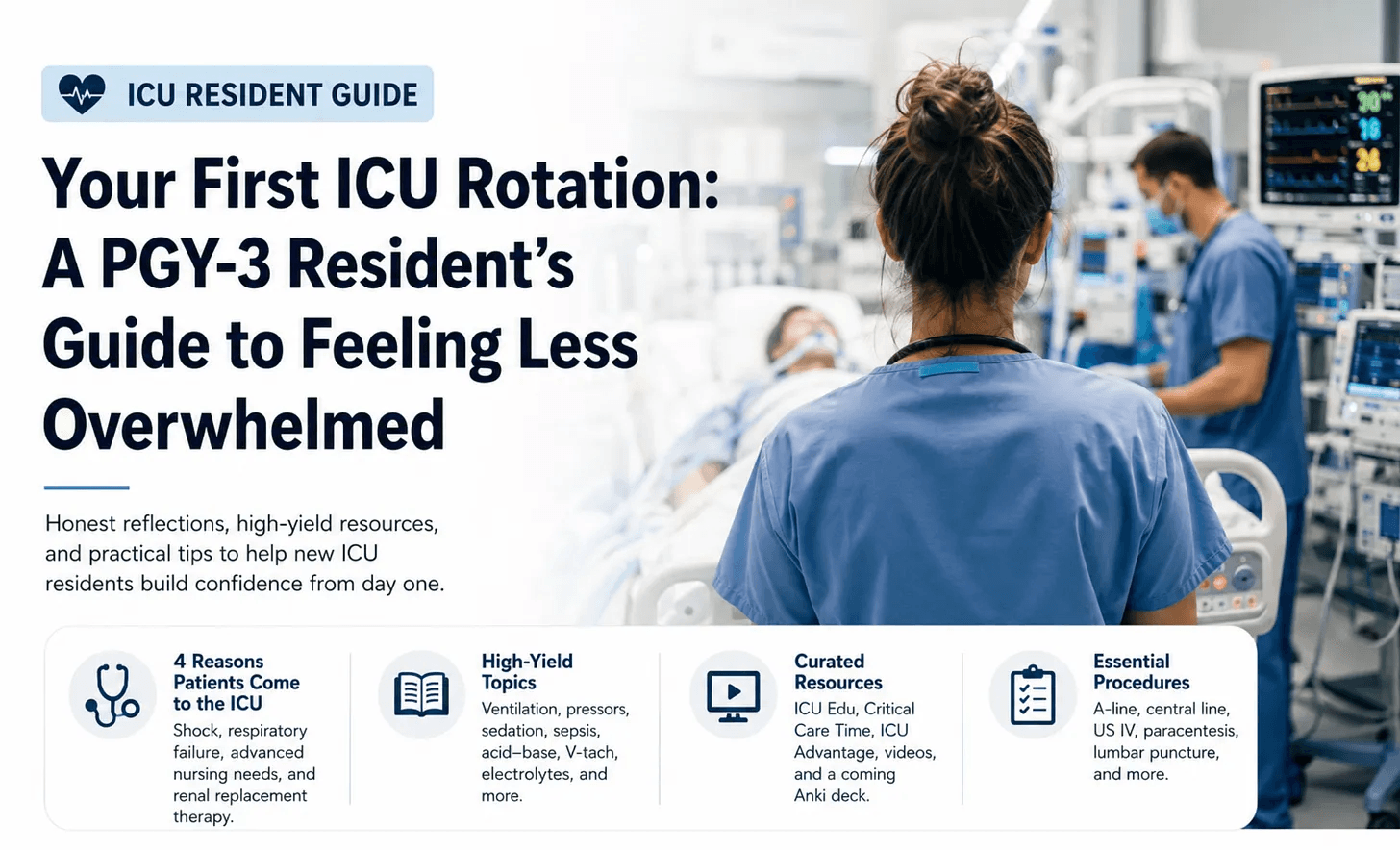
A PGY-3's Guide to Feeling Less Overwhelmed
I recently finished an ICU block working alongside July interns, some of the earliest of early medical trainees.
Watching them step into the unit reminded me just how overwhelming the ICU can feel.
There are ventilators humming, monitors alarming, medications running through multiple pumps, consultants calling, families waiting for updates, and critically ill patients whose conditions can change in minutes. Meanwhile, the new resident is quietly wondering:
Am I supposed to understand all of this already?
The answer is no.
You are not expected to know everything when you arrive in the ICU. In fact, nobody knows everything in the ICU. Critical care is too broad, too complicated, and too dependent on teamwork for any one person to hold all of it in their head.
What can help, however, is arriving with a basic mental framework.
My goal with this guide is not to turn someone into an intensivist before their first shift. It is to make the first few days feel a little less chaotic and to help the ICU become a more valuable learning environment.
Think of this as a collection of things I wish I could have shared with my interns in a more controlled way.
Why patients come to the ICU
Patients earn an ICU bed for one of four reasons:
Shock. Any etiology needing hemodynamic support and close blood-pressure monitoring.
Acute respiratory failure. Advanced ventilation in its various flavors, including invasive ventilation, ECMO or veno-venous cannulation, and bypass.
Advanced nursing support. Care that, by intensity or frequency, can only be delivered in the unit. Every institution draws this line differently. The occasional oddball fits here too: hourly ophthalmic drops for an eye emergency, burn care, and wound care.
Emergency renal replacement therapy. CVVH or CRRT.
The best part: when patients graduate this level of care, they move on. That turnover makes the ICU a fast-paced place to practice some of the purest medicine you will do in residency.
How to use this guide
The ICU is full of idiosyncrasies that trip up first-timers and repeat rotators alike. The fix is a working knowledge of the basics plus a resource you can dip into in quick bites: on the commute, after a shift, or in the rare downtime between admits.
Below is a focused set of resources I leaned on, curated to orient rather than overwhelm. Start anywhere.
Drips: pressors, sedation, paralytics
The ventilator
Core problems
Fantastic resources
Procedures to get comfortable with
- Arterial line
- Central line
- Ultrasound-guided IV
- Paracentesis
- Lumbar puncture
Coming soon
An Anki deck built from these resources. Download it, drill the high-yield points, and review between shifts so the knowledge actually sticks.
- Resident's Guide to Step 3: Minimal Time, Maximum Results
- USMLE Step 3 CCS Cases: Quick Framework with 5 Mnemonics
Best of luck.

Mendel Jacobs, MD, MPH
Menachem "Mendel" Jacobs, MD, MPH is an Internal Medicine Resident at Yale School of Medicine pursuing academic cardiology. He publishes under Menachem Jacobs.
Connect on LinkedInRelated Articles
Best Sketchy Pathology Anki Deck: Conaanaa's SALT Deck
How to use Conaanaa's SketchyPath SALT deck with Sketchy Pathology, Anki, UWorld, and pathology review without drowning in cards.
Sketchy Medical With Anki: The Best Pepper Deck Workflow for Sketchy Micro and Pharm
A practical guide to using Sketchy Medical with Anki, including what Sketchy means, how to use Sketchy Micro and Sketchy Pharm, and when to use the Pepper decks.
The SLARP Framework: A Practical Approach to Undifferentiated Acute Hypoxemia
A bedside framework for approaching acute hypoxemic respiratory failure when the diagnosis is not yet clear.