The SLARP Framework: A Practical Approach to Undifferentiated Acute Hypoxemia
A bedside framework for approaching acute hypoxemic respiratory failure when the diagnosis is not yet clear.
Every intern has the same moment.
It is 2 AM. Your patient suddenly becomes hypoxemic. The chest X-ray is hazy. The BNP is mildly elevated. The white count is 14,000. Nobody is quite sure why they are deteriorating.
Is this pneumonia? Heart failure? A COPD exacerbation? An inflammatory lung disease?
Often, the honest answer is we do not know yet.
And that is okay.
Your job is not to guess the diagnosis in the first fifteen minutes. Your job is to stabilize the patient, treat the most plausible reversible processes, and continue gathering information. Sometimes that means treating several possibilities simultaneously while the clinical picture evolves.
That is where I find the SLARP framework useful.
I first learned this framework from Dr. Kylie Rostad during my Step-Down Unit rotation at Yale New Haven Hospital. With her permission, I have adapted it slightly into a teaching tool that I have found helpful for interns and medical students. It is not a validated diagnostic algorithm or a substitute for clinical judgment. It is simply a practical bedside mental model for approaching one of the most common and intimidating presentations in the hospital.
A Typical Presentation
Imagine a 65-year-old man with COPD, HFpEF, and recent sick contacts presenting with acute hypoxemic respiratory failure.
His chest X-ray shows diffuse bilateral opacities. His BNP is mildly elevated. His white count is 14,000. He is afebrile and does not appear obviously volume overloaded.
So what is it?
- Pneumonia?
- COPD exacerbation?
- Acute heart failure?
- Organizing pneumonia?
- An ILD flare?
At the bedside, you may not know.
Fortunately, you do not always have to.
The Framework
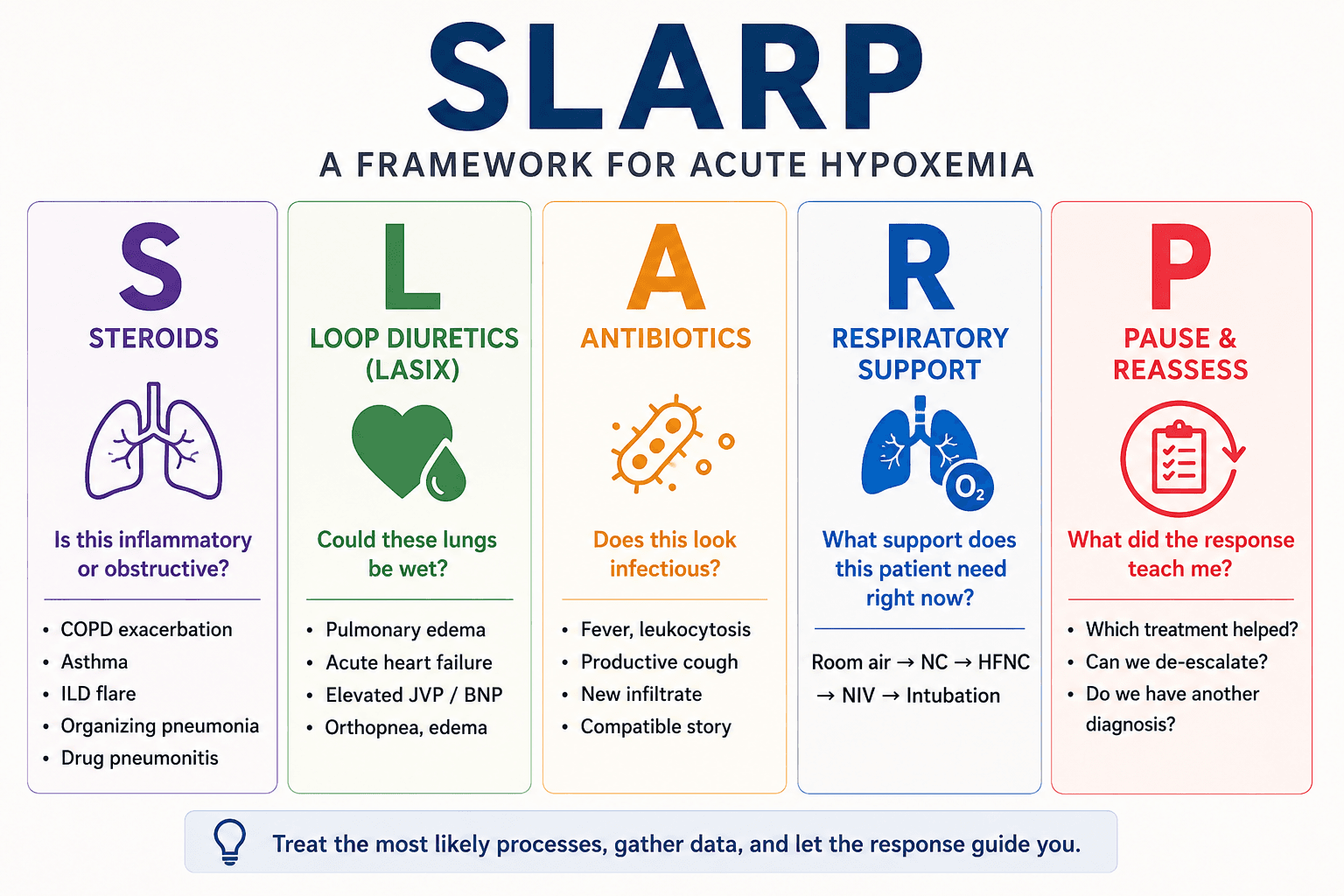
When a patient is acutely hypoxemic and the diagnosis is not immediately clear, SLARP helps organize both your differential diagnosis and your initial management.
| Letter | Stands for | Ask yourself |
|---|---|---|
| S | Steroids | Is this inflammatory or obstructive? |
| L | Loop diuretics, often Lasix | Could these lungs be wet? |
| A | Antibiotics | Does this look infectious? |
| R | Respiratory support | What respiratory support does this patient need right now? |
| P | Pause and reassess | What did the patient's response teach me? |
One important caveat: although the mnemonic begins with S, the patient begins with R. Stabilize oxygenation and ventilation first. The letters are arranged for memory, not chronology.
R — Respiratory Support
Do this first.
The diagnosis can wait.
The airway cannot.
Before working through the differential, determine what level of respiratory support the patient needs:
- Room air
- Nasal cannula
- High-flow nasal cannula
- Non-invasive ventilation, especially for COPD exacerbation or cardiogenic pulmonary edema
- Intubation
Escalate when you see:
- Increasing oxygen requirements
- Rising work of breathing
- Altered mental status
- Inability to protect the airway
- Failure of non-invasive support
Pearl: a patient comfortable on 2 L nasal cannula and another requiring 60 L/min of high-flow nasal cannula are not equally sick simply because both have an SpO2 of 94%. Always pay attention to the amount of support required, not just the saturation.
S — Steroids
Ask yourself: could this be an inflammatory or obstructive lung process?
Common examples include:
- COPD exacerbation
- Asthma
- ILD flare
- Organizing pneumonia
- Drug-induced pneumonitis
Look for clues such as wheezing, a history of obstructive lung disease, hyperinflation, ground-glass or organizing infiltrates, eosinophilia, or recent immune checkpoint inhibitor therapy.
For a COPD exacerbation, prednisone 40 mg daily for five days with bronchodilators is a common starting regimen. Patients with severe inflammatory lung diseases often require much higher steroid doses, so early pulmonary consultation is appropriate.
Pearl: not every steroid-responsive disease gets COPD doses.
Remember: steroids are not benign. If the overall picture appears more infectious than inflammatory, empiric steroids may do more harm than good.
L — Loop Diuretics (Lasix)
Ask yourself: could these lungs simply be wet?
Think about acute decompensated heart failure.
Look for:
- Elevated JVP
- Peripheral edema
- Orthopnea
- Pulmonary edema on imaging
- Elevated BNP or NT-proBNP
- Echocardiographic evidence of elevated filling pressures
Treat with IV loop diuretics, monitor urine output, reassess within a few hours, and escalate therapy if the response is inadequate.
Pearl: a low BNP makes acute heart failure much less likely. A high BNP supports the diagnosis but always requires clinical context.
A — Antibiotics
Ask yourself: does this actually look infectious?
Look for:
- Fever
- Leukocytosis
- Productive cough
- A new infiltrate
- A compatible clinical story
For most hospitalized patients with community-acquired pneumonia, ceftriaxone plus azithromycin, or doxycycline when appropriate, remains a reasonable empiric regimen.
Broaden therapy only when genuine risk factors for resistant organisms exist.
Pearl: send cultures before the first antibiotic whenever feasible. The information you need for de-escalation in 48 hours starts now.
P — Pause and Reassess
This is the most important step, and the one trainees skip most often.
After the first 24 to 48 hours, ask yourself:
- Which treatment actually helped?
- Did the patient improve after diuresis?
- Did steroids make the biggest difference?
- Were cultures negative?
- Can antibiotics be narrowed?
- Does another diagnosis now seem more likely?
Treatment response is data.
Do not continue empiric therapies simply because they were started.
Use the patient's trajectory to refine the diagnosis.
What SLARP Does Not Cover
SLARP is a framework, not a complete differential.
Always keep these diagnoses in mind:
- Pulmonary embolism, perhaps the most important omission
- Pneumothorax
- Aspiration
- Mucus plugging or atelectasis
- ARDS
- Diffuse alveolar hemorrhage
- Intracardiac or intrapulmonary shunt
- Upper airway obstruction
Some patients fit neatly into one category.
Many do not.
The Take-Home
SLARP is not a recipe for giving everyone steroids, loop diuretics, antibiotics, and escalating oxygen.
It is a framework for thinking.
Each intervention asks a different diagnostic question.
- S: Is this inflammatory?
- L: Could these lungs be wet?
- A: Does this look infectious?
- R: What respiratory support does the patient need right now?
- P: What did the patient's response teach me?
The goal is not to guess the diagnosis in the first fifteen minutes.
It is to stabilize the patient, treat the most plausible reversible processes, and let the next 24 hours make you smarter than the first fifteen minutes ever could.
That is the real lesson behind SLARP.
Frequently Asked Questions
What does SLARP stand for?
Steroids, Loop Diuretics (Lasix), Antibiotics, Respiratory support, and Pause and reassess. It is a bedside teaching framework, not a validated diagnostic algorithm.
Is SLARP evidence-based?
No. SLARP is a mental model adapted from bedside teaching. It does not replace clinical judgment, institutional protocols, or disease-specific guidelines.
When should I use SLARP?
Use it when a hospitalized patient is acutely hypoxemic and the cause is not immediately clear. It is most useful as a structure for early stabilization, organizing the differential, and reassessing the response to empiric treatment.
Acknowledgment
This framework is adapted, with permission, from bedside teaching by Dr. Kylie Rostad during my Step-Down Unit rotation at Yale New Haven Hospital. Any modifications or errors are my own.
Educational content intended for clinicians and trainees. This article is not medical advice and should not replace clinical judgment, institutional protocols, or current evidence-based guidelines.

Mendel Jacobs, MD, MPH
Menachem "Mendel" Jacobs, MD, MPH is an Internal Medicine Resident at Yale School of Medicine pursuing academic cardiology. He publishes under Menachem Jacobs.
Connect on LinkedInRelated Articles
Best Sketchy Pathology Anki Deck: Conaanaa's SALT Deck
How to use Conaanaa's SketchyPath SALT deck with Sketchy Pathology, Anki, UWorld, and pathology review without drowning in cards.
Sketchy Medical With Anki: The Best Pepper Deck Workflow for Sketchy Micro and Pharm
A practical guide to using Sketchy Medical with Anki, including what Sketchy means, how to use Sketchy Micro and Sketchy Pharm, and when to use the Pepper decks.
How to Pre-Round: The VELCRO Framework
A simple pre-rounding checklist for medical students and interns. VELCRO: Vitals, Exam, Labs, Consultants, Radiology, Other, plus how it connects to the RIME framework.