How to Study for Step 2 CK: A 4-Week USMLE Step 2 Study Plan
How to study for Step 2 CK with a focused plan for Divine Intervention podcasts, UWorld, NBME practice tests, Anki, rotations, and exam-day question load.
I was recently on a rotation in our step-down unit with a third-year medical student who was stressing about Step 2 CK.
I will always have an ear for sympathy. The exam matters, the pressure is real, and medical training has a special talent for making smart people feel like they are one bad practice test away from ruin.
But I also had to be honest with her: this student was already beating me in qualifications. She was brilliant, clearly ahead of me in raw brain power as a Yale MD-PhD student, and somehow doing all of this with a couple of kids in tow. I went to a great institution for medical school, but it was not Yale, and I certainly was not carrying that much life at the same time.
That said, I do not think Step 2 CK is a test you need to lose yourself over. Maybe because I did not have endless time for it, I had to break the exam down into a simple, brutal science: content, questions, practice tests, retention. That was the methodology. It worked well enough to get me the score I needed and help me match into my dream Internal Medicine residency at Yale New Haven.
So this is not a magic plan, and it is not a guarantee. It is the study system I wish I could hand to a stressed student in the hospital: focused, efficient, and very doable.
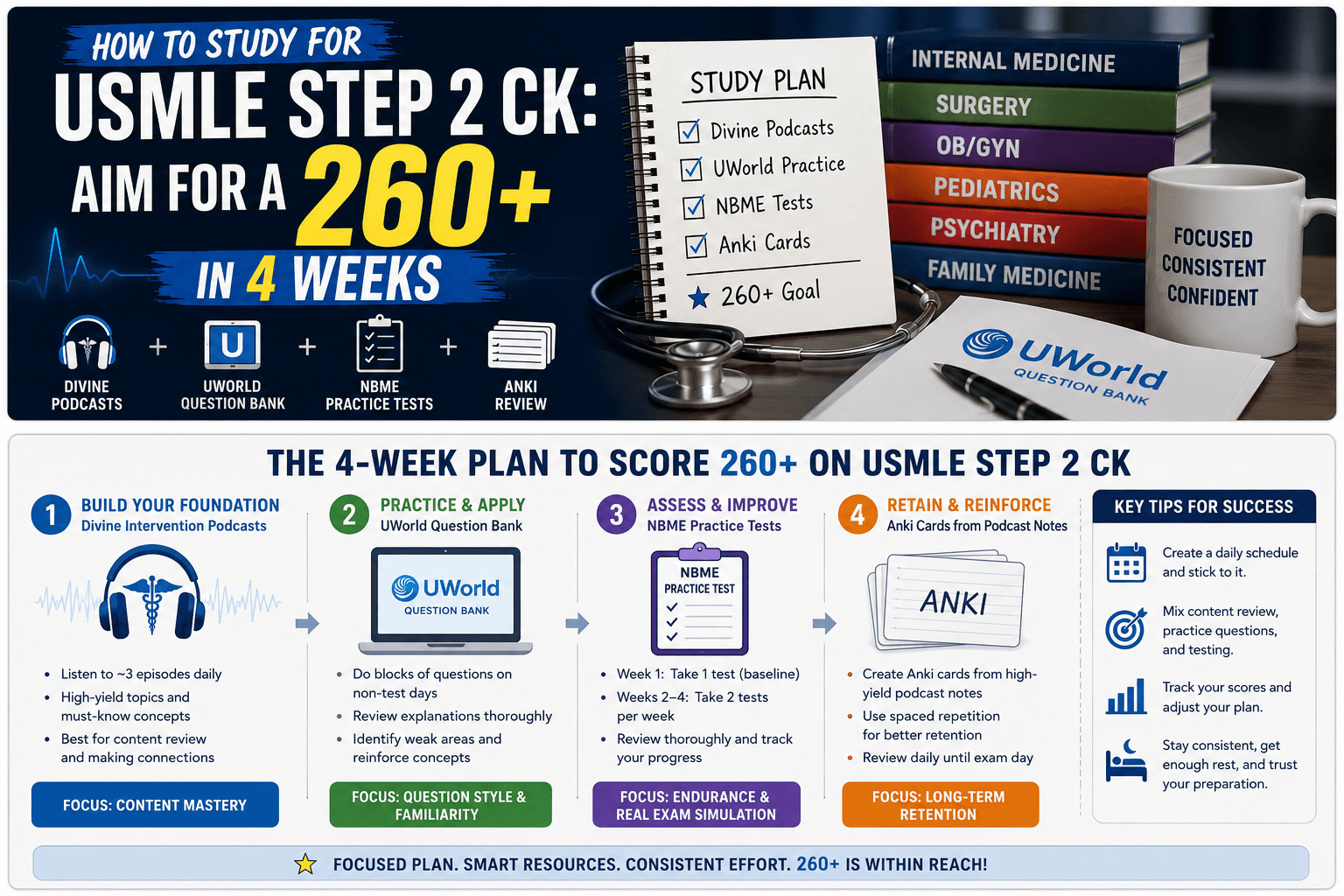
Preparing for USMLE Step 2 CK in four weeks while aiming for a high score is ambitious. It is also much more approachable when the plan is simple: build a base, do questions, test yourself under realistic conditions, and retain what you keep missing.
This is the framework I used: Divine Intervention podcasts for content review, UWorld for question style and application, NBME practice tests for calibration and endurance, and Anki for the facts and patterns that needed to stick.
Quick Answer: How to Study for Step 2 CK
If you are trying to figure out how to study for Step 2 CK, the short version is this:
- Use rotations and shelf studying to build your base.
- Use Divine Intervention for high-yield review and associations.
- Use UWorld to learn the question style.
- Use NBME practice tests to calibrate your score and build endurance.
- Use Anki only for facts and patterns you keep missing.
The common mistake is trying to use every resource. Step 2 rewards repeated practice with clinical reasoning more than resource collecting.
How Many Questions Are on Step 2 CK?
As of the current USMLE format, Step 2 CK is a one-day, 9-hour exam with up to 318 questions. For exams on or after May 7, 2026, USMLE lists 16 blocks of 30 minutes each, with no more than 20 questions per block, plus a minimum of 55 minutes of break time and a 5-minute optional tutorial. The official USMLE page calls these questions "items," but for studying purposes, think of them as questions. Always confirm the current format on the official USMLE Step 2 CK exam content page before test day.
That structure matters because Step 2 is not only a knowledge exam. It is also an endurance exam.
What Is Step 2 CK and Why Does It Matter?
With Step 1 now pass/fail, Step 2 CK has become an especially important part of the residency application. It tests clinical knowledge and problem-solving in a practical context: diagnosis, management, risk factors, prognosis, screening, ethics, quality, safety, and next best steps.
The goal is not to know every fact in medicine. The goal is to recognize what the exam is asking, apply the right clinical frame, and do it repeatedly while tired.
Three key aspects of preparation
Content mastery
Start by building a strong foundation in the high-yield clinical knowledge that shows up across shelves and Step 2 CK.
Question style and familiarity
Learn the language of the exam. Step 2 CK often tests common diagnoses through uncommon wording, or asks for the next best step after giving you just enough information to rule out tempting wrong answers.
Endurance
The exam is long. Build stamina by progressively lengthening question blocks and taking full practice tests under realistic conditions.
How to Study for Step 2 During Rotations
The best time to study for Step 2 is during clerkships, even if dedicated study still comes later. Each rotation gives you a built-in content block: medicine, surgery, pediatrics, OB/GYN, psychiatry, family medicine, neurology, and ambulatory care.
A realistic rotation plan looks like this:
- Do UWorld questions that match the shelf you are on.
- Make a small number of Anki cards for repeated misses.
- Listen to Divine Intervention episodes during dead time: commuting, walking, cleaning, or post-call decompression.
- Take the shelf seriously because shelf studying becomes Step 2 studying.
You do not need to be in "dedicated mode" all year. But you do want every rotation to leave behind usable knowledge instead of a pile of half-remembered notes.
Start with Divine Intervention podcasts
Begin with content review using Divine Intervention podcasts. These episodes are high-yield, efficient, and easy to fit into the day: commuting, walking, cleaning, exercising, or winding down.
My approach was to listen to about three episodes per day. The best episodes do more than list facts; they connect diseases to sequelae, risk factors, screening, complications, and management patterns. That kind of connection-building matters because Step 2 CK often tests associations rather than isolated definitions.
In this guide, "Divine Intervention" means the medical education podcast resource used by many Step 2 students, not the everyday phrase. Its value is that it turns scattered clinical facts into patterns you can recognize quickly.
Suggested Divine Intervention episodes and resources
Medicine review series
Internal Medicine makes up a large share of Step 2 CK, so the medicine review series is worth doing before or early in dedicated study.
I watched these before my shelf exams rather than during dedicated Step 2 time. They are long, but they help set the frame.
Ophthalmology
Ophthalmology can feel scattered because many students do not have a robust ophthalmology resource during clerkships. This episode helped me stop bleeding UWorld questions in that category.
Risk factors
The risk factor episodes are crucial. I treated them almost like the Pathoma first chapters of Step 2 CK: foundational, repeatable, and disproportionately useful.
- Clutch Risk Factors 1, Episode 37
- Clutch Risk Factors 2, Episode 97
- Clutch Risk Factors 3, Episode 184
I listened to each more than once, including close to test day.
Biostatistics and bias
Biostatistics is easier when you understand the logic rather than memorize formulas in isolation.
Military medicine
Military-related scenarios can show up in ways that feel unfamiliar if you have not reviewed them directly.
- Divine Intervention Episode 204: Military
- Military Micro, Episode 231
Palliative care, professionalism, and ethics
These topics are increasingly important across Step 2 and Step 3.
Additional high-yield Divine resources
- How to use Divine Podcasts
- USMLE Radiology, Episode 26
- Vaccines, Episode 250
- Next Best Step, Episode 137
- Updated Screening Guidelines, Episode 325
- Quality and Safety / Legal Stuff, Episode 230
- Transition of Care, Episode 234
- Diagnostic Errors, Episode 275
- All Shelf Exams YouTube Playlist
Integrate UWorld
After building a basic review structure with Divine Intervention, shift heavily into UWorld. UWorld is where you learn the test’s cadence: the phrasing, traps, common distractors, and the difference between knowing a fact and applying it under pressure.
On non-test days, do blocks of questions and review explanations carefully. The review is the studying. When you miss a question, ask why:
- Did I not know the content?
- Did I misread the question?
- Did I recognize the diagnosis but choose the wrong next step?
- Did I get distracted by a true but irrelevant fact?
That diagnosis of your own error pattern is often more valuable than the percentage on any single block.
Schedule NBME practice tests
NBME practice tests are for calibration and endurance. Take one practice test in the first week to establish a baseline, then plan for roughly two practice tests per week afterward if your schedule allows.
Use them to answer three questions:
- Is my score moving?
- Which subject areas keep costing points?
- Can I maintain attention across a long testing session?
Practice tests are not just score predictors. They are rehearsal.
Create Anki cards from podcast notes
To improve retention, create Anki cards from the Divine Intervention podcast notes.
The key is not to turn every line into a card. Make cards for things you actually want to remember: associations, screening rules, risk factors, complications, and concepts you repeatedly miss.
You can also use this Anki card maker to convert notes into focused cards.
For preclinical visual resources, I also wrote a separate guide on using Sketchy Medical with Anki and the Pepper decks.
A four-week rhythm
Here is the simple version:
- Daily: about three Divine episodes or targeted review sessions.
- Most days: UWorld blocks with careful review.
- Weekly: NBME practice tests to calibrate progress.
- Ongoing: Anki for missed facts, patterns, and associations.
- Final week: focus on weak areas, risk factors, screening, ethics, quality and safety, and endurance.
Conclusion
So, how should you study for USMLE Step 2 CK?
Use a focused approach. Start with a content spine, apply it through questions, test yourself repeatedly, and retain the highest-yield misses with spaced repetition.
A 260+ is never guaranteed, and everyone starts from a different baseline. But with a clear plan, smart resources, and consistent execution, you can give yourself a real shot at a strong score without drowning in every possible resource.
FAQs
How should I study for Step 2 CK?
Use UWorld for question style, Divine Intervention for high-yield clinical associations, NBME practice tests for calibration, and Anki for repeated misses. Do not build a plan around passive reading alone.
How many questions are on Step 2 CK?
USMLE lists Step 2 CK as up to 318 questions. For exams on or after May 7, 2026, the test uses 16 blocks of 30 minutes each, with no more than 20 questions per block.
How do I study for Step 2 during rotations?
Treat each clerkship as part of Step 2 studying. Do shelf-specific UWorld questions, review misses, make targeted Anki cards, and use Divine Intervention episodes to reinforce high-yield topics during small pockets of time.
What is the best strategy for using UWorld?
Do blocks of questions, review explanations thoroughly, and track why you are missing questions. The goal is not just volume; it is turning each block into better clinical reasoning.
How many NBME practice tests should I take?
Start with one early to establish a baseline. If your schedule allows, increase to about two per week during dedicated study so you can monitor progress and build endurance.
Are Anki cards effective for medical exams?
Yes, especially for spaced repetition and active recall. They work best when the cards are targeted to your actual weak points rather than copied indiscriminately.
Can I improve test endurance?
Yes. Full-length practice tests and longer study blocks help build the stamina needed for exam day.
What should I do the day before the exam?
Keep it light. Review high-yield summaries, logistics, and a small set of weak areas. Then protect sleep and arrive rested.

Mendel Jacobs, MD, MPH
Menachem "Mendel" Jacobs, MD, MPH is an Internal Medicine Resident at Yale School of Medicine pursuing academic cardiology. He publishes under Menachem Jacobs.
Connect on LinkedInRelated Articles
Best Sketchy Pathology Anki Deck: Conaanaa's SALT Deck
How to use Conaanaa's SketchyPath SALT deck with Sketchy Pathology, Anki, UWorld, and pathology review without drowning in cards.
Sketchy Medical With Anki: The Best Pepper Deck Workflow for Sketchy Micro and Pharm
A practical guide to using Sketchy Medical with Anki, including what Sketchy means, how to use Sketchy Micro and Sketchy Pharm, and when to use the Pepper decks.
The SLARP Framework: A Practical Approach to Undifferentiated Acute Hypoxemia
A bedside framework for approaching acute hypoxemic respiratory failure when the diagnosis is not yet clear.