Cholesterol Blood Tests: LDL-C vs ApoB vs Lp(a) vs hs-CRP
A preventive cardiology guide to LDL cholesterol, ApoB, Lp(a), and hs-CRP: what each blood test measures, when it helps, and how to use the results.
On this page
What to read next
- Start here for the overview: Cholesterol Blood Tests: LDL-C vs ApoB vs Lp(a) vs hs-CRP.
- Build the LDL foundation: LDL Cholesterol: What the Number Means and Why It Matters.
- Count particle burden: ApoB Test: What It Measures, Why It Matters, and How to Lower It.
- Check inherited risk: Lipoprotein(a).
- See the scoring logic: Vital8 Methods and Scoring System.
The short answer
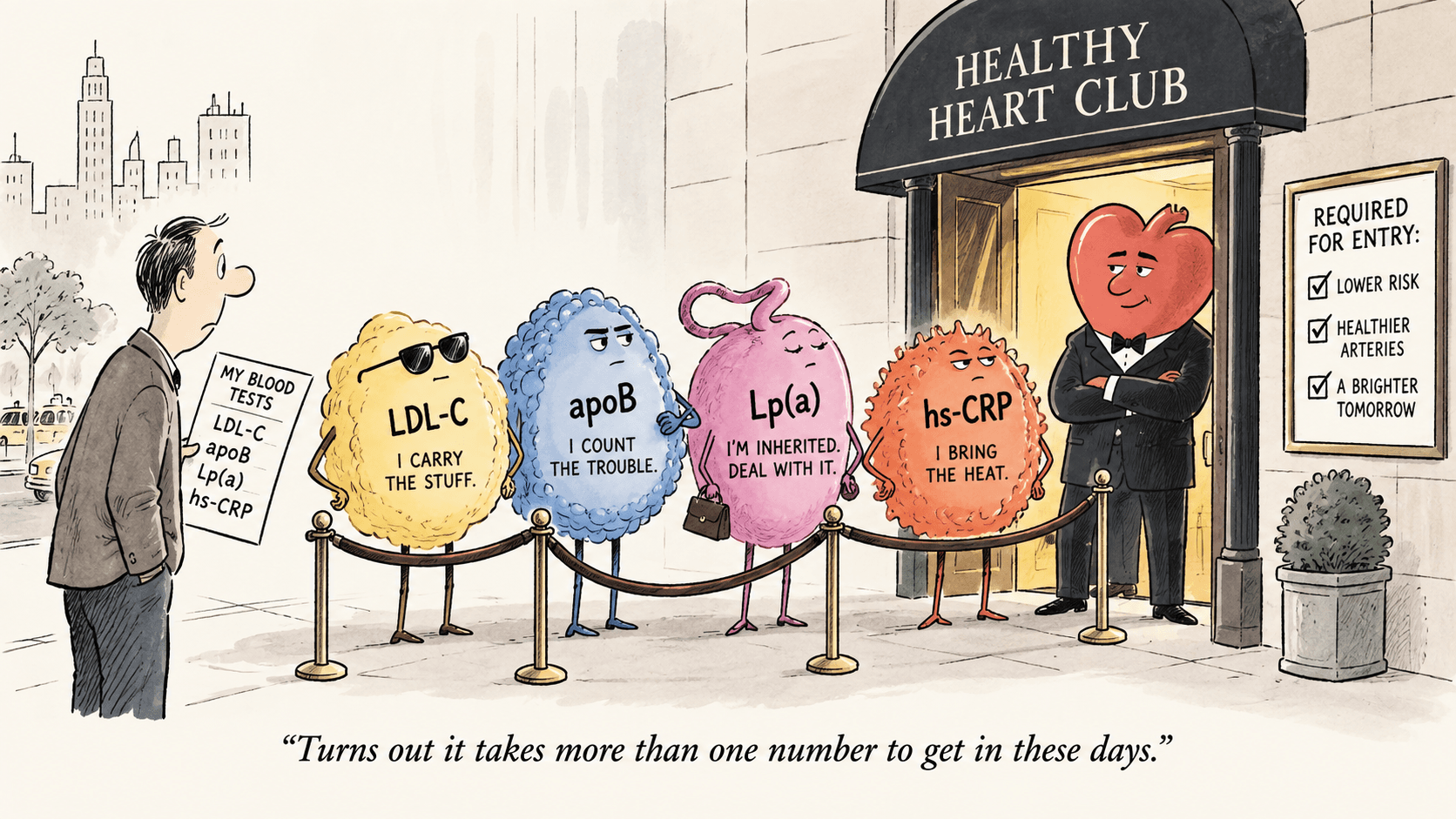
LDL-C, ApoB, Lp(a), and hs-CRP are not four versions of the same test. They answer different questions.
- LDL-C tells you how much cholesterol is being carried inside LDL particles.
- ApoB estimates how many artery-damaging particles are circulating.
- Lp(a) identifies a mostly inherited cholesterol particle that is not on a standard lipid panel.
- hs-CRP measures low-grade inflammation, which can mark residual inflammatory risk.
The standard lipid panel is still the starting point. It is cheap, familiar, and backed by the strongest treatment-outcomes evidence in preventive cardiology.[1] But it does not capture every pathway to cardiovascular risk. Sometimes you need a sharper lens.
That does not mean everyone needs every test every year. More labs do not automatically create better care. They help when the result changes what you do next.
The comparison at a glance
| Test | What it measures | What it adds | When it is most useful |
|---|---|---|---|
| LDL-C | Cholesterol carried inside LDL particles | The main treatment target with the strongest trial evidence | Everyone with a routine lipid panel |
| ApoB | Number of atherogenic lipoprotein particles | Finds high particle burden when LDL-C looks deceptively fine | High triglycerides, diabetes, metabolic syndrome, obesity, or unclear residual risk |
| Lp(a) | An inherited LDL-like particle with apolipoprotein(a) | Finds genetic risk missed by the standard cholesterol panel | Once in adulthood; especially family history or premature cardiovascular disease |
| hs-CRP | Low-grade systemic inflammation | Shows inflammatory risk that lipid tests do not see | Selective risk refinement; repeat if unexpectedly high or during illness |
None of these requires fasting in most routine clinical use.[1][2]
LDL-C: the cholesterol cargo
LDL-C is the amount of cholesterol carried inside LDL particles. It is the number most people mean when they say "bad cholesterol."
It deserves that central role. Lowering LDL-C reduces heart attacks and strokes, and the benefit tracks with the size and duration of LDL-C reduction.[1] This is one of the best-proven ideas in medicine. The boring ideas are sometimes boring because they keep winning.
Current U.S. dyslipidemia guidance uses LDL-C goals that depend on risk. Very-high-risk secondary prevention generally aims below 55 mg/dL. High-risk primary prevention often aims below 70 mg/dL once treatment is started, while lower-risk situations may use less aggressive thresholds.[1]
LDL-C is also modifiable. Diet pattern, weight change when appropriate, physical activity, statins, ezetimibe, bempedoic acid, PCSK9 inhibitors, and inclisiran can all lower LDL or LDL-related particle burden. For the deeper version, start with the LDL cholesterol guide.
What LDL-C misses is particle number. Two people can have the same LDL-C but very different numbers of particles carrying that cholesterol. That is where ApoB becomes useful.
ApoB: the particle count
ApoB is the structural protein carried by the major atherogenic lipoproteins: LDL, VLDL remnants, IDL, and Lp(a). In practical clinical terms, ApoB works like a count of plaque-forming particles.[2]
This matters most when cholesterol cargo and particle number disagree. That discordance is common in insulin resistance, metabolic syndrome, type 2 diabetes, obesity, and high triglycerides. LDL-C may look acceptable while the number of particles remains high.[2][3]
Genetic studies reinforce the biology. When LDL-C, triglycerides, and ApoB are analyzed together, ApoB repeatedly looks like the lipid trait most directly tied to coronary risk.[4][5]
The limitation is important: no randomized trial has assigned people to ApoB-guided treatment versus LDL-C-guided treatment and proven that the ApoB-guided strategy wins. ApoB is a strong risk marker and a useful treatment-context marker, not a magic replacement for clinical judgment.[2]
I would ask about ApoB when:
- Triglycerides are elevated, especially around 150-200 mg/dL or higher.
- There is diabetes, metabolic syndrome, obesity, or insulin resistance.
- LDL-C looks "normal," but family history, coronary calcium, or non-HDL-C suggests more risk.
- You are already on lipid-lowering therapy and want to know whether particle burden remains high.
For more detail, read ApoB Test: What It Measures, Why It Matters, and How to Lower It.
Lp(a): the inherited risk particle
Lp(a), pronounced "L-P-little-a," is an LDL-like particle with an added apolipoprotein(a) tail. Your level is mostly genetic, usually stable across life, and not meaningfully lowered by diet or ordinary exercise.[6][7]
That is frustrating, but useful.
A standard lipid panel does not include Lp(a). LDL-C may look reasonable while Lp(a) quietly raises risk. Current U.S. guidance recommends measuring Lp(a) once in all adults, and it treats levels around 50 mg/dL, or 125 nmol/L, and above as risk-enhancing.[1]
The test does not need to be repeated often. For most people, once is enough.
The treatment implication is also different. There is not yet an approved therapy proven to reduce cardiovascular events specifically by lowering Lp(a). Several RNA-based drugs are in advanced trials, but the current move is to treat everything else more aggressively: LDL-C, ApoB/non-HDL-C, blood pressure, blood sugar, nicotine exposure, and fitness.[6][7]
Lp(a) is not a lifestyle grade. It is inherited context. If it is high, the practical question becomes: how low should the modifiable risk factors be?
For the full story, read Lipoprotein(a): The Inherited Cholesterol Particle Most People Have Never Heard Of.
hs-CRP: the inflammation signal
High-sensitivity C-reactive protein, or hs-CRP, is not a cholesterol test. It is a blood marker of inflammation.
That makes it both interesting and annoying.
Inflammation participates in atherosclerosis, and residual inflammatory risk can persist even when LDL-C is controlled.[8][9] Contemporary prevention guidelines still treat hs-CRP selectively. In U.S. cholesterol guidance, hs-CRP of 2 mg/L or higher can function as a risk-enhancing factor in selected primary-prevention decisions.[1]
Older risk categories are often remembered this way:
| hs-CRP | Usual interpretation |
|---|---|
| <1 mg/L | Lower inflammatory risk |
| 1-3 mg/L | Average or intermediate inflammatory risk |
| >3 mg/L | Higher inflammatory risk |
| >10 mg/L | Often acute illness or another inflammatory condition; recheck when well |
The catch is that hs-CRP is nonspecific. A cold, dental infection, injury, inflammatory arthritis flare, or hard workout can raise it. A single high value is not a diagnosis of inflamed coronary plaque.[9][10]
That is why I would not use hs-CRP as a standalone decision-maker. I would use it as context. If LDL-C/ApoB are controlled but hs-CRP remains elevated when the person is otherwise well, that can sharpen the conversation about weight, activity, tobacco, sleep, metabolic health, statin therapy, and, in very high-risk contexts, anti-inflammatory risk pathways.[8]
What the guidelines say
Here is the practical version.
- LDL-C: routine and central. It remains the standard treatment target in most cholesterol care.[1]
- ApoB: useful selectively, especially when triglycerides, diabetes, metabolic syndrome, or discordance make LDL-C less reliable.[1][2]
- Lp(a): check once in adulthood. A high result changes how aggressively the rest of risk should be managed.[1][6]
- hs-CRP: selective risk refinement, not routine screening for everyone. Interpret carefully and repeat when needed.[1][8]
European and North American groups do not phrase every recommendation identically, but the direction is clear: LDL-C remains the foundation; ApoB helps when particle number matters; Lp(a) should not stay hidden; hs-CRP is useful only when interpreted in context.[1][2][11]
How the tests combine
The useful question is not "which test is best?" It is "what risk pathway am I missing?"
Normal LDL-C but high ApoB: the cholesterol cargo looks okay, but particle number is high. This often happens with triglyceride-rich, cholesterol-poor particles. The risk conversation should not stop at LDL-C.
Controlled LDL-C but high Lp(a): inherited risk remains. The response is usually to drive modifiable risk lower, especially LDL-C/ApoB, blood pressure, blood sugar, and nicotine exposure.
Good lipids but elevated hs-CRP: inflammation may be part of residual risk, but first make sure the value is not from an infection, injury, or inflammatory condition.
Everything looks high: do not overcomplicate it. The answer is usually comprehensive prevention: nutrition, movement, sleep, weight when relevant, no nicotine, blood pressure control, glucose control, and evidence-based lipid-lowering. That is the whole point of Vital8.
How this fits into Vital8
Life's Essential 8 uses non-HDL cholesterol because it can be calculated from a standard lipid panel and captures cholesterol carried by all non-HDL particles. That makes sense for a population-level score.
Vital8 keeps that foundation, then adds educational context. ApoB can clarify particle burden. Lp(a) can reveal inherited risk. hs-CRP can flag inflammatory risk. These are not replacements for the core score; they are ways to understand why two people with similar Life's Essential 8 numbers may not have identical cardiovascular risk.
The main number still comes from the basics. The deeper tests help decide whether the basics need to be pushed harder.
Frequently asked questions
Which cholesterol blood test is most important? LDL-C remains the main treatment target with the strongest outcome evidence. ApoB can be more informative when LDL-C and particle number disagree.[1][2]
Is ApoB better than LDL-C? Sometimes. ApoB is often a better risk marker in diabetes, metabolic syndrome, high triglycerides, obesity, or treated patients with residual risk. LDL-C is still central because it is familiar, widely available, and trial-proven as a treatment target.[2][3]
Should everyone get Lp(a) checked? Current U.S. guidance recommends measuring Lp(a) once in all adults. It is especially important with premature cardiovascular disease, strong family history, or unexplained risk.[1]
What is a normal hs-CRP? Under 1 mg/L is usually lower risk, 1-3 mg/L intermediate, and above 3 mg/L higher. A value above 10 mg/L often reflects acute inflammation and should usually be repeated when well.[10]
Do I need all four tests? Not automatically. A standard lipid panel is the starting point. ApoB, Lp(a), and hs-CRP are most useful when the result would change risk interpretation or treatment intensity.
How often should they be checked? LDL-C and ApoB can be repeated to track treatment. Lp(a) is generally once in a lifetime. hs-CRP should be repeated if it is unexpectedly high or measured during illness.
- Vital8 Control Cholesterol
- Life's Essential 8 and the Vital8 framework
- Check your Vital8 score
- LDL Cholesterol: What the Number Means and Why It Matters
- ApoB Test: What It Measures, Why It Matters, and How to Lower It
- Lipoprotein(a): The Inherited Cholesterol Particle Most People Have Never Heard Of
- Eating Well Without Overthinking It
- The Science Behind Vital8
- Vital8 Methods and Scoring System
Educational content only. Not individualized medical advice. Discuss testing and treatment decisions with your clinician.
References
- 2026 ACC/AHA/AACVPR/ABC/ACPM/ADA/AGS/APhA/ASPC/NLA/PCNA Guideline on the Management of Dyslipidemia. Writing Committee Members, Blumenthal RS, Morris PB, et al. Circulation. 2026;153(17):e1154-e1276. doi:10.1161/CIR.0000000000001423.
- Role of Apolipoprotein B in the Clinical Management of Cardiovascular Risk in Adults: An Expert Clinical Consensus From the National Lipid Association. Soffer DE, Marston NA, Maki KC, et al. Journal of Clinical Lipidology. 2024. doi:10.1016/j.jacl.2024.08.013.
- ApoB, LDL-C, and Non-HDL-C as Markers of Cardiovascular Risk. Sehayek D, Cole J, Bjornson E, et al. Journal of Clinical Lipidology. 2025. doi:10.1016/j.jacl.2025.05.024.
- Evaluating the Relationship Between Circulating Lipoprotein Lipids and Apolipoproteins With Risk of Coronary Heart Disease: A Multivariable Mendelian Randomisation Analysis. Richardson TG, Sanderson E, Palmer TM, et al. PLOS Medicine. 2020;17(3):e1003062. doi:10.1371/journal.pmed.1003062.
- High-Throughput Multivariable Mendelian Randomization Analysis Prioritizes Apolipoprotein B as Key Lipid Risk Factor for Coronary Artery Disease. Zuber V, Gill D, Ala-Korpela M, et al. International Journal of Epidemiology. 2021;50(3):893-901. doi:10.1093/ije/dyaa216.
- Lipoprotein(a): A Review of Risk Factors, Measurements, and Novel Treatment Modalities. Karp A, Jacobs M, Barris B, Labkowsky A, Frishman WH. Cardiology in Review. 2025;33(4):352-358. doi:10.1097/CRD.0000000000000667.
- Lipoprotein(a). Mora S, Kronenberg F. JAMA. 2025;333(21):1918-1919. doi:10.1001/jama.2025.2373.
- Inflammation and Cardiovascular Disease: 2025 ACC Scientific Statement. Mensah GA, Arnold N, Prabhu SD, Ridker PM, Welty FK. Journal of the American College of Cardiology. 2026;87(11):1381-1404. doi:10.1016/j.jacc.2025.08.047.
- Low-Density Lipoprotein Cholesterol, Lipoprotein(a), and High-Sensitivity C-Reactive Protein Are Independent Predictors of Cardiovascular Events. Markus MRP, Ittermann T, Coronado JM, et al. European Heart Journal. 2025. doi:10.1093/eurheartj/ehaf281.
- Markers of Inflammation and Cardiovascular Disease: Application to Clinical and Public Health Practice. Pearson TA, Mensah GA, Alexander RW, et al. Circulation. 2003;107(3):499-511. doi:10.1161/01.CIR.0000052939.59093.45.
- 2025 Focused Update of the 2019 ESC/EAS Guidelines for the Management of Dyslipidaemias. Mach F, Koskinas KC, Roeters van Lennep JE, et al. European Heart Journal. 2025;46(42):4359-4378. doi:10.1093/eurheartj/ehaf190.
This guide is part of the MendelMD preventive cardiology library. Explore cholesterol and lipid guides and the LDL reduction calculator. Vital8 is our broader framework for cardiovascular health.
Continue exploring
What the number means and how LDL is lowered.
ApoB Test →Understand particle number and its relationship to LDL cholesterol.
Lipoprotein(a) →Explore this inherited lipid measurement.
LDL Reduction Calculator →Model statin doses and selected combination therapies.
Preventive Cardiology →
Mendel Jacobs, MD, MPH
Menachem "Mendel" Jacobs, MD, MPH is an Internal Medicine Resident at Yale School of Medicine pursuing academic cardiology. He publishes under Menachem Jacobs.
Connect on LinkedIn