ApoB Test: What It Measures, Why It Matters, and How to Lower It
Learn what an ApoB blood test measures, when it adds information beyond LDL cholesterol, and how to interpret and lower ApoB.
On this page
What to read next
- Start here for particle risk: ApoB Test: What It Measures, Why It Matters, and How to Lower It.
- Compare the markers: Cholesterol Blood Tests: LDL-C vs ApoB vs Lp(a) vs hs-CRP.
- Build the LDL foundation: LDL Cholesterol: What the Number Means and Why It Matters.
- Check inherited risk: Lipoprotein(a).
- Build the behavior foundation: Eating Well Without Overthinking It.
- Review the scoring appendix: Vital8 Methods and Scoring System.
The short answer
The apoB blood test measures the number of artery-damaging cholesterol particles in your blood. LDL cholesterol, or LDL-C, measures how much cholesterol is being carried inside LDL particles. That sounds similar. It is not.
The easiest way to think about it:
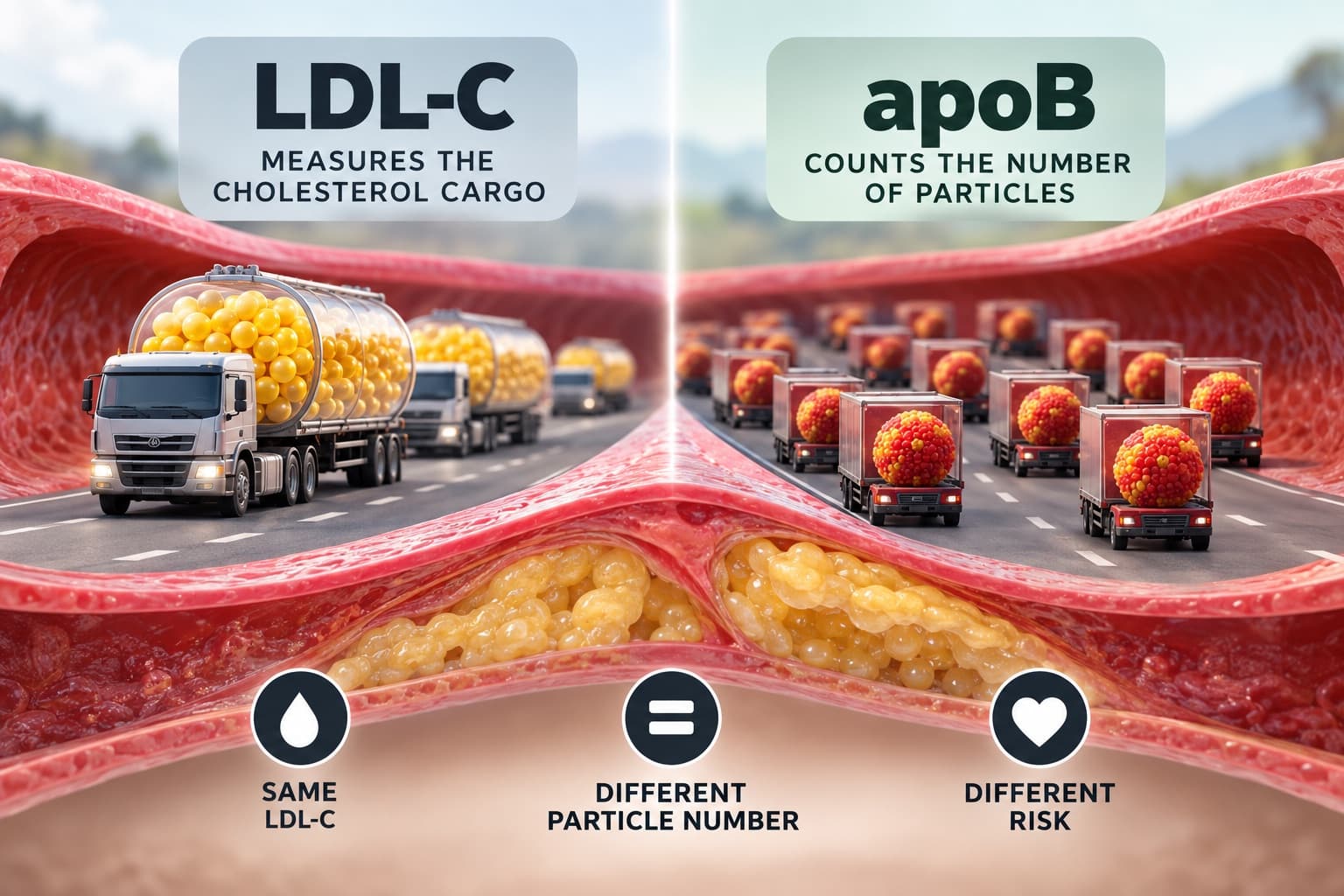
- LDL-C is cargo. It asks how much cholesterol is riding inside the particles.
- ApoB is traffic. It asks how many atherogenic particles are on the road.
Every LDL, VLDL, IDL, remnant, and Lp(a) particle carries one apoB molecule, so apoB functions as a particle count.[1][2] That is why two people can have the same LDL-C but different apoB levels, and therefore different cardiovascular risk. Same cholesterol cargo. Different number of trucks. Different odds that one gets stuck in an artery wall.
This is the part that matters clinically: when LDL-C and apoB disagree, risk usually follows apoB more closely.[1][3]
What is an apoB blood test?
An apoB test is a standard blood test that estimates the circulating concentration of atherogenic lipoprotein particles. These are the particles that can enter the artery wall, get retained there, and start or accelerate atherosclerosis.[2][4]
The main apoB-containing particles are:
- LDL, the classic "bad cholesterol" particle.
- VLDL and IDL, triglyceride-rich particles and their remnants.
- Lp(a), an inherited LDL-like particle that also carries apoB.
HDL, the so-called "good cholesterol," does not carry apoB, so it is not counted by the apoB test.[2]
The test usually does not require fasting. In typical clinical use, apoB is dominated by apoB-100 particles made by the liver, and levels change very little between fasting and nonfasting states.[2][5]
ApoB vs LDL cholesterol
LDL-C remains the default number in most cholesterol conversations because it is cheap, familiar, and deeply supported by trial evidence. That is reasonable. LDL-C is not useless. It is just not always the full story.
| Test | What it measures | What it misses | Best use |
|---|---|---|---|
| LDL-C | Cholesterol inside LDL particles | How many particles are carrying that cholesterol | The standard treatment target for most people |
| Non-HDL-C | Cholesterol inside all non-HDL particles | Particle number itself | A no-extra-cost marker when triglycerides are elevated |
| ApoB | The number of atherogenic particles | Which particle type is responsible unless paired with the lipid panel and Lp(a) | Discordance, metabolic risk, high triglycerides, or residual risk on treatment |
The reason apoB can outperform LDL-C is biological. Atherosclerosis is driven by apoB-containing particles entering and being retained in the artery wall. If you have more particles, you have more opportunities for retention.[4]
That difference becomes most important when particles are cholesterol-poor. This is common in insulin resistance, metabolic syndrome, type 2 diabetes, and high triglycerides. The LDL-C can look acceptable while the apoB particle count remains high.[1][6]
When LDL-C and apoB disagree
Doctors call this discordance. It is a dry word for a useful problem: the cholesterol number and the particle number are telling different stories.
Discordance is more likely when:
- Triglycerides are elevated.
- HDL-C is low.
- There is type 2 diabetes, insulin resistance, or metabolic syndrome.
- LDL-C is at goal but the overall clinical picture still feels higher risk.
- Someone is already on lipid-lowering therapy and there is a question about residual particle burden.
In one metabolic syndrome study, among people whose LDL-C was below the treatment cutoff, 25% still had high apoB and 31% still had high non-HDL cholesterol.[6] Translation: LDL-C alone would have made a meaningful chunk of risk look quieter than it was.
A 2025 systematic review of discordance studies found that apoB outperformed LDL-C in all 9 studies that directly compared them, and outperformed non-HDL-C in 7 studies.[3] That does not mean LDL-C should be thrown out. It means apoB is often the better tiebreaker when the numbers disagree.
What apoB level is high?
There is no single magic cutoff that works for every person, because the right target depends on total cardiovascular risk. A 42-year-old with no risk factors and a 72-year-old with coronary disease should not be interpreted the same way.
Still, these are useful reference points:
| ApoB level | How to read it |
|---|---|
| <90 mg/dL | Often treated as a desirable level for lower-risk adults in US lipid guidance and NLA discussions. |
| 90-129 mg/dL | A middle zone where context matters: LDL-C, non-HDL-C, triglycerides, diabetes, blood pressure, smoking, family history, and coronary calcium all change the meaning. |
| >=130 mg/dL | Usually considered high and roughly comparable to an LDL-C of 160 mg/dL or higher as a risk-enhancing marker. |
| Lower targets in high-risk patients | Some expert groups discuss thresholds around 60-70 mg/dL for very-high- and high-risk patients on therapy, but LDL-C and non-HDL-C remain the main formal targets in most guidelines. |
The practical move is not to memorize the table and treat yourself. It is to ask a better question with your clinician: "Given my whole risk profile, is my particle burden low enough?"
Who should consider an apoB test?
You do not need apoB to begin caring about cholesterol. A standard lipid panel, especially LDL-C and non-HDL-C, remains the foundation. In Vital8, non-HDL cholesterol is useful because it comes from the ordinary lipid panel and captures cholesterol in all atherogenic particles.
ApoB becomes especially useful when the basic panel may be misleading. Current US guidance describes apoB as reasonable or potentially reasonable in selected adults, particularly when there is cardiometabolic disease, diabetes, elevated triglycerides, or uncertainty about whether treatment should be intensified.[1]
I would think about asking for apoB if any of these fit:
- Your triglycerides are high, especially around 150-200 mg/dL or higher.
- You have type 2 diabetes, metabolic syndrome, or significant insulin resistance.
- Your LDL-C looks "normal," but your non-HDL-C, family history, coronary calcium, or overall risk does not.
- You are already on cholesterol medication and want to know whether particle burden is still elevated.
- You have suspected familial combined hyperlipidemia or another inherited lipid pattern.
The NLA consensus is more enthusiastic than most general guidelines: it argues that apoB is underused, validated, and clinically helpful for risk assessment and treatment decisions.[5] That is where the field is drifting. Slowly, because medicine loves a fax machine more than a clean biomarker.
The genetic evidence
One reason apoB is persuasive is that the genetics line up with the biology.
Mendelian randomization studies use inherited genetic variation as a kind of natural experiment. When LDL-C, triglycerides, and apoB are analyzed together, apoB repeatedly comes out as the lipid measure most closely tied to coronary artery disease.[7][8] Similar genetic work also points to apoB-containing particles as important in peripheral artery disease.[9]
That matters because it makes apoB feel less like another shiny lab marker and more like a direct readout of the thing doing the damage.
How to lower apoB
The good news is that apoB is not a separate universe. The same things that lower atherogenic cholesterol particles generally lower apoB.
The lifestyle version:
- Eat in a pattern that lowers atherogenic particles. Favor vegetables, legumes, nuts, whole grains, fruit, fish, and olive oil. Reduce saturated fat, trans fat, processed meat, refined carbohydrates, and sugar-sweetened drinks. The practical version is here: Eating Well Without Overthinking It.
- Lower triglyceride pressure. If triglycerides are high, weight loss when appropriate, regular activity, less alcohol, fewer refined carbohydrates, and better glycemic control can all help.
- Move consistently. Regular aerobic activity improves insulin sensitivity and cardiometabolic risk. For the fitness side of the Vital8 framework, start with What's a Good VO2 Max?.
- Treat the rest of the risk stack. Blood pressure, blood sugar, nicotine exposure, sleep, and weight all change the meaning of a lipid result. That is the whole point of the Vital8 score.
The medication version is familiar: statins, ezetimibe, PCSK9 inhibitors, inclisiran, and bempedoic acid all reduce apoB-containing particles by increasing clearance, reducing production, or both.[1][2]
There is one subtle catch. The percent drop in LDL-C is often larger than the percent drop in apoB, especially when triglyceride-rich particles remain. That is why an apoB check can be useful after treatment if the LDL-C looks good but the patient still has metabolic risk.[2]
The honest limitations
ApoB is useful. It is not magic.
- No outcome trial has proven that apoB-guided treatment beats LDL-C-guided treatment. The case for apoB comes from biology, cohorts, discordance analyses, genetics, and trial re-analyses, not from a randomized trial assigning one group to apoB targets and another to LDL-C targets.[2][5]
- It does not tell you whether Lp(a) is the culprit. Lp(a) carries apoB, so apoB includes it, but you still need a separate Lp(a) test to know whether inherited Lp(a) risk is present.[1]
- Insurance coverage is uneven. The test is technically straightforward, but access and reimbursement still lag behind the evidence.[5]
- LDL-C and non-HDL-C remain central. They are not obsolete. Non-HDL-C is especially useful because it costs nothing extra and already captures cholesterol across all non-HDL particles.[10]
The real clinical role of apoB is not to replace judgment. It is to make the invisible particle count visible when the cholesterol cargo number is not enough.
Frequently asked questions
What is apolipoprotein B? ApoB is the structural protein on atherogenic cholesterol particles. Because each particle has one apoB molecule, the blood level works like a particle count.[2][5]
Is apoB better than LDL cholesterol? Often, yes for risk prediction, especially when LDL-C and apoB disagree. The advantage is strongest in metabolic syndrome, diabetes, high triglycerides, and treated patients with residual risk.[1][3]
Do I need to fast for apoB? Usually no. ApoB changes little between fasting and nonfasting states in ordinary clinical settings.[2][5]
What is a high apoB level? A commonly used high threshold is around 130 mg/dL. Lower targets are often discussed for higher-risk patients, but your target depends on your overall cardiovascular risk.[1][5]
How do I lower apoB? The same way you lower atherogenic particle burden: a heart-protective eating pattern, improved insulin resistance and triglycerides, regular activity, and when indicated, lipid-lowering medications such as statins, ezetimibe, PCSK9 inhibitors, inclisiran, or bempedoic acid.[1][2]
Does apoB include Lp(a)? Yes. Lp(a) particles carry apoB, so they are counted inside total apoB. But apoB cannot separate Lp(a) from LDL and remnants. Lp(a) needs its own test.[1]
The bottom line
LDL-C tells you how much cholesterol is being carried. ApoB tells you how many artery-damaging particles are carrying it.
For many people, those numbers point in the same direction. When they do not, apoB is often the clearer signal. It is especially worth knowing in diabetes, metabolic syndrome, high triglycerides, or any situation where the LDL number looks reassuring but the clinical picture does not.
That is why apoB belongs in the Vital8 cholesterol conversation. Not as a replacement for the basics, but as a sharper lens on the same problem: keeping apoB-containing particles low enough, early enough, for long enough that the arteries get to stay boring.
- Vital8 Control Cholesterol
- LDL Cholesterol: What the Number Means and Why It Matters
- Cholesterol Blood Tests: LDL-C vs ApoB vs Lp(a) vs hs-CRP
- Lipoprotein(a): The Inherited Cholesterol Particle Most People Have Never Heard Of
- Eating Well Without Overthinking It
- A1c Explained: What Your Number Means and What It Should Be
- Quit Smoking: What the Evidence Says About Cigarettes, Vapes, and Nicotine Pouches
- The Science Behind Vital8
- Vital8 Methods and Scoring System
References
- 2026 ACC/AHA/AACVPR/ABC/ACPM/ADA/AGS/APhA/ASPC/NLA/PCNA Guideline on the Management of Dyslipidemia. Writing Committee Members, Blumenthal RS, Morris PB, et al. Circulation. 2026;153(17):e1154-e1276. doi:10.1161/CIR.0000000000001423.
- Apolipoprotein B: Bridging the Gap Between Evidence and Clinical Practice. De Oliveira-Gomes D, Joshi PH, Peterson ED, et al. Circulation. 2024;150(1):70-81. doi:10.1161/CIRCULATIONAHA.123.066904.
- ApoB, LDL-C, and Non-HDL-C as Markers of Cardiovascular Risk. Sehayek D, Cole J, Bjornson E, et al. Journal of Clinical Lipidology. 2025. doi:10.1016/j.jacl.2025.05.024.
- Physiological Bases for the Superiority of Apolipoprotein B Over LDL-C and Non-HDL-C as a Marker of Cardiovascular Risk. Glavinovic T, Thanassoulis G, de Graaf J, et al. Journal of the American Heart Association. 2022;11(20):e025858. doi:10.1161/JAHA.122.025858.
- Role of Apolipoprotein B in the Clinical Management of Cardiovascular Risk in Adults: An Expert Clinical Consensus From the National Lipid Association. Soffer DE, Marston NA, Maki KC, et al. Journal of Clinical Lipidology. 2024. doi:10.1016/j.jacl.2024.08.013.
- Novel and Traditional Lipid Profiles in Metabolic Syndrome Reveal a High Atherogenicity. Paredes S, Fonseca L, Ribeiro L, et al. Scientific Reports. 2019;9:11792. doi:10.1038/s41598-019-48120-5.
- Evaluating the Relationship Between Circulating Lipoprotein Lipids and Apolipoproteins With Risk of Coronary Heart Disease: A Multivariable Mendelian Randomisation Analysis. Richardson TG, Sanderson E, Palmer TM, et al. PLOS Medicine. 2020;17(3):e1003062. doi:10.1371/journal.pmed.1003062.
- High-Throughput Multivariable Mendelian Randomization Analysis Prioritizes Apolipoprotein B as Key Lipid Risk Factor for Coronary Artery Disease. Zuber V, Gill D, Ala-Korpela M, et al. International Journal of Epidemiology. 2021;50(3):893-901. doi:10.1093/ije/dyaa216.
- Prioritizing the Role of Major Lipoproteins and Subfractions as Risk Factors for Peripheral Artery Disease. Levin MG, Zuber V, Walker VM, et al. Circulation. 2021;144(5):353-364. doi:10.1161/CIRCULATIONAHA.121.053797.
- Lipid Measurements in the Management of Cardiovascular Diseases: Practical Recommendations. A Scientific Statement From the National Lipid Association. Wilson PWF, Jacobson TA, Martin SS, et al. Journal of Clinical Lipidology. 2021;15(5):629-648. doi:10.1016/j.jacl.2021.09.046.
This guide is part of the MendelMD preventive cardiology library. Explore cholesterol and lipid guides and the LDL reduction calculator. Vital8 is our broader framework for cardiovascular health.
Continue exploring
Start with a guide to what each measurement tells you.
LDL Cholesterol →What the number means and how LDL is lowered.
Lipoprotein(a) →Explore this inherited lipid measurement.
LDL Reduction Calculator →Model statin doses and selected combination therapies.
Preventive Cardiology →
Mendel Jacobs, MD, MPH
Menachem "Mendel" Jacobs, MD, MPH is an Internal Medicine Resident at Yale School of Medicine pursuing academic cardiology. He publishes under Menachem Jacobs.
Connect on LinkedIn