The Science Behind Vital8: A Life's Essential 8 (LE8) Methodology White Paper
The evidence and scientific rationale behind Vital8, an educational cardiovascular health score built on the American Heart Association's Life's Essential 8 (LE8) framework — covering preventive cardiology, ApoB/non-HDL cholesterol, and VO2 max.
On this page
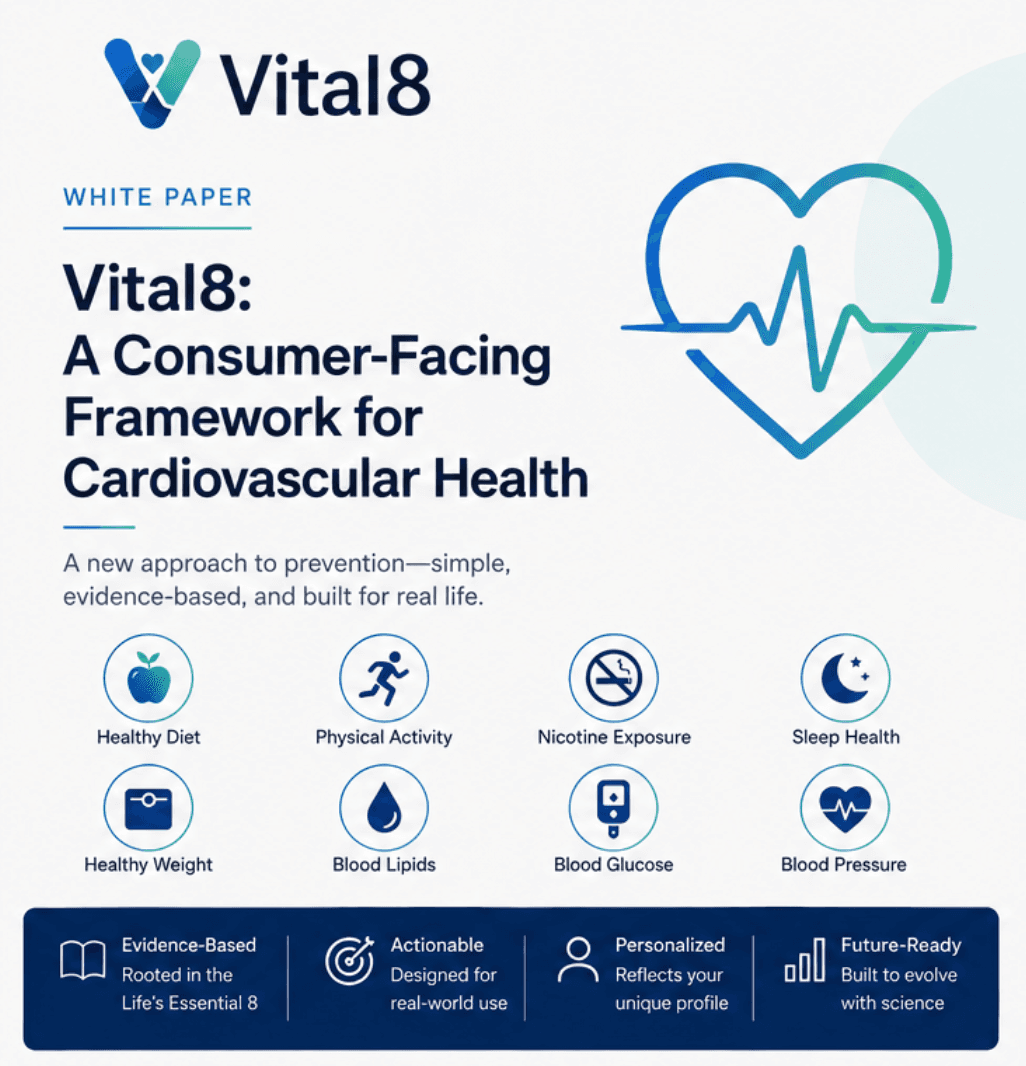
This white paper explains the evidence behind Vital8. For the exact thresholds, formulas, and treatment adjustments, see the companion Vital8 Methods and Scoring System. You can try the current tool from the Vital8 page.
Vital8 is an educational tool, not a diagnosis or a substitute for medical care. It is meant to make cardiovascular prevention easier to understand and discuss. Clinically relevant results should be reviewed with a healthcare professional.
Independence note: Vital8 and MendelMD are independent projects with no association with the American Heart Association. They are built from publicly available data, published methods, and scientific literature. All opinions and interpretations are my own.
Purpose
Vital8 translates the American Heart Association's Life's Essential 8 (LE8) framework into an accessible, actionable cardiovascular health score. Its purpose is to help individuals understand where they stand across modifiable cardiovascular health domains and to generate personalized, evidence-based goals for improvement.
This white paper describes the scientific rationale behind each Vital8 domain, the optional exploratory layers, and the goal-setting methodology.
What is preventive cardiology?
Preventive cardiology is the work of lowering cardiovascular risk before a heart attack, stroke, or heart failure hospitalization occurs. In practice, that means identifying and improving modifiable risk factors early: blood pressure, cholesterol (increasingly understood through ApoB or non-HDL cholesterol), blood sugar, body weight, physical activity, diet, sleep, and tobacco exposure. Life's Essential 8 (LE8) is the American Heart Association's framework for measuring these factors; Vital8 is an educational tool built around that framework.
The Life's Essential 8 (LE8) Foundation
In 2022, the AHA updated its cardiovascular health construct from Life's Simple 7 to Life's Essential 8, adding sleep health and refining the scoring algorithm to a continuous 0–100 scale across eight domains: diet, physical activity, nicotine exposure, sleep health, BMI, blood lipids, blood glucose, and blood pressure.[1] This framework reflects the AHA's shift from disease treatment toward health promotion and primordial prevention.[2]
The evidence supporting the LE8 score as a predictor of cardiovascular outcomes is robust:
- A meta-analysis of 34 observational studies encompassing 1,786,664 participants found that higher LE8 scores were associated with a 53% reduction in cardiovascular disease (HR 0.47, 95% CI 0.39–0.56), a 46% reduction in all-cause mortality (HR 0.54, 95% CI 0.43–0.69), and a 63% reduction in CVD mortality (HR 0.37, 95% CI 0.26–0.52).[3]
- In the UK Biobank (n = 137,794), high cardiovascular health by LE8 was associated with a 66% lower risk of coronary heart disease (HR 0.34, 95% CI 0.30–0.38) and 55% lower risk of stroke (HR 0.45, 95% CI 0.37–0.54) compared with low cardiovascular health.[4]
- In NHANES analyses, a dose-response relationship was observed: each incremental improvement in LE8 score corresponded to proportionally lower all-cause and CVD-specific mortality.[5]
- In the Framingham Heart Study, cumulative LE8 scores measured over approximately 25 years showed strong, graded inverse associations with CHD, heart failure, stroke, and all-cause mortality.[6]
Vital8 preserves the LE8 architecture — eight domains, 0–100 per domain, unweighted average, and three-tier categorization (high at least 80, moderate 50-79, low below 50) — while adapting language and input methods for consumer self-assessment.
Domain Rationale
Each Vital8 domain maps directly to an LE8 component. Consumer-friendly naming (e.g., "Daily Fuel" for diet, "Movement" for physical activity, "Body Size" for BMI) is used for accessibility without altering the underlying construct.
Daily Fuel (Diet): The AHA dietary metric assesses adherence to a heart-healthy dietary pattern. Vital8 uses eight food-pattern inputs (fruits/vegetables, whole grains, sugary drinks, processed meals, protein pattern, fish/seafood, nuts/legumes, sodium) that approximate the components assessed in validated dietary indices. The USPSTF found that behavioral counseling targeting increased fruits, vegetables, whole grains, and reduced sodium led to meaningful reductions in blood pressure, cholesterol, and cardiovascular events (pooled RR 0.81, 95% CI 0.74–0.88).[7] While Vital8's simplified diet assessment is not equivalent to a validated DASH or Mediterranean diet score, it captures the directionally important food patterns that drive cardiovascular benefit.
Movement (Physical Activity): The AHA recommends ≥150 minutes per week of moderate-intensity physical activity or ≥75 minutes of vigorous activity. Vital8 uses the standard moderate-equivalent formula (moderate minutes + 2 × vigorous minutes) and applies linear interpolation within ranges aligned to LE8 thresholds.[1] Major prevention guidance consistently treats regular physical activity as a core cardiovascular prevention behavior.[8]
Nicotine: Tobacco cessation is the single most impactful modifiable risk factor for CVD. The LE8 scoring distinguishes current use, former use by quit duration, and type (combustible vs. non-combustible), and Vital8 mirrors this hierarchy. The inclusion of secondhand smoke/vapor exposure as a score modifier reflects evidence that passive exposure carries independent cardiovascular risk.[1]
Sleep Rhythm: Sleep was added to LE8 based on evidence linking both short (below 7 hours) and long (at least 9 hours) sleep duration to increased cardiovascular risk. Vital8's scoring assigns optimal points to 7 to less than 9 hours, with stepwise reductions for durations outside this range, consistent with the AHA's recommendation.[1]
Body Size (BMI): BMI is used as a screening metric because it is part of the LE8 construct and is widely available in routine care. Vital8 applies continuous linear interpolation within overweight and obesity ranges rather than discrete categories, providing more granular feedback. The score of 30 for BMI below 18.5 reflects that underweight status is associated with adverse health outcomes without penalizing it as severely as class III obesity. The app includes a disclaimer that BMI does not measure body composition.
Cholesterol Particles (Non-HDL Cholesterol): The LE8 update shifted from total cholesterol to non-HDL cholesterol, which captures LDL, VLDL, and other atherogenic particles. Non-HDL cholesterol is also a simple, low-cost proxy for apolipoprotein B (ApoB) — the actual number of atherogenic particles in the blood, and a marker increasingly emphasized in modern lipid guidelines. Vital8 adopts non-HDL as its metric. The 20-point reduction for cholesterol-lowering medication use reflects the LE8 principle that treated optimal levels represent a different health state than untreated optimal levels.[1]
Blood Sugar: Vital8 accepts either hemoglobin A1c or fasting glucose and uses separate scoring tracks for individuals with and without known diabetes, directly mirroring the LE8 approach. The distinction between diabetes and non-diabetes tracks ensures that well-controlled diabetes (A1c below 7%) is recognized as a managed condition rather than scored equivalently to someone without metabolic disease.[1] The medication adjustment parallels the cholesterol and blood pressure domains.
Blood Pressure: Vital8 scores systolic and diastolic blood pressure separately and uses the worse score, consistent with LE8 methodology. The thresholds align with current ACC/AHA blood pressure categories. The medication adjustment follows the same rationale as other treated metrics. The display of mean arterial pressure (MAP) with a flag below 65 mmHg provides safety context without affecting the score.[1]
Optional Fitness Layer
Cardiorespiratory fitness (CRF) is among the strongest independent predictors of cardiovascular and all-cause mortality. An overview of meta-analyses encompassing over 20.9 million observations found that high versus low CRF was associated with roughly half the risk of all-cause mortality, with each 1-MET higher CRF associated with an 11%–17% mortality reduction.[9] The AHA has called for CRF to be treated as a clinical vital sign.[10] Each 1-MET improvement in CRF is associated with approximately 13% and 15% reductions in all-cause mortality and CVD events, respectively.[11]
VO2 max — the maximum amount of oxygen your body can use during intense exercise — is the standard measure of cardiorespiratory fitness, usually expressed in METs or mL/kg/min. Because fitness declines with age and differs by sex, VO2 max is interpreted against age- and sex-specific percentile norms rather than a single universal cutoff, which is why "good" VO2 max by age varies. It is measured most precisely by cardiopulmonary exercise testing (CPET) in a lab, and estimated more accessibly through submaximal treadmill or step tests, timed walk/run tests, and many consumer wearables.
Despite this evidence, CRF is not included in the core LE8 score. Vital8's optional fitness layer addresses this gap by incorporating an age- and sex-specific VO2max/CRF percentile as one component of a separate exploratory adjusted score. The raw Vital8 score remains the primary number. The CRF multipliers are anchored to the Kokkinos veterans cohort (n = 750,302), with the 50th percentile as neutral, the lowest fitness categories reducing the exploratory estimate, and CRF at or above the 98th percentile contributing a maximum multiplier of 1.44.[22] The resulting exploratory score range is 0-144; a score of 144 requires a raw score of 100, neutral Lp(a) and hsCRP multipliers, and CRF at or above the 98th percentile. Because Movement and Body Size already contribute to the raw score and correlate with CRF, this layer may partly double-count fitness-related health; that is a pre-specified limitation to test empirically.
Optional Biomarker Layer
High-sensitivity C-reactive protein (hsCRP) and lipoprotein(a) [Lp(a)] are established cardiovascular risk enhancers. Vital8's biomarker layer treats them as exploratory context rather than core LE8 domains, and each multiplier is derived from a published relative-risk or hazard-ratio anchor using a square-root transform: multiplier = sqrt(1 / HR).
- The Multi-Ethnic Study of Atherosclerosis (MESA, n = 6,668) is an important cautionary study: isolated elevation of either Lp(a) at or above 50 mg/dL or hsCRP at or above 2 mg/L was not associated with higher CVD risk, while concomitant elevation was associated with higher events.[12] This supports displaying both markers together, but does not by itself justify independent multipliers.
- Independent-multiplier support comes from later analyses. Markus et al. found LDL cholesterol, Lp(a), and hsCRP were independent predictors of cardiovascular events.[13] Small et al. found that higher Lp(a) was associated with MACE, myocardial infarction, and peripheral artery disease across primary and secondary prevention populations regardless of baseline hsCRP, with no significant interaction in primary prevention.[17] A systematic review and meta-analysis similarly found elevated Lp(a) associated with MACE across both low hsCRP (pooled HR 1.26, 95% CI 1.11-1.42) and high hsCRP groups (pooled HR 1.33, 95% CI 1.20-1.47).[18]
- hsCRP multiplier anchors come from a large UK Biobank general-population analysis, which reported graded cardiovascular risk across hsCRP levels, including higher MACE risk above 3 mg/L and at or above 2 mg/L.[19]
- Additional population evidence suggests the Lp(a)-inflammation relationship is biologically and clinically complex rather than reducible to one threshold rule; BiomarCaRE found effect modification specifically among participants with established coronary heart disease, which is why the independent-multiplier assumption should be scoped primarily to primary-prevention use.[20]
Vital8 combines Lp(a), hsCRP, and CRF multiplicatively because the underlying anchors come from proportional-hazards models and Lp(a)-derived relative risk is described as multiplicative with other risk factors. The product is not a calibrated hazard estimate: Lp(a), hsCRP, and CRF are anchored to related but non-identical outcomes. It should be read as an ordinal risk-ranking signal for hypothesis generation and validation. hsCRP at or above 10 mg/L is excluded from adjustment with a multiplier of 1.00 and triggers a retest-when-well flag, because values at that level may reflect acute infection or inflammation rather than chronic vascular risk.[14]
Goal-Setting Methodology
Vital8 generates personalized goals based on each domain's current score and the specific inputs that produced it. This approach is grounded in evidence that goal setting and self-monitoring are core components of effective behavioral counseling interventions for cardiovascular risk reduction.[7]
The USPSTF found strong evidence (Grade B) that behavioral counseling interventions incorporating goal setting, self-monitoring, and addressing barriers to change reduced cardiovascular events in adults with risk factors. These interventions produced meaningful improvements across multiple risk factors including blood pressure, cholesterol, and weight.[7]
The AHA's 2025 scientific statement on technology and cardiovascular health specifically endorses the use of mobile applications and digital tools that incorporate self-monitoring, goal setting, and risk calculations to promote positive health behavior change.[15] Digital health solutions have demonstrated efficacy across multiple CVD prevention domains, particularly physical activity, blood pressure management, and tobacco cessation.[16]
Vital8's goal output uses SMART goal principles (specific, measurable, achievable, relevant, time-bound) to translate domain scores into concrete next steps. For example, a Movement score of 40 (corresponding to approximately 60 moderate-equivalent minutes per week) generates a goal to incrementally increase activity toward the 150-minute threshold, with each incremental MET improvement conferring measurable mortality benefit.[11]
Limitations and Appropriate Use
Vital8 is an educational adaptation of a validated epidemiologic construct. It has not itself been validated as a clinical risk prediction tool. Key limitations include:
- Self-reported inputs (diet, activity, sleep) are subject to recall and social desirability bias.
- Single self-entered blood pressure readings may not reflect true average blood pressure.
- BMI does not capture body composition, visceral adiposity, or cardiometabolic fitness.
- The simplified diet score is not equivalent to validated dietary assessment instruments.
- The optional fitness and biomarker layers, while grounded in evidence, have not been validated as score modifiers.
- The exploratory product combines anchors from related but non-identical outcomes and should not be interpreted as a calibrated event probability.
- The exploratory product has no calibration and no prospective test. A future validation study should treat the multiplier product as the exposure variable and test whether it improves discrimination beyond raw LE8 alone, using measures such as delta c-statistic and net reclassification improvement.
- LE8 may not meaningfully outperform Life's Simple 7 for discrimination in every cohort; in REGARDS, discrimination was practically similar between LE8 and LS7.[21]
- Vital8 does not incorporate age, sex, family history, or social determinants of health — all of which influence cardiovascular risk.
Vital8 is not a substitute for clinical evaluation, contemporary cardiovascular risk assessment such as the AHA PREVENT equations, or medical advice. Users are encouraged to share their results with their healthcare providers.
Summary
Vital8 translates the AHA's Life's Essential 8 into an accessible cardiovascular health score. The foundation is intentionally simple: eight modifiable domains, each scored from 0 to 100, averaged into a single snapshot of cardiovascular health.
The optional fitness and biomarker layers add context where the literature is compelling but not yet part of the core LE8 score. They should be read as educational signals, not as validated risk recalibration. For elevated Lp(a), the message is intentionally two-sided: lifestyle usually does not lower the Lp(a) value itself, but LE8-aligned habits and early intensification of modifiable risk factors remain the constructive path. The practical aim is to help people see what is already strong, what deserves attention, and which next step is worth discussing with a clinician.
For the exact thresholds, formulas, and treatment adjustments used by the calculator, see the technical companion: the Vital8 Methods and Scoring System.
References
- Life's Essential 8: Updating and Enhancing the American Heart Association's Construct of Cardiovascular Health: A Presidential Advisory From the American Heart Association. Lloyd-Jones DM, Allen NB, Anderson CAM, et al. Circulation. 2022;146(5):e18-e43. doi:10.1161/CIR.0000000000001078.
- 2025 ACC/AHA Clinical Practice Guidelines Core Principles and Development Process: A Report of the American College of Cardiology/American Heart Association Joint Committee on Clinical Practice Guidelines. Otto CM, Abdullah AR, Davis LL, et al. Journal of the American College of Cardiology. 2026;87(9):1165-1176. doi:10.1016/j.jacc.2025.06.013.
- Life's Essential 8 and the Risk of Cardiovascular Disease: A Systematic Review and Meta-Analysis. Sebastian SA, Shah Y, Paul H, Arsene C. European Journal of Preventive Cardiology. 2025;32(5):358-373. doi:10.1093/eurjpc/zwae280.
- Life's Essential 8, Genetic Susceptibility, and Incident Cardiovascular Disease: A Prospective Study. Li X, Ma H, Wang X, Feng H, Qi L. Arteriosclerosis, Thrombosis, and Vascular Biology. 2023;43(7):1324-1333. doi:10.1161/ATVBAHA.123.319290.
- Association of the American Heart Association's New "Life's Essential 8" With All-Cause and Cardiovascular Disease-Specific Mortality: Prospective Cohort Study. Sun J, Li Y, Zhao M, et al. BMC Medicine. 2023;21(1):116. doi:10.1186/s12916-023-02824-8.
- Relating Cumulative Life's Essential 8 Score With Cardiovascular Disease and Death: The Framingham Heart Study. Xanthakis V, Prescott B, Ning H, Krishnan V, Lloyd-Jones DM. JACC. Advances. 2026;5(5):102706. doi:10.1016/j.jacadv.2026.102706.
- Behavioral Counseling Interventions to Promote a Healthy Diet and Physical Activity for Cardiovascular Disease Prevention in Adults With Cardiovascular Risk Factors. US Preventive Services Task Force, Krist AH, Davidson KW, et al. JAMA. 2020;324(20):2069-2075. doi:10.1001/jama.2020.21749.
- Primary Prevention of Ischaemic Heart Disease: Populations, Individuals, and Health Professionals. Gupta R, Wood DA. Lancet. 2019;394(10199):685-696. doi:10.1016/S0140-6736(19)31893-8.
- Cardiorespiratory Fitness Is a Strong and Consistent Predictor of Morbidity and Mortality Among Adults: An Overview of Meta-Analyses Representing Over 20.9 Million Observations From 199 Unique Cohort Studies. Lang JJ, Prince SA, Merucci K, et al. British Journal of Sports Medicine. 2024;58(10):556-566. doi:10.1136/bjsports-2023-107849.
- Importance of Assessing Cardiorespiratory Fitness in Clinical Practice: A Case for Fitness as a Clinical Vital Sign. Ross R, Blair SN, Arena R, et al. Circulation. 2016;134(24):e653-e699. doi:10.1161/CIR.0000000000000461.
- Exercise for Primary and Secondary Prevention of Cardiovascular Disease: JACC Focus Seminar 1/4. Tucker WJ, Fegers-Wustrow I, Halle M, Haykowsky MJ, Chung EH, Kovacic JC. Journal of the American College of Cardiology. 2022;80(11):1091-1106. doi:10.1016/j.jacc.2022.07.004.
- High-Sensitivity C-Reactive Protein Modifies the Cardiovascular Risk of Lipoprotein(a): Multi-Ethnic Study of Atherosclerosis. Zhang W, Speiser JL, Ye F, et al. Journal of the American College of Cardiology. 2021;78(11):1083-1094. doi:10.1016/j.jacc.2021.07.016.
- Low-Density Lipoprotein Cholesterol, Lipoprotein(a), and High-Sensitivity C-Reactive Protein Are Independent Predictors of Cardiovascular Events. Markus MRP, Ittermann T, Coronado JM, et al. European Heart Journal. 2025. doi:10.1093/eurheartj/ehaf281.
- Inflammation and Cardiovascular Disease: 2025 ACC Scientific Statement. Mensah GA, Arnold N, Prabhu SD, Ridker PM, Welty FK. Journal of the American College of Cardiology. 2026;87(11):1381-1404. doi:10.1016/j.jacc.2025.08.047.
- Role of Technology in Promoting Heart Healthy Behavior Change to Increase Equity in Optimal Cardiovascular Health: A Scientific Statement From the American Heart Association. Powell-Wiley TM, Brewer LC, Burke LE, et al. Circulation. 2025;151(18):e972-e985. doi:10.1161/CIR.0000000000001314.
- Digital Health Solutions for Cardiovascular Disease Prevention: Systematic Review. Qi Y, Mohamad E, Anis Azlan A, Zhang C, Ma Y, Wu A. Journal of Medical Internet Research. 2025;27:e64981. doi:10.2196/64981.
- Lipoprotein(a), C-Reactive Protein, and Cardiovascular Risk in Primary and Secondary Prevention Populations. Small AM, Pournamdari A, Melloni GEM, et al. JAMA Cardiology. 2024;9(4):385-391. doi:10.1001/jamacardio.2023.5605.
- Association of Lipoprotein(a) With Major Adverse Cardiovascular Events Across hs-CRP: A Systematic Review and Meta-Analysis. Alebna PL, Han CY, Ambrosio M, et al. JACC. Advances. 2024;3(12):101409. doi:10.1016/j.jacadv.2024.101409.
- C-Reactive Protein and Cardiovascular Risk in the General Population. Kurt B, Reugels M, Schneider KM, et al. European Heart Journal. 2025;ehaf937. doi:10.1093/eurheartj/ehaf937.
- C-Reactive Protein Modifies Lipoprotein(a)-Related Risk for Coronary Heart Disease: The BiomarCaRE Project. Arnold N, Blaum C, Gossling A, et al. European Heart Journal. 2024;45(12):1043-1054. doi:10.1093/eurheartj/ehad867.
- Comparative Discrimination of Life's Simple 7 and Life's Essential 8 to Stratify Cardiovascular Risk: Is the Added Complexity Worth It?. Howard G, Cushman M, Blair J, et al. Circulation. 2024;149(12):905-913. doi:10.1161/CIRCULATIONAHA.123.065472.
- Cardiorespiratory Fitness and Mortality Risk Across the Spectra of Age, Race, and Sex. Kokkinos P, Faselis C, Samuel IBH, et al. Journal of the American College of Cardiology. 2022;80(6):598-609. doi:10.1016/j.jacc.2022.05.031.
Continue exploring

Mendel Jacobs, MD, MPH
Menachem "Mendel" Jacobs, MD, MPH is an Internal Medicine Resident at Yale School of Medicine pursuing academic cardiology. He publishes under Menachem Jacobs.
Connect on LinkedIn