Blood Pressure and Heart Health: A Prevention Guide
A practical hypertension guide: why blood pressure matters, how to lower it, when medication helps, and where to start protecting your heart.
On this page
High blood pressure rarely announces itself. You can feel well, keep up with work, and have no idea that your heart and arteries are dealing with extra pressure every day. That is part of what makes hypertension easy to put off: the consequences feel distant, while taking medication or changing dinner is something you have to deal with now.
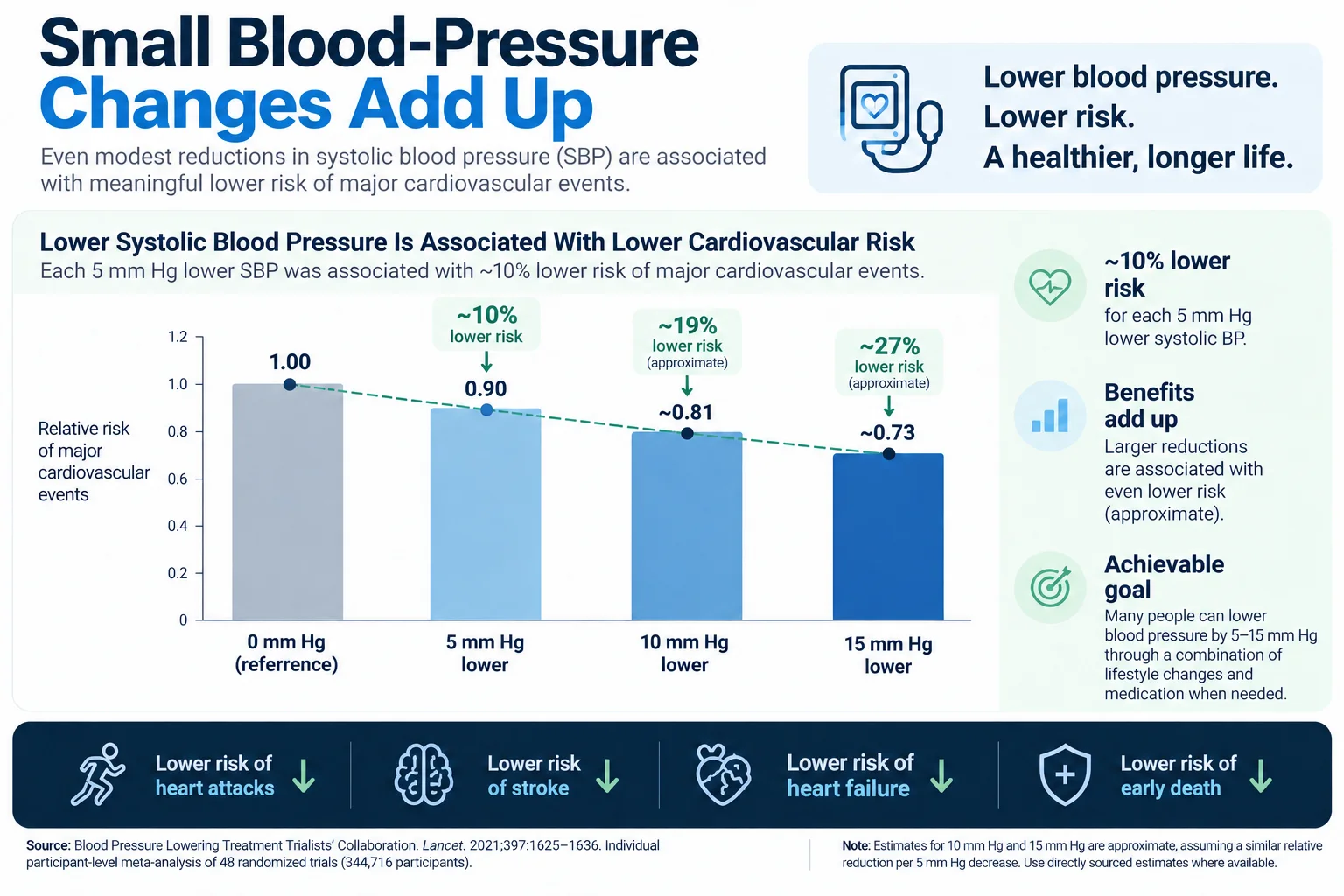
The reason to take it seriously is that treatment changes outcomes. Lowering blood pressure reduces cardiovascular events, and the benefit does not require a dramatic change on the monitor. Across 48 randomized trials involving 344,716 participants, a 5 mm Hg reduction in systolic pressure was associated with roughly 10% fewer major cardiovascular events.[5]
This is the starting guide to blood pressure in the MendelMD preventive cardiology library. It explains why the number matters and what you can do about it. The companion articles cover blood pressure stages, measuring at home, urgent readings, and hypertension and life expectancy in more detail.
This guide discusses adults outside pregnancy. Chest pain, stroke signs, or severe breathing difficulty require emergency care regardless of the blood-pressure reading.
Educational use only. This content provides general health information. It does not constitute medical advice or medical care and is not a substitute for individualized guidance, diagnosis, or treatment from a qualified healthcare professional. Do not start, stop, or change treatment based on this page alone.
The 30-second takeaway
For most adults:
- Normal blood pressure is below 120/80 mm Hg.[1]
- One high reading does not establish hypertension. Your average from several correctly measured readings is more useful.
- Small improvements matter. A 5 mm Hg reduction in systolic pressure is associated with roughly 10% fewer major cardiovascular events in randomized-trial data.[5]
- The strongest lifestyle levers are a DASH-style eating pattern, less sodium, more potassium-rich food when safe, regular exercise, weight loss when appropriate, and less alcohol.[1][10]
- Medication decisions depend on both the number and the person. Cardiovascular disease, diabetes, kidney disease, prior stroke, pregnancy, age, frailty, and overall predicted risk all change the conversation.[1][13]
- Very high blood pressure with concerning symptoms is an emergency. See the urgent-care section below.
The goal is not to turn you into your own cardiologist. It is to help you understand the number, measure it well, improve what you can, and have a better conversation with your clinician.
Why blood pressure is worth getting right
High pressure makes the heart pump against more resistance and can damage arteries and small vessels in the brain and kidneys. The result can be a heart attack, stroke, heart failure, kidney disease, or loss of independence—not just a number outside a reference range.[1]
Randomized trials are particularly useful here because they test whether lowering pressure changes what happens next. SPRINT enrolled 9,361 adults at increased cardiovascular risk without diabetes or prior stroke and compared a systolic target below 120 with one below 140 mm Hg. Intensive treatment reduced major cardiovascular outcomes and deaths, but also increased some adverse events, including hypotension, electrolyte abnormalities, and acute kidney injury.[6]
That is a reason to treat thoughtfully, with a target you can tolerate and follow-up that catches problems. The full discussion of the trial, its limitations, and modeled survival benefits is in High Blood Pressure and Life Expectancy.[7]
Small changes can still be meaningful
A five-point systolic improvement can look unimpressive on a home monitor. In the trial meta-analysis, it corresponded to about a 10% relative reduction in major cardiovascular events.[5] The absolute benefit depends on your starting risk: the same relative improvement prevents more events in someone at higher baseline risk.
You do not need a perfect reading before prevention starts helping. Sustained progress matters, especially when it comes alongside better cholesterol control, less nicotine exposure, physical activity, and good diabetes care.
What is blood pressure?
Blood pressure is the force of blood pushing against the walls of your arteries. It is written as two numbers, such as 118/76 mm Hg.
- Systolic pressure, the first number, is the pressure when the heart contracts and pushes blood forward.
- Diastolic pressure, the second number, is the pressure while the heart relaxes and fills between beats.
Both numbers matter. Blood pressure also moves throughout the day. Exercise, stress, caffeine, pain, poor sleep, a full bladder, and talking during the measurement can change it. Your usual pressure is more informative than an isolated reading.
What does my reading mean?
For U.S. adults, normal blood pressure is below 120 systolic and below 80 diastolic. Hypertension starts at an average systolic pressure of 130 or a diastolic pressure of 80. A value of 140 systolic or 90 diastolic falls in stage 2.[1]
Use the higher category when the two numbers disagree. A reading of 125/85, for example, falls in stage 1 because of the bottom number. One isolated result does not establish a diagnosis: a correctly measured average, often including home readings, is what guides routine care.
The blood pressure stages chart explains the categories and works through examples. Different international guidelines use different labels; the categories here follow the 2025 U.S. AHA/ACC guideline.[3][4]
Why high blood pressure causes damage
Imagine exposing your arteries to slightly too much pressure around the clock for decades. High pressure injures the arterial lining, accelerates atherosclerosis, makes the heart work harder, and damages small vessels in the kidneys and brain.
That is why hypertension is linked with heart attack, stroke, heart failure, atrial fibrillation, chronic kidney disease, cognitive decline, and premature death.[1]
The goal is more than longevity. Preventing a disabling stroke, preserving kidney function, or avoiding the breathlessness of heart failure can protect independence and quality of life.
Blood pressure also does not act alone. A person with mildly elevated blood pressure, favorable cholesterol, normal glucose, no nicotine exposure, and good fitness has a different risk profile from someone with the same pressure plus diabetes, high LDL cholesterol, smoking, and kidney disease. The number may be identical; the risk is not.
Start with a trustworthy home average
Before changing treatment, make sure the measurement deserves your attention. A cuff that is too small, an unsupported arm, or talking through the reading can move the number. Home monitoring can also reveal white-coat hypertension—high readings in the office but not at home—or masked hypertension, when the reverse happens.[11]
Use a validated upper-arm monitor with the correct cuff size. Rest first, support your back and arm, keep your feet flat, and take two readings at least a minute apart. For a baseline, morning and evening measurements over several days are more informative than a single check.
The step-by-step home blood pressure guide covers positioning, a seven-day log, and common mistakes. Cuffless watch estimates should not replace a validated cuff for diagnosis or treatment decisions.[1]
How can I lower my blood pressure?
Blood pressure is unusually responsive to daily habits. You do not need to optimize everything at once. Find the weakest return in your current routine and start with the easiest meaningful win.
| What to change | Practical direction | What the evidence supports |
|---|---|---|
| Eating pattern | DASH-style pattern | One of the strongest lifestyle interventions for blood pressure [1][10] |
| Sodium | Under 2,300 mg/day; moving toward 1,500 mg can help some adults | Lower sodium generally lowers blood pressure [1] |
| Potassium | More potassium-rich foods when medically appropriate | Can lower blood pressure; ask first if kidney disease or medication raises potassium [1] |
| Weight | Modest sustained loss when excess adiposity is present | Roughly 1 mm Hg lower systolic pressure per kilogram lost is a useful population estimate [1] |
| Exercise | At least 150 minutes/week of moderate aerobic activity plus resistance training | Aerobic, resistance, and some isometric training can help [1][10] |
| Alcohol | Less is generally better for blood pressure | Reducing higher intake can lower pressure [1] |
Diet: probably the biggest lifestyle lever
DASH stands for Dietary Approaches to Stop Hypertension. The pattern emphasizes fruits, vegetables, whole grains, beans, nuts, and low-fat or nonfat dairy while limiting highly processed foods, sodium, and foods high in saturated fat. It naturally raises potassium, magnesium, calcium, and fiber without requiring you to micromanage every nutrient.
A Mediterranean-style pattern is another excellent option. For most people, moving the overall pattern in this direction matters more than following a named diet perfectly. Start with Eating Well Without Overthinking It.
Most sodium comes from packaged, prepared, and restaurant food—not only the salt shaker. Bread, sauces, deli meat, soup, frozen food, and takeout can contribute large amounts without tasting extremely salty. Reading the labels on the foods you eat most often can reveal one or two high-impact changes.
Potassium-rich foods include beans, lentils, leafy greens, potatoes, tomatoes, avocados, bananas, yogurt, and many other fruits and vegetables. If you have kidney disease or take medication that can raise potassium, ask your clinician before deliberately increasing potassium or using a potassium-based salt substitute.
Weight, exercise, alcohol, nicotine, and sleep
If excess weight is affecting your health, modest loss can improve blood pressure before you reach any theoretical “ideal” weight. It may also improve glucose, triglycerides, sleep apnea, mobility, and fitness. Read Weight and Heart Health for a fuller guide.
Aim for at least 150 minutes of moderate aerobic activity each week and add resistance training. That can be a brisk 30-minute walk on five days. Consistency matters more than an elaborate heart-rate-zone plan. For a deeper look at fitness, see What’s a Good VO2 Max?.
Alcohol tends to raise pressure as intake rises. If you drink regularly and your pressure is elevated, reducing alcohol for several weeks while tracking your home average is a useful experiment.
Nicotine acutely raises pressure, while smoking directly damages blood vessels and sharply increases cardiovascular risk. If you smoke, quitting is far more important than optimizing a few points on the monitor.
Sleep matters too. Obstructive sleep apnea can contribute to hypertension. Loud snoring, witnessed pauses in breathing, gasping, persistent daytime sleepiness, or blood pressure that remains difficult to control are reasons to discuss evaluation with a clinician. Read Sleep, Heart Health, and Longevity.
A simple plan for this week
- Find your usual blood pressure. Measure correctly at home for several days and calculate the average.
- Find your biggest sodium source. Check the foods and restaurant meals you repeat most often.
- Put produce on every plate. This supports a DASH-style pattern and usually raises potassium intake.
- Walk for 30 minutes most days. Start where you are and build gradually.
- Look honestly at alcohol. If you drink regularly, reduce it and follow the trend in your readings.
Build a system that works for years, not a seven-day blood-pressure challenge.
When is medication recommended?
Medication decisions depend on both the blood-pressure average and overall cardiovascular risk. Under the 2025 AHA/ACC guideline:[1][13]
| Situation | General guideline direction |
|---|---|
| Average blood pressure at least 140/90 mm Hg | Medication plus lifestyle treatment |
| At least 130/80 with cardiovascular disease, prior stroke, diabetes, chronic kidney disease, or PREVENT 10-year risk at least 7.5% | Medication plus lifestyle treatment |
| At least 130/80 with PREVENT risk below 7.5% | Begin lifestyle treatment; medication is recommended if the average remains at least 130/80 after 3–6 months |
For most adults treated for hypertension, the guideline target is below 130/80 mm Hg.[1] For stage 2 hypertension, starting two complementary first-line agents—often in one pill—may be appropriate.
Targets and medication choices still require individual judgment. Pregnancy, frailty, falls, orthostatic symptoms, kidney disease, drug interactions, and how the pressure was measured all matter. Needing medication does not mean lifestyle “failed.” Both are tools serving the same goal: fewer strokes, heart attacks, heart-failure events, and years living with cardiovascular disease.
When should you get medical help?
Chest pain, stroke signs, severe breathing difficulty, sudden severe headache, or confusion can be an emergency at any blood pressure. Call 911 in the U.S.; do not delay care to get a reading.
A systolic pressure above 180 or a diastolic pressure above 120 is severely elevated. With concerning symptoms, call emergency services. If you feel well, remain seated, repeat after at least one minute, and contact your clinician promptly if it remains this high. Do not take extra medication unless instructed.[12][15]
For less urgent elevations, arrange a visit if your home average is at least 130/80, treatment is not reaching your agreed goal, or medication causes side effects. Seek earlier advice for new or worsening symptoms. Pregnancy and the postpartum period use different thresholds and require advice from your maternity team.
The guide to dangerous blood-pressure readings explains the differences between emergency care, a prompt call, and routine follow-up.
How blood pressure affects your Vital8 score
Vital8 scores systolic and diastolic blood pressure separately and uses the lower component score:
| Systolic | Diastolic | Points |
|---|---|---|
| Below 120 | Below 80 | 100 |
| 120–129 | — | 75 |
| 130–139 | 80–89 | 50 |
| 140–159 | 90–99 | 25 |
| At least 160 | At least 100 | 0 |
If a user reports taking blood-pressure medication, the Life’s Essential 8 method subtracts 20 points, with a floor of zero.[14] This does not mean treatment is harmful. It reflects the underlying diagnosis and residual risk. Treating hypertension still lowers cardiovascular events; never avoid or stop medication to improve a score.
Use the free Vital8 assessment to see blood pressure alongside nutrition, activity, nicotine exposure, sleep, body size, cholesterol, and blood sugar. The Vital8 methods explain the scoring rules and limitations.
Frequently asked questions
Is 130/80 high blood pressure?
Under the 2025 AHA/ACC guideline, an average at or above 130 systolic or 80 diastolic meets the definition of stage 1 hypertension.[1] The next question is what your correctly measured average and overall cardiovascular risk look like.
Which number matters more?
Both. Either systolic or diastolic pressure can place a reading in a higher category. Systolic pressure generally becomes a stronger predictor of cardiovascular events with age.
How much can lifestyle really help?
Potentially quite a lot. Diet quality, weight loss when appropriate, exercise, sodium reduction, potassium-rich foods when safe, and less alcohol can each lower pressure. The combined response varies by person and does not remove the need for medication when risk or pressure is high.
Do I have to take medication forever?
Not always. Sustained lifestyle changes or weight loss can sometimes reduce medication requirements, but hypertension is usually chronic. Do not stop medication because one reading is normal; it may be normal because the treatment is working.
Can my smartwatch measure blood pressure?
Not reliably enough to replace a validated upper-arm cuff. The 2025 guideline recommends against relying on cuffless devices for diagnosis or treatment decisions.[1]
Can I feel when my blood pressure is high?
Usually not. Feeling fine does not mean the pressure is normal. Measuring it is the only reliable way to know.
Choose the next guide you need
| Your question | Read next |
|---|---|
| Is this reading normal, elevated, or hypertension? | Blood pressure stages and examples |
| Can I trust my home readings? | How to check blood pressure at home |
| Do I need urgent help? | When high blood pressure is an emergency |
| What does control mean for my long-term health? | High blood pressure and life expectancy |
What to do next
- Measure correctly at home and calculate a multi-day average.
- If it is elevated, choose one high-impact lifestyle change you can repeat.
- Move toward a DASH-style eating pattern and identify your largest sodium sources.
- Aim for at least 150 minutes of moderate activity per week plus resistance training.
- If your average remains at or above 130/80 mm Hg, discuss your overall cardiovascular risk and treatment options with your clinician.
Blood pressure matters, but it is one part of cardiovascular health. Cholesterol, blood sugar, fitness, weight, diet, sleep, and nicotine exposure matter too. The goal is not to collect perfect numbers. It is to use the numbers to understand risk and improve the things you can change.
References
- Jones DW, Ferdinand KC, Taler SJ, et al. 2025 AHA/ACC/AANP/AAPA/ABC/ACCP/ACPM/AGS/AMA/ASPC/NMA/PCNA/SGIM guideline for the prevention, detection, evaluation, and management of high blood pressure in adults. Circulation. 2025. doi:10.1161/CIR.0000000000001356. Read source.
- Greenland P, Peterson E. The new 2017 ACC/AHA guidelines “up the pressure” on diagnosis and treatment of hypertension. JAMA. 2017;318(21):2083-2084. doi:10.1001/jama.2017.18605. Read source.
- Whelton PK, Carey RM, Mancia G, et al. Harmonization of the American College of Cardiology/American Heart Association and European Society of Cardiology/European Society of Hypertension blood pressure/hypertension guidelines. J Am Coll Cardiol. 2022;80(12):1192-1201. doi:10.1016/j.jacc.2022.07.005. Read source.
- McCarthy CP, Bruno RM, Rahimi K, et al. Global and European landscape of major hypertension guidelines. Lancet. 2025;405(10482):874-876. doi:10.1016/S0140-6736(24)02795-8. Read source.
- Blood Pressure Lowering Treatment Trialists’ Collaboration. Pharmacological blood pressure lowering for primary and secondary prevention of cardiovascular disease across different levels of blood pressure: an individual participant-level data meta-analysis. Lancet. 2021;397(10285):1625-1636. doi:10.1016/S0140-6736(21)00590-0. Read source.
- SPRINT Research Group. A randomized trial of intensive versus standard blood-pressure control. N Engl J Med. 2015;373:2103-2116. doi:10.1056/NEJMoa1511939. Read source.
- Vaduganathan M, Claggett BL, Juraschek SP, Solomon SD. Assessment of long-term benefit of intensive blood pressure control on residual life span: secondary analysis of SPRINT. JAMA Cardiol. 2020;5(5):576-581. doi:10.1001/jamacardio.2019.6192. Read source.
- Zaninotto P, Steptoe A, Shim EJ. Cardiovascular disease incidence and mortality among people with diabetes and/or hypertension. PLoS One. 2024;19(5):e0303306. doi:10.1371/journal.pone.0303306. Read source.
- Usui I. Common metabolic features of hypertension and type 2 diabetes. Hypertens Res. 2023;46(5):1227-1233. doi:10.1038/s41440-023-01233-x. Read source.
- Valenzuela PL, Carrera-Bastos P, Gálvez BG, et al. Lifestyle interventions for the prevention and treatment of hypertension. Nat Rev Cardiol. 2021;18(4):251-275. doi:10.1038/s41569-020-00437-9. Read source.
- Muntner P, Shimbo D, Carey RM, et al. Measurement of blood pressure in humans: a scientific statement from the American Heart Association. Hypertension. 2019;73(5):e35-e66. doi:10.1161/HYP.0000000000000087. Read source.
- Bress AP, Anderson TS, Flack JM, et al. The management of elevated blood pressure in the acute care setting: a scientific statement from the American Heart Association. Hypertension. 2024;81(8):e94-e106. doi:10.1161/HYP.0000000000000238. Read source.
- Khan SS, Lloyd-Jones DM, Abdalla M, et al. Use of risk assessment to guide decision-making for blood pressure management in the primary prevention of cardiovascular disease. J Am Coll Cardiol. 2025;86(18):1539-1559. doi:10.1016/j.jacc.2025.08.001. Read source.
- Lloyd-Jones DM, Allen NB, Anderson CAM, et al. Life’s Essential 8: updating and enhancing the American Heart Association’s construct of cardiovascular health. Circulation. 2022;146(5):e18-e43. doi:10.1161/CIR.0000000000001078. Read source.
- American Heart Association. When to call 911 about high blood pressure. Read guidance.
This guide is part of the MendelMD preventive cardiology library. Continue with LDL cholesterol, A1c and blood sugar, nutrition, and sleep, or take the free Vital8 assessment.
Continue exploring
Interpret both numbers using the current U.S. categories.
How to Check Blood Pressure at Home →Choose a monitor and obtain a trustworthy average.
When Is High Blood Pressure an Emergency? →Know when to call 911 and when to contact your clinician.
High Blood Pressure and Life Expectancy →Understand the longevity evidence and its limits.
Preventive Cardiology →
Mendel Jacobs, MD, MPH
Menachem "Mendel" Jacobs, MD, MPH is an Internal Medicine Resident at Yale School of Medicine pursuing academic cardiology. He publishes under Menachem Jacobs.
Connect on LinkedIn