How to Check Blood Pressure at Home
Get a reliable home blood pressure average: choose a validated cuff, sit correctly, take repeated readings, and bring a useful seven-day log to your visit.
On this page
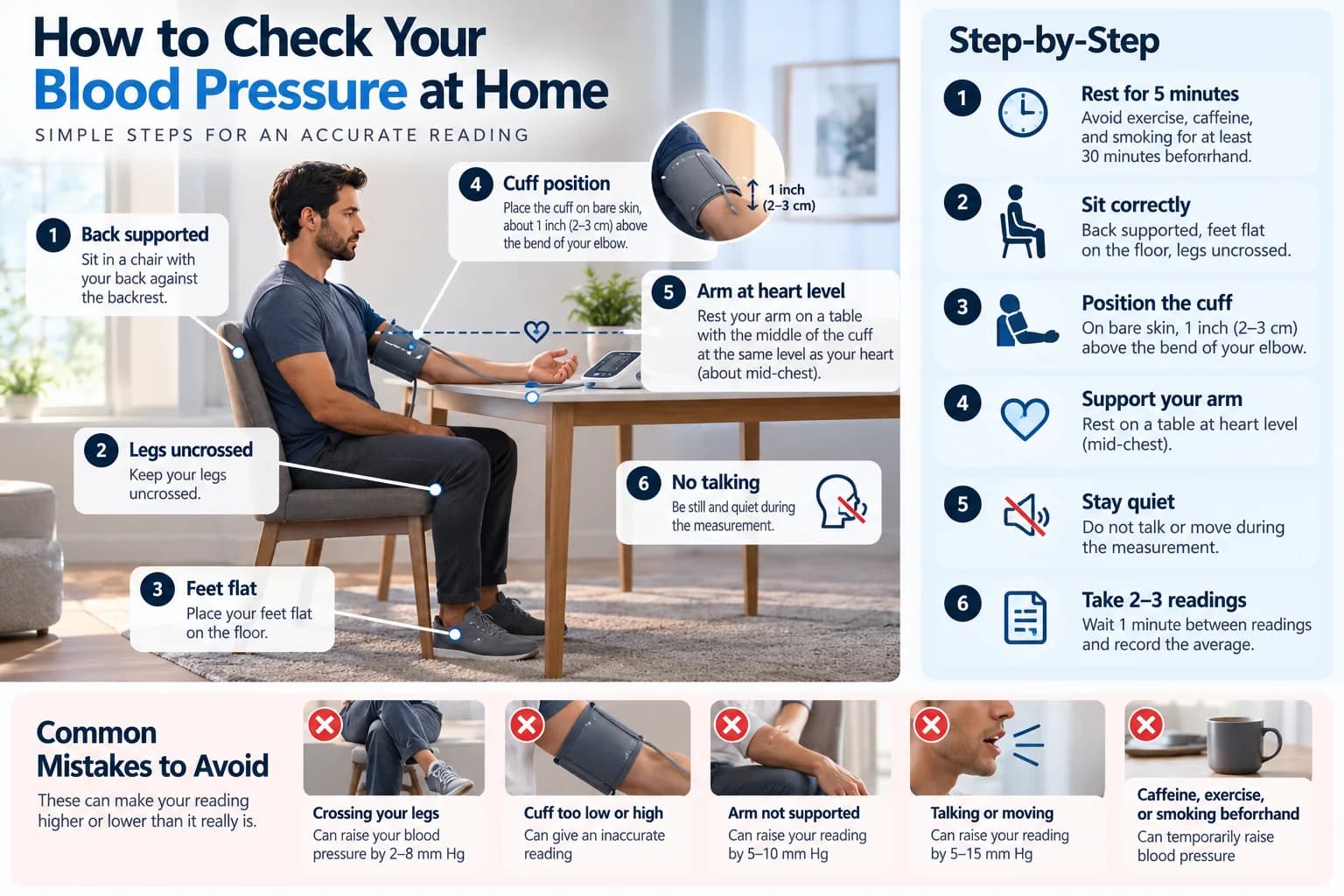
A home blood-pressure monitor is useful only if the reading is worth trusting. Checking while answering emails, with your arm hanging off the couch and the cuff over a sleeve, can create a number that looks precise without being accurate.
The aim is a repeatable routine: the right device, the right position, and enough readings to see your usual pattern. That gives your clinician better information than a collection of checks taken only when you feel stressed.
Educational use only. This content provides general health information. It does not constitute medical advice or medical care and is not a substitute for individualized guidance, diagnosis, or treatment from a qualified healthcare professional. Do not start, stop, or change treatment based on this page alone.
The 30-second takeaway
Use a validated upper-arm monitor with the right cuff size. Rest quietly for five minutes, support your back and arm, and keep your feet flat. Take two readings at least one minute apart, morning and evening, ideally for seven days before a visit.[1][2]
This schedule is for routine monitoring. Do not delay emergency care to finish a log. Chest pain or stroke signs can be an emergency at any pressure; see when high blood pressure needs urgent help.
Choose a monitor that has been tested
An automatic upper-arm cuff is generally the most practical option. Check that the exact model has passed an accepted validation process; a familiar brand or an online review is not the same thing. ValidateBP lists validated devices in the U.S.
Measure your upper arm and choose a cuff whose stated size range includes it. A cuff that is too small can read falsely high; an oversized cuff can also distort results. Bring the device to an appointment so your team can check your technique and compare readings.[3]
If your arm shape or size makes a standard cuff difficult, ask your clinician about an appropriate alternative. People who are pregnant should use a device validated for pregnancy. Do not substitute a smartwatch or another cuffless estimate for a validated monitor when making diagnosis or treatment decisions.[4]
Prepare before pressing start
For the preceding 30 minutes, avoid exercise, smoking, and caffeine. Empty your bladder. Then sit quietly for five minutes without talking, scrolling, or trying to answer a message. Pain, recent exertion, and a rushed check can all complicate interpretation.[1]
You do not need a special room. You need a chair, a table, and a few uninterrupted minutes.
Get the position right
- Sit in a chair with your back supported.
- Keep both feet flat, with legs uncrossed.
- Put the cuff on your bare upper arm, following its placement instructions.
- Rest the arm on a table or other support so the middle of the cuff is at heart level.
- Keep your hand relaxed. Stay quiet and still while the machine measures.
The arm should be supported rather than held up by muscle effort. A desk that is too low or a cuff placed over a thick sleeve is an easy setup problem to fix.[3]
Build a useful seven-day log
For a baseline before an appointment, a common plan is two readings in the morning and two in the evening for seven days. Separate each pair by at least one minute. If seven days is not practical, at least three days can still be helpful; follow the schedule your care team recommends.[2]
Measure at consistent times. Morning checks are often done before breakfast and before the usual blood-pressure medication dose. Do not skip or delay medication to take a reading; agree on the timing with your clinician and record it consistently.
Repeat this record for each day:
| Session | What to record |
|---|---|
| Morning | Reading 1, reading 2, and medication timing |
| Evening | Reading 1, reading 2, and medication timing |
| Notes | Date, symptoms, missed doses, or anything unusual |
Keep every scheduled reading, or use the device's memory. Do not repeatedly measure until you get a number you like. Calculate systolic and diastolic averages separately; your clinician may use a specific protocol, including whether to omit the first day's values. Bring the original readings so that choice remains possible.
Why home and office readings may disagree
White-coat hypertension means pressure is high in the office but not outside it. Masked hypertension means office readings look acceptable while out-of-office readings are high. Neither can be identified from how anxious or relaxed you feel alone.[3]
When the pattern is unclear, a clinician may recommend ambulatory monitoring, which measures pressure repeatedly during ordinary daily life and sleep. Home measurement adds information; it does not replace clinical assessment.
What should you do with the results?
For routine interpretation, use your multi-day average and the blood pressure stages chart. An average at or above 130 systolic or 80 diastolic is worth discussing with your clinician under current U.S. guidance. If you are already treated, compare readings with your personal agreed target, not just the chart.
If systolic pressure is above 180 or diastolic pressure above 120, use the urgent-readings action plan rather than waiting for the end of the week. A very low reading with fainting, chest pain, or other significant symptoms also deserves prompt assessment.
Frequently asked questions
Should I check before or after medication?
Morning measurements are commonly taken before the usual dose, but your care team may recommend another schedule. Keep timing consistent and do not miss medication to obtain a reading.
Why are the first and second readings different?
Blood pressure naturally varies, and you may settle further during the session. Record both readings instead of choosing the lower one.
Can I use a wrist monitor?
A validated upper-arm monitor is usually preferred. If an upper-arm cuff cannot be used, ask your clinician which alternative is appropriate and how to position it correctly.
Should I measure every time I feel anxious?
A planned routine generally gives a more useful picture than repeated checks driven by anxiety. Discuss an appropriate schedule if monitoring itself is becoming stressful.
A simple plan for this week
Check your device and cuff size, choose morning and evening times you can repeat, and record a week of measurements. Bring that log and your monitor to your next visit. The main hypertension guide explains the treatment and lifestyle decisions that follow.
References
- CDC. Measuring your blood pressure. Measurement guidance.
- Shimbo D, Artinian NT, Basile JN, et al. Self-measured blood pressure monitoring at home: a joint policy statement from the AHA and AMA. Circulation. 2020;142:e42–e63. Statement.
- Muntner P, Shimbo D, Carey RM, et al. Measurement of blood pressure in humans. Hypertension. 2019;73:e35–e66. Statement.
- Jones DW, Ferdinand KC, Taler SJ, et al. 2025 multisociety high blood pressure guideline. Guideline.
Continue exploring
Start with prevention, treatment, and a practical plan.
High Blood Pressure Stages →Interpret both numbers using the current U.S. categories.
When Is High Blood Pressure an Emergency? →Know when to call 911 and when to contact your clinician.
High Blood Pressure and Life Expectancy →Understand the longevity evidence and its limits.
Preventive Cardiology →
Mendel Jacobs, MD, MPH
Menachem "Mendel" Jacobs, MD, MPH is an Internal Medicine Resident at Yale School of Medicine pursuing academic cardiology. He publishes under Menachem Jacobs.
Connect on LinkedIn