High Blood Pressure Stages: Know Your Numbers
Use the blood pressure chart to understand normal, elevated, stage 1, and stage 2 readings—and why either number can put you in a higher category.
On this page
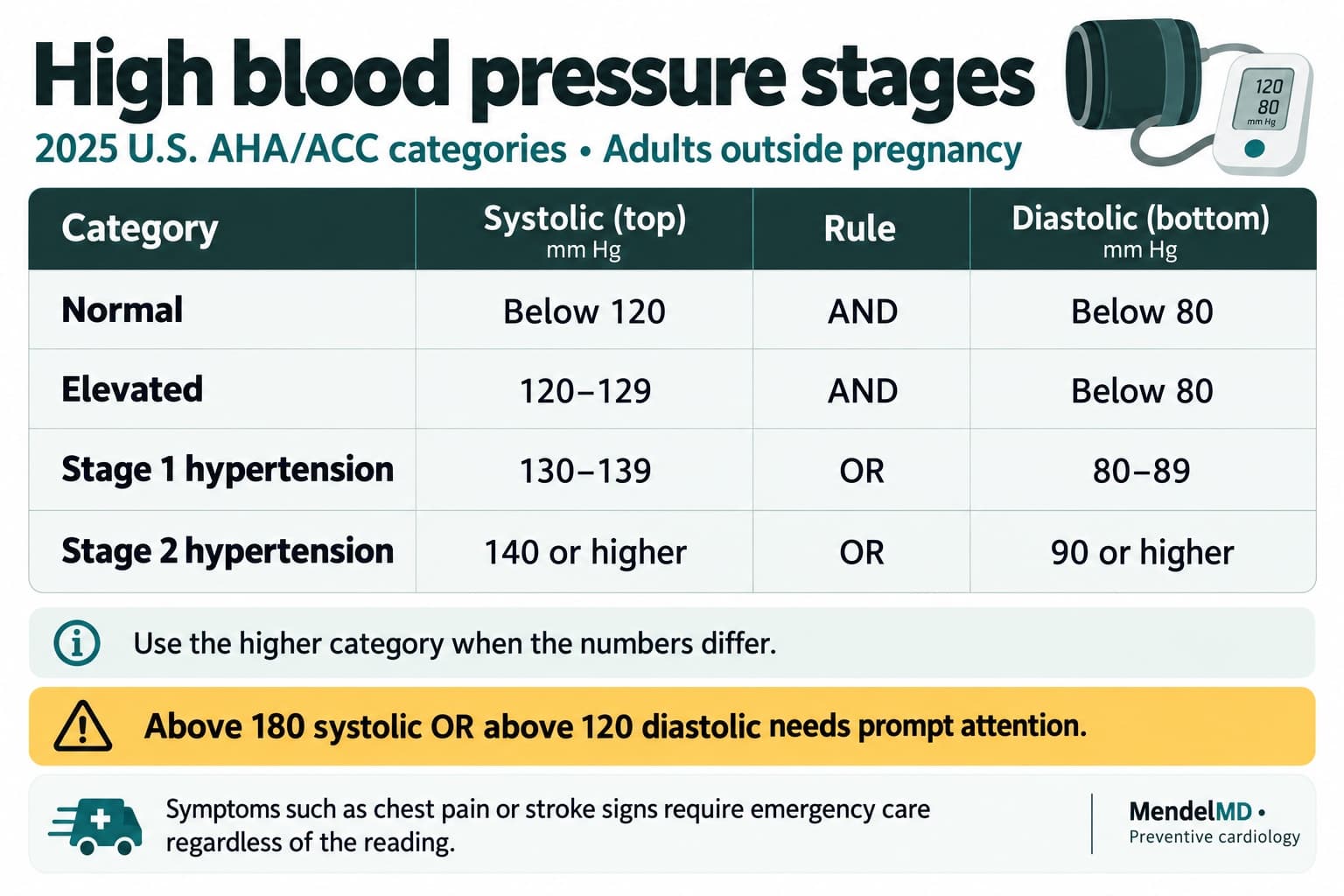
A blood-pressure reading gives you two numbers, but people often focus on only one. A top number of 125 sounds reassuring—until you notice the bottom number is 85. Under current U.S. categories, that reading falls in stage 1 hypertension.
The useful rule is simple: when the two numbers fall in different categories, use the higher category. The chart below follows the 2025 AHA/ACC guideline for adults outside pregnancy.[1]
Educational use only. This content provides general health information. It does not constitute medical advice or medical care and is not a substitute for individualized guidance, diagnosis, or treatment from a qualified healthcare professional. Do not start, stop, or change treatment based on this page alone.
The 30-second takeaway
- Normal: below 120 systolic and below 80 diastolic.
- Stage 1 hypertension: 130–139 systolic or 80–89 diastolic.
- Stage 2 hypertension: at least 140 systolic or at least 90 diastolic.
- A category describes a reading; a diagnosis usually requires an average of repeated, accurate readings.
Chest pain or stroke signs require emergency care regardless of the number. For a severely elevated reading or concerning symptoms, use the urgent blood pressure guide.
Blood pressure chart: the current U.S. stages
| Category | Systolic | Diastolic |
|---|---|---|
| Normal | Below 120 | and below 80 |
| Elevated | 120–129 | and below 80 |
| Stage 1 | 130–139 | or 80–89 |
| Stage 2 | 140 or higher | or 90 or higher |
All values are in mm Hg. These categories are unchanged in the 2025 U.S. guideline. They are not the pregnancy classification, and other countries may use different diagnostic thresholds.[1][2]
The top number measures pressure while the heart contracts. The bottom number measures pressure while it relaxes between beats. Both contribute useful information. An elevated bottom number is not canceled out by a normal top number.
What common readings mean
| Reading | Category | Why |
|---|---|---|
| 118/76 | Normal | Both values are below the normal cutoffs. |
| 125/75 | Elevated | The top number is 120–129 and the bottom is below 80. |
| 125/85 | Stage 1 | The bottom number is in the 80–89 range. |
| 135/75 | Stage 1 | The top number is in the 130–139 range. |
| 128/92 | Stage 2 | A bottom number of at least 90 is enough. |
| 145/82 | Stage 2 | A top number of at least 140 is enough. |
A reading near a boundary deserves context. Cardiovascular risk does not suddenly jump when systolic pressure moves from 129 to 130. Categories help clinicians decide when to investigate or treat; risk itself changes more gradually.
One reading is not the whole story
Blood pressure responds to activity, stress, caffeine, nicotine, pain, and measurement technique. A high result can be real without representing your usual pressure.
For routine diagnosis, clinicians generally use the average of at least two careful measurements on at least two occasions, with home or ambulatory monitoring when appropriate. White-coat and masked hypertension are reasons the office and home picture may differ.[3]
The next useful step is a good measurement routine. See how to check blood pressure at home for the setup and recording plan. Repeated measurement is for routine assessment; it should never delay care for emergency symptoms.
Does stage 1 mean I need medication?
The category starts the conversation; it does not finish it. At stage 1, your clinician considers cardiovascular disease, previous stroke, diabetes, kidney disease, and estimated cardiovascular risk. People at higher risk may benefit from medication alongside lifestyle changes. For lower-risk adults whose average remains at least 130/80 after three to six months of lifestyle treatment, the 2025 guideline also recommends medication.[1]
At an average of 140 systolic or 90 diastolic or higher, the guideline generally recommends medication plus lifestyle treatment. Its usual treatment goal for most adults is below 130/80, with adjustments for tolerability and individual circumstances. These are general guideline recommendations, not a personal prescription or treatment target. A diagnosis threshold and a personal treatment target are related but different ideas.
The main blood pressure prevention guide explains how medication, diet, exercise, sodium, and other habits fit together.
What about readings above 180 or 120?
A systolic reading above 180 or a diastolic reading above 120 needs prompt attention. Both numbers do not have to be high. Concerning symptoms make it an emergency; without symptoms, repeat the reading and contact your clinician promptly if it remains severely elevated.[2]
Read when high blood pressure is an emergency for the full action plan, including the important pregnancy exception.
Frequently asked questions
Is 130/80 high blood pressure?
An average of 130 systolic or 80 diastolic reaches stage 1 under current U.S. guidance. A single reading alone usually does not establish a diagnosis.
Is 140/90 stage 1 or stage 2?
It is stage 2 under the 2025 U.S. AHA/ACC categories. Either a systolic value of at least 140 or a diastolic value of at least 90 qualifies.
What if only my bottom number is high?
Use the higher category. For example, 125/85 is stage 1 and 125/92 is stage 2. Discuss the pattern with your clinician rather than dismissing the bottom number.
Does a normal reading mean I can stop medication?
No. The pressure may be normal because treatment is working. Medication changes should be made with your clinician, using the overall pattern and any side effects.
Your next step
If you feel well and are trying to understand a routine reading, establish a correctly measured home average and bring it to your clinician. Use the home-measurement guide next, then return to the hypertension prevention guide for ways to improve it.
References
- Jones DW, Ferdinand KC, Taler SJ, et al. 2025 multisociety guideline for the prevention, detection, evaluation, and management of high blood pressure in adults. J Am Coll Cardiol. 2025. Guideline.
- American Heart Association. Understanding blood pressure readings. Patient guidance.
- Muntner P, Shimbo D, Carey RM, et al. Measurement of blood pressure in humans: a scientific statement from the American Heart Association. Hypertension. 2019. Statement.
Continue exploring
Start with prevention, treatment, and a practical plan.
How to Check Blood Pressure at Home →Choose a monitor and obtain a trustworthy average.
When Is High Blood Pressure an Emergency? →Know when to call 911 and when to contact your clinician.
High Blood Pressure and Life Expectancy →Understand the longevity evidence and its limits.
Preventive Cardiology →
Mendel Jacobs, MD, MPH
Menachem "Mendel" Jacobs, MD, MPH is an Internal Medicine Resident at Yale School of Medicine pursuing academic cardiology. He publishes under Menachem Jacobs.
Connect on LinkedIn