The AI in Healthcare Map: 10 Categories, Dozens of Companies
A taxonomy for understanding the healthcare AI market by user, workflow, risk, and distribution.
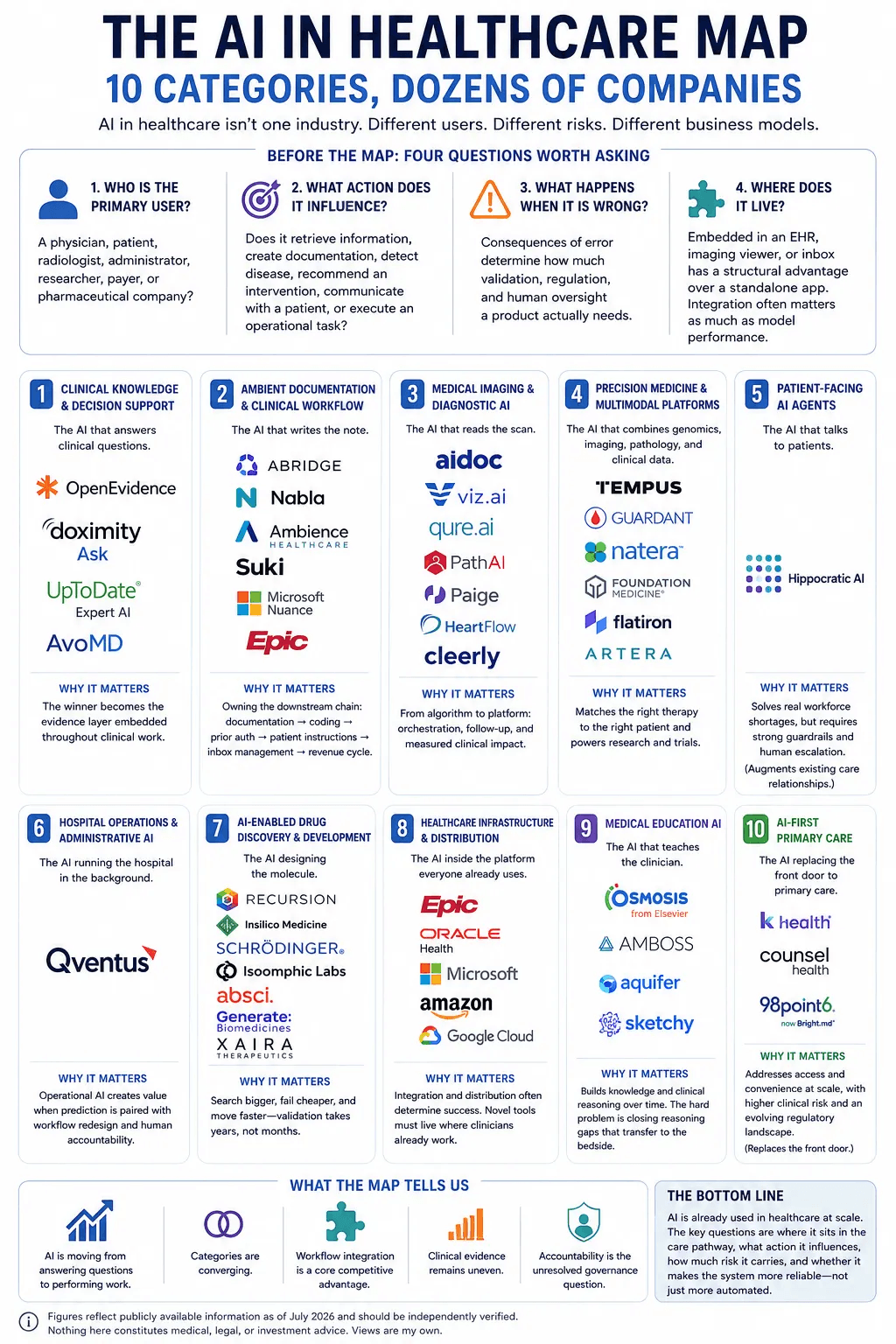
Ask ten people to name the leading AI company in healthcare, and you may get ten different answers. They may all be correct.
"AI in healthcare" gets discussed as though it were a single industry. It isn't. The software answering a physician's clinical question is fundamentally different from the tool analyzing a CT scan, drafting a progress note, calling a patient after discharge, managing hospital beds, or designing a new molecule. These products serve different users, face different regulatory standards, and make money in different ways.
A useful map divides the market into ten categories. Here is what each one contains, who the key players are, and why it matters.
A taxonomy
Before evaluating any specific tool, these four questions cut through most of the noise:
Who is the primary user? A physician, patient, radiologist, administrator, researcher, payer, or pharmaceutical company?
What action does it influence? Does it retrieve information, create documentation, detect disease, recommend an intervention, communicate with a patient, or execute an operational task?
What happens when it is wrong? A poorly phrased note is not equivalent to a missed pulmonary embolism. The consequences of error determine how much validation, regulation, and human oversight a product actually needs.
Where does it live? A product embedded within an EHR, imaging viewer, or inbox has a structural advantage over a standalone application that asks clinicians to change their workflow.
That last point is becoming the central commercial lesson of healthcare AI: distribution and integration frequently matter as much as model performance.
1. Clinical knowledge and decision support
The AI that answers clinical questions.
This is where generative AI is growing fastest among physicians. OpenEvidence has built an AI-native clinical search engine that provides citation-linked answers to verified clinicians. In January 2026, it raised $250 million at a $12 billion valuation and reported approximately 18 million clinical consultations in December 2025 alone.
Its main competitor is Doximity Ask, which gained serious clinical-reference capability after acquiring Pathway in July 2025 for up to $63 million. What makes Doximity interesting isn't just the answer quality. It is that Ask sits inside an app 85% of US physicians already use for communication, telehealth, and documentation.
The established incumbent, UpToDate Expert AI, launched in September 2025. Its advantage is decades of expert-curated content; its disadvantage is that it entered the generative-AI interface late.
A different flavor of clinical AI: AvoMD builds structured care pathways and protocol tools that guide clinical decisions step by step. Less "answer this question" and more "walk through this clinical scenario." Where OpenEvidence searches evidence, AvoMD operationalizes it into institutional workflows.
The real competition here isn't about who gives the best isolated answer. It is about which platform combines trustworthy evidence, transparent sourcing, patient context, and the least workflow friction, or has access to the biggest funnel. The winner becomes the evidence layer embedded throughout clinical work.
2. Ambient documentation and clinical workflow
The AI that writes the note.
This is the most commercially mature category. Ambient scribe tools listen to clinical encounters and generate draft documentation. The best ones are expanding well beyond that.
Abridge raised a $300 million Series E in June 2025 and now partners with more than 150 health systems. It has reframed itself as a "care intelligence" platform connecting documentation, evidence, and payment workflows. Nabla raised a $70 million Series C and reported 85,000 clinicians across 130+ organizations. Microsoft Nuance, Ambience Healthcare, and Suki are also significant players.
The category is also under pressure from within: Epic released AI Charting in 2026, drafting notes and queuing orders natively inside the EHR millions of clinicians already use.
The defensible play isn't just note-writing. It is owning the full downstream chain: documentation, coding, prior authorization, patient instructions, inbox management, and revenue cycle. The clinical conversation is valuable because it contains the raw material for all of those processes.
3. Medical imaging and diagnostic AI
The AI that reads the scan.
Imaging is the most heavily regulated category in healthcare AI. The FDA maintains a public database of authorized AI-enabled medical devices, and radiology historically accounts for a large share.
Aidoc recently received FDA clearance for a comprehensive abdominal CT triage system covering 14 findings, a meaningful shift from single-condition algorithms toward broader foundation models analyzing one exam for multiple abnormalities simultaneously. Viz.ai demonstrated that diagnostic AI creates the most value when the result changes what happens next: its stroke-detection system automates the alert chain connecting radiologists, neurologists, and interventional teams.
Other key companies: Qure.ai for chest imaging and global screening, PathAI and Paige for computational pathology, HeartFlow and Cleerly for coronary CT analysis.
The transition underway is from algorithm to platform. Hospitals don't want dozens of disconnected products, each detecting one abnormality through its own interface. They want orchestration: multiple models, results routed to the right team, follow-up tracked, and clinical impact measured.
4. Precision medicine and multimodal data platforms
The AI that combines genomics, imaging, pathology, and clinical data.
Tempus AI is the clearest example of the platform strategy here. It reported approximately $1.27 billion in 2025 revenue, acquired digital pathology company Paige and previously Arterys and Deep 6 AI, combining testing, imaging, pathology, and clinical-trial data into a single flywheel.
Other players: Guardant Health and Natera in liquid biopsy, Foundation Medicine in genomic profiling, Flatiron Health in oncology data, Artera in AI-derived cancer risk stratification.
The business model: generate or ingest clinical data, structure it across modalities, return useful information to clinicians, and use the resulting dataset for research, drug development, and trials. This is where AI can directly influence which patient receives which therapy, which raises difficult questions about validation, access, reimbursement, and dataset bias that are far from resolved.
5. Patient-facing AI agents
The AI that talks to patients.
Hippocratic AI raised a $126 million Series C in November 2025 at a $3.5 billion valuation, with voice agents focused on non-diagnostic tasks: post-discharge calls, medication reminders, preventive-care outreach, appointment preparation.
The economic rationale is real. Healthcare faces persistent shortages in nursing, care management, and call-center capacity. But patient-facing AI changes the safety equation entirely. A documentation tool creates a draft for clinician review. A voice agent speaks directly to a frightened, medically complex, or sometimes confused patient.
Responsible deployment requires clear scope limits, escalation rules, identity disclosure, language access, and a reliable path to a human. The strongest near-term applications are bounded tasks with low clinical stakes. The central question isn't whether an agent can complete the conversation. It is whether the surrounding system can recognize when it can't.
Note: this category covers AI that augments existing care relationships. AI that replaces the front door to primary care entirely is Category 10.
6. Hospital operations and administrative automation
The AI running the hospital in the background.
Qventus applies AI to perioperative coordination, inpatient capacity, and discharge planning, the kind of work that generates significant value without anyone noticing. Filled OR time, reduced avoidable delays, and earlier discharge identification can translate to substantial financial returns.
The nuance: a model can identify a likely discharge. The patient may still need transportation, dialysis placement, home oxygen, or family support. Successful operational AI pairs prediction with workflow redesign and clearly assigned human accountability.
7. AI-enabled drug discovery and development
The AI designing the molecule.
Recursion describes its platform as AI-native across biology, chemistry, and clinical development. Insilico Medicine announced a collaboration with Eli Lilly in March 2026 with potential deal value up to $2.75 billion. Other key players: Schrodinger, Isomorphic Labs, Absci, Generate:Biomedicines, Xaira Therapeutics.
The promise is compelling: search larger chemical spaces, reduce failed synthesis, identify failures earlier. The honest caveat: an AI-designed molecule still has to survive toxicology, manufacturing, clinical trials, and regulatory review. A successful ambient-documentation rollout may show value in months. Validating an AI-native drug platform may take a decade.
8. Healthcare infrastructure and distribution
The AI inside the platform everyone already uses.
Epic and Oracle Health control the EHR environments where most clinical AI ultimately has to live. Microsoft provides cloud infrastructure, enterprise software, and clinical AI through Nuance. Amazon and Google supply foundation models and healthcare-specific cloud services.
This layer may determine which startups succeed or fail regardless of model quality. A novel product can demonstrate excellent performance and still fail because it requires a separate login, lacks access to patient data, or can't place its result inside the workflow clinicians already use.
Conversely, an imperfect but well-integrated product can achieve rapid adoption. This is the single most underappreciated structural reality in healthcare AI.
9. Medical education AI
The AI that teaches the clinician.
This category is distinct from clinical decision support. OpenEvidence and UpToDate help you answer a question you already have at the point of care. Medical education AI builds knowledge in trainees over time: adaptive learning, clinical reasoning practice, structured curriculum. Different user, different moment, different purpose.
The major platforms are all adding significant AI layers. Osmosis, acquired by Elsevier, creates AI-generated explanations and adaptive content across medical school curricula. AMBOSS has woven AI-powered clinical reasoning tools into its question bank and reference library, used by hundreds of thousands of medical students and physicians globally. Aquifer builds virtual patient cases designed to develop clinical reasoning skills in students and residents. Sketchy uses visual mnemonics, now augmented with AI-personalized review paths, to make pharmacology and microbiology stick.
The real question isn't whether AI can generate more content. It is whether it can identify gaps in clinical reasoning, not just knowledge gaps, and close them in a way that transfers to the bedside. That's a harder problem than personalized flashcards, and the companies that solve it will have built something genuinely defensible.
10. AI-first primary care
The AI replacing the front door to primary care.
This is different from Category 5. Patient-facing AI agents augment existing care relationships. They call your patient after discharge or remind them to take medication. The companies in this category are trying to be the primary care relationship. The model: AI triages first, collects history, provides initial guidance. A physician joins on demand when the situation requires diagnosis, a prescription, or a referral.
K Health is the largest established player, having raised over $400 million. Its AI symptom assessment draws on data from millions of clinical encounters to identify likely diagnoses before a physician is ever involved, dramatically compressing the time to clinical decision. Counsel Health offers free AI chat with board-certified physician access at $29 per visit, no insurance required, and launched Counsel Studio, an API that lets other healthcare organizations embed the same AI-plus-physician model into their own products. 98point6, now operating as Bright.md, pioneered the text-first primary care model before pivoting to B2B.
The category addresses two real problems simultaneously: primary care physician shortages, and the fact that most primary care visits could be handled earlier, faster, and more conveniently than the current system allows. The risk is different in kind from other categories. A documentation AI that misses something produces a flawed note a clinician reviews. An AI triage system that misses something may delay care for a patient who had no other access point. The safety bar here is different, and the regulatory and liability frameworks are still catching up.
What the map tells us
Five patterns are becoming clear:
AI is moving from answering questions to performing work. The market is progressing from copilots that draft or suggest toward agents that initiate, route, schedule, code, and coordinate actions.
Categories are converging. Documentation companies are expanding into coding and orders. Diagnostic companies are becoming workflow platforms. Precision-medicine companies are combining testing, pathology, imaging, and clinical trials. EHR vendors are building capabilities that compete with the startups running on their platforms.
Workflow integration is a core competitive advantage. Often more important than model performance in isolation.
Clinical evidence remains uneven. Deployment numbers, valuations, and funding rounds indicate commercial momentum, not necessarily improved patient outcomes. The two are not the same.
Accountability is the unresolved governance question. Every organization adopting AI should be able to answer: Who reviews the output? Who acts on it? How is failure detected? What happens when the model is uncertain? How is performance monitored after deployment?
The question is no longer whether AI will be used in healthcare. It already is, at scale. The more important questions are where it sits in the care pathway, what action it influences, how much risk it carries, and whether it makes the surrounding system more reliable, not merely more automated.
Figures reflect publicly available information as of July 2026 and should be independently verified. Nothing here constitutes medical, legal, or investment advice. Views are my own.

Mendel Jacobs, MD, MPH
Menachem "Mendel" Jacobs, MD, MPH is an Internal Medicine Resident at Yale School of Medicine pursuing academic cardiology. He publishes under Menachem Jacobs.
Connect on LinkedInRelated Articles
How to Evaluate a Clinical AI Tool: The Five Layers
Medical AI benchmarks contradict each other because they measure different things. A five-layer framework for evaluating clinical LLMs — from board-exam accuracy to patient outcomes — and why the evaluation layer usually decides the winner.
How Medical AI Got Graded: The Evolution of Clinical LLM Benchmarks
From PubMedQA in 2019 to pragmatic patient-outcome trials in 2026 — how medical AI evaluation evolved, what each generation of benchmarks exposed that the last one couldn't see, and what exam scores can and cannot tell us.
OpenEvidence vs ChatGPT: Which Should a Clinician Actually Use?
OpenEvidence versus ChatGPT: compare evidence on medical benchmarks, citation reliability, safety, and physician use, with study-specific limitations.