What Is OpenEvidence? A Physician's Review (2026)
OpenEvidence is a citation-backed clinical AI tool for medical questions. Here is what it does well, where it fails, and how I would use it as a physician.
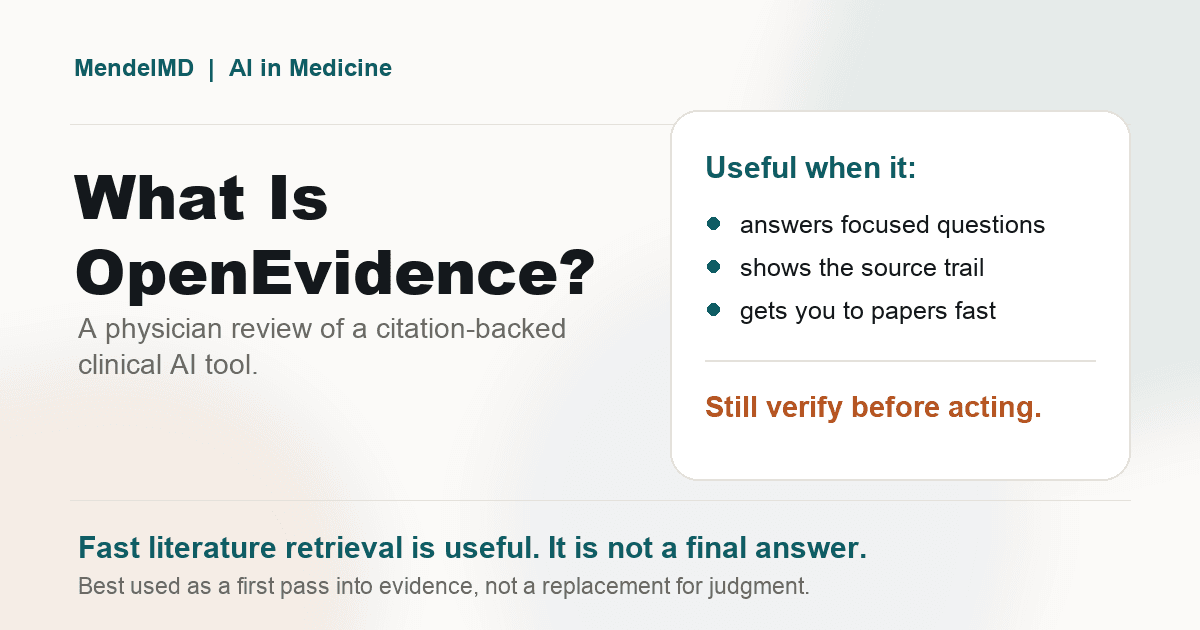
OpenEvidence is one of the first AI tools that feels like it actually found a job in clinical medicine.
Not because it is perfect. It is not. But because the job is obvious: take a focused medical question, search the literature, synthesize an answer, and show me the sources.
That is very different from asking a general chatbot to sound confident about medicine.
Disclosure: I use OpenEvidence regularly, including when researching my own writing. I have no financial relationship with OpenEvidence or any company mentioned here. Details reflect public reporting and published literature available in August 2026.
What OpenEvidence is
OpenEvidence is a clinical AI evidence tool for verified clinicians. Public reporting describes it as free to government-verified physicians and supported partly by advertising, including pharmaceutical advertising shown on a small share of queries.[1]
Its basic architecture is retrieval-augmented generation. That means it tries to answer from retrieved medical sources rather than purely from model memory. In practice, the appeal is simple: the answer comes with links you can open.
That does not mean the answer is automatically correct. It means the claim is at least checkable.
Why physicians are using it
The adoption numbers are wild by healthcare standards. Becker's, summarizing public reporting, described OpenEvidence as used by more than half of U.S. physicians.[1] A 2026 global survey, by contrast, found only 27.8% of physicians across 50 countries and territories had used any AI tool in practice.[2]
That tells you something. Physicians do not adopt extra logins for fun. They adopt tools that save time or solve a real pain point.
For me, OpenEvidence is useful when the question is narrow enough that I can judge the answer. If I ask about anticoagulation, lipid targets, a drug interaction, or an evidence summary, I want the paper trail. I do not want beautiful prose with a fake PMID.
What it does well
OpenEvidence's strongest evidence is citation fidelity.
In a spine-surgery hallucination study, OpenEvidence had perfect citation accuracy, while general models fabricated citations at meaningful rates.[3] In a consensus-group evaluation, ChatGPT fabricated 53% of citations, Gemini fabricated 12%, and OpenEvidence fabricated none.[4]
That is not a small distinction. If the citation is fake, the answer is already clinically damaged.
It also performs well in safety-focused comparisons. In NOHARM, a 1,100-task medical safety benchmark derived from physician-to-specialist consultations, clinical AI tools including OpenEvidence outperformed generalist LLMs, and most severe errors were omissions rather than obvious harmful recommendations.[5]
Omissions matter. A tool can sound safe and still fail by leaving out the test, treatment, escalation, or follow-up that should have been there.
Where it fails
OpenEvidence can cite a real paper and still summarize it incorrectly. A pharmacy critique described medication-related examples where the response did not faithfully match the cited sources.[6]
That is the failure mode I worry about most. Fake citations are easy to condemn. Real citations with wrong synthesis are more seductive.
There are also limits to retrieval. In gynecologic oncology, a guideline-anchored RAG system outperformed a literature-only OpenEvidence configuration that did not yet have NCCN access at the time of testing.[7] The lesson is basic: if the right guideline or local rule is not in the retrieval set, the answer can miss it.
And long conversations are risky. A clinical RAG study found hallucination rose from 5% with no dialogue history to 40% after ten prior exchanges.[8] I would not use a long chat thread as a running medical consult. Ask the question cleanly. Then ask the next one cleanly.
How I use it
I use OpenEvidence as a fast first pass into the literature, not as the last word.
My usual pattern:
- Ask one focused clinical question.
- Read the summary.
- Open the citations behind any claim that would change management.
- Compare against guidelines, local policy, and the patient in front of me.
I do not use it to make decisions I cannot independently evaluate. I do not use it as a substitute for a specialist. And I do not use it to generate patient instructions without rewriting them.
That may sound conservative. Good. Medicine should make us a little conservative with new tools.
OpenEvidence vs ChatGPT
The short version: ChatGPT is often better for reasoning and explanation. OpenEvidence is usually the better first stop for clinical evidence.
The longer version is in OpenEvidence vs ChatGPT: What the Evidence Actually Shows. The key point is that the studies are not really fighting. They are usually measuring different things: benchmark knowledge, citation accuracy, harmful omissions, clarity, and physician workflow.
Those are not interchangeable.
Verdict
OpenEvidence is useful, fast, and much more verifiable than a consumer chatbot. It is also not a doctor, not a guideline, and not a substitute for reading the paper yourself.
The best use is boring: let it get you to the evidence faster, then do the physician part.
Frequently asked questions
Is OpenEvidence free? Public reporting describes it as free to government-verified physicians and supported partly by ads.[1] Access rules can change, so clinicians should check the current product page.
Is OpenEvidence accurate? It performs very well on citation accuracy in published comparisons, but it has documented source-summarization errors.[3][4][6]
Does OpenEvidence replace UpToDate? No. I think of OpenEvidence as fast evidence retrieval and UpToDate as curated expert synthesis. Those overlap, but they are not the same job.
Can patients use OpenEvidence? The product is designed around verified clinician access. Patients using general chatbots should be especially cautious, because patient-framed prompts can produce worse citation behavior in some evaluations.[3]
- OpenEvidence vs ChatGPT: What the Evidence Actually Shows
- Google's AMIE: What the Evidence Actually Shows
- The AI in Healthcare Map
Educational content for clinicians. Not medical advice.
References
- OpenEvidence: 6 things to know about the AI tool used by half of physicians. Becker's Hospital Review. 2026.
- Global physician perspectives on artificial intelligence in healthcare across 50 countries and territories. NPJ Digital Medicine. 2026. PMID: 42129441.
- Large Language Model Hallucinations in Spine Surgery: A Comparative Analysis of Clinician vs Patient-Level Prompts. Neurosurgery Practice. 2026. PMID: 42232526.
- Can Large Language Models Be a Viable Tool for Consensus Working Groups? Experience of the Ventral Rectopexy Expert Consensus Group. Diseases of the Colon and Rectum. 2026. PMID: 41492895.
- First, do NOHARM: a medical safety benchmark and randomized study of physician and AI teaming on clinical consultations. arXiv. 2026.
- Prescribing Caution: A Critique of OpenEvidence to Answer Medication-Related Questions. Journal of the American College of Clinical Pharmacy. 2026. PMID: 42286997.
- Guideline-anchored retrieval-augmented generation outperforms baseline and literature-only configurations in gynecologic oncology decision support. Gynecologic Oncology. 2026. PMID: 42462288.
- RAG in clinical practice: a cautionary tale of AI "Truthfulness". npj Health Systems. 2026. PMID: 42527530.

Mendel Jacobs, MD, MPH
Menachem "Mendel" Jacobs, MD, MPH is an Internal Medicine Resident at Yale School of Medicine pursuing academic cardiology. He publishes under Menachem Jacobs.
Connect on LinkedInRelated Articles
How to Evaluate a Clinical AI Tool: The Five Layers
Medical AI benchmarks contradict each other because they measure different things. A five-layer framework for evaluating clinical LLMs — from board-exam accuracy to patient outcomes — and why the evaluation layer usually decides the winner.
How Medical AI Got Graded: The Evolution of Clinical LLM Benchmarks
From PubMedQA in 2019 to pragmatic patient-outcome trials in 2026 — how medical AI evaluation evolved, what each generation of benchmarks exposed that the last one couldn't see, and what exam scores can and cannot tell us.
OpenEvidence vs ChatGPT: Which Should a Clinician Actually Use?
OpenEvidence versus ChatGPT: compare evidence on medical benchmarks, citation reliability, safety, and physician use, with study-specific limitations.