How Much Exercise Do You Need? Physical Activity, Fitness, and Longevity
How much exercise adults need, why cardiorespiratory fitness matters, and how activity affects heart health, blood sugar, cancer risk, brain health, and longevity.
On this page
Fewer than one in four American adults (24.2%) gets enough aerobic and muscle-strengthening activity to meet the national guidelines [1]. Exercise is usually sold as a way to lose weight, which undersells it. Regular activity lowers blood pressure, improves blood sugar control, keeps muscles strong enough to stay independent, and is consistently linked with longer life.
Physical activity is what you do: walking, lifting, gardening, climbing stairs. Cardiorespiratory fitness is the state of your body as a result: how well your heart, lungs, blood, and muscles deliver and use oxygen, and how metabolically healthy they are. Both matter, and both can be improved at any age. Below is what the evidence shows, where you stand, and a brief, evidence-based guide to improve this pillar of health.
This guide is for adult education. It does not diagnose a condition, prescribe an exercise program, or replace individualized medical care.
The 30-second takeaway
-
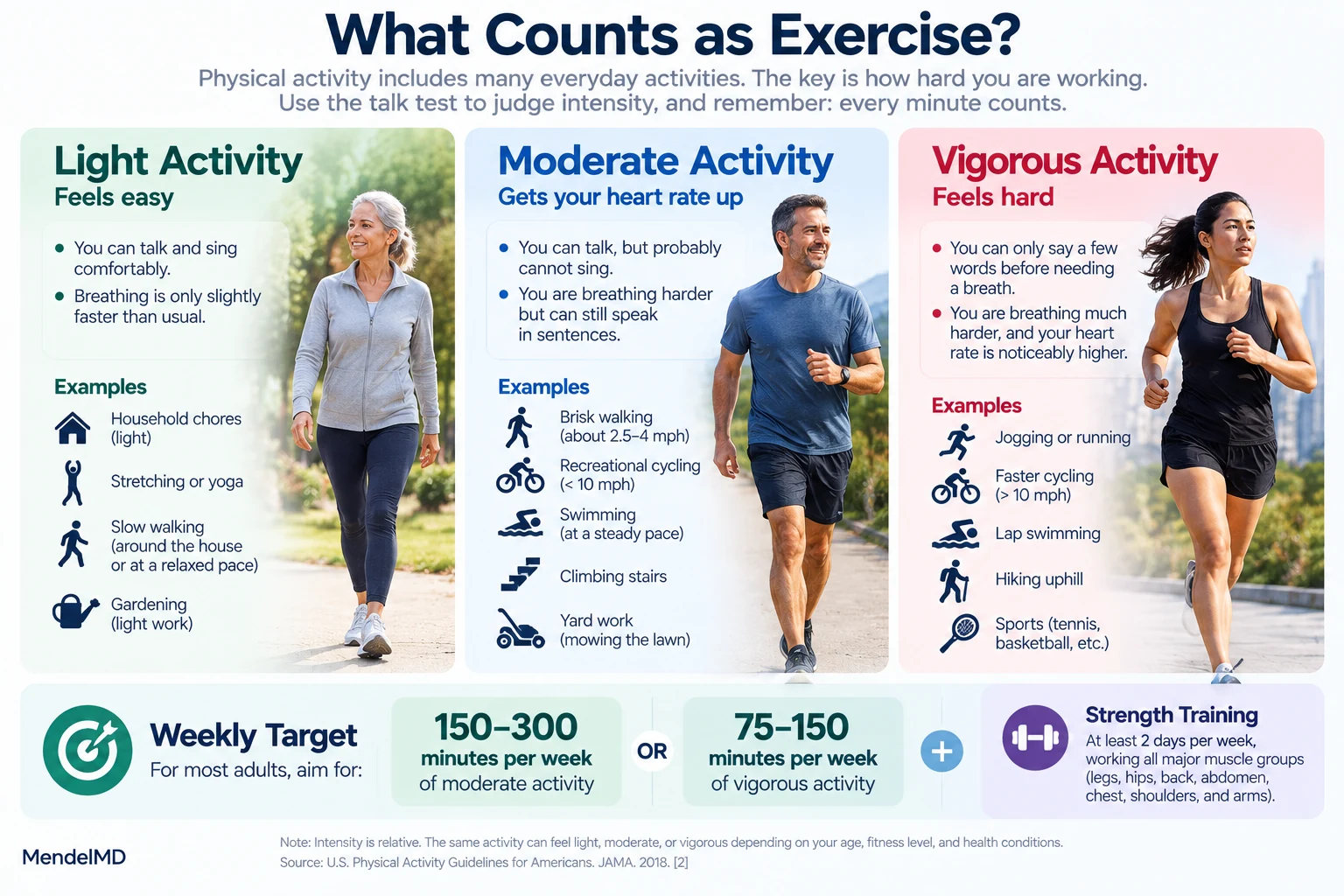
Aim for 150 to 300 minutes a week of moderate activity, or 75 to 150 minutes of vigorous activity, or a mix, plus muscle-strengthening on at least two days [2].
-
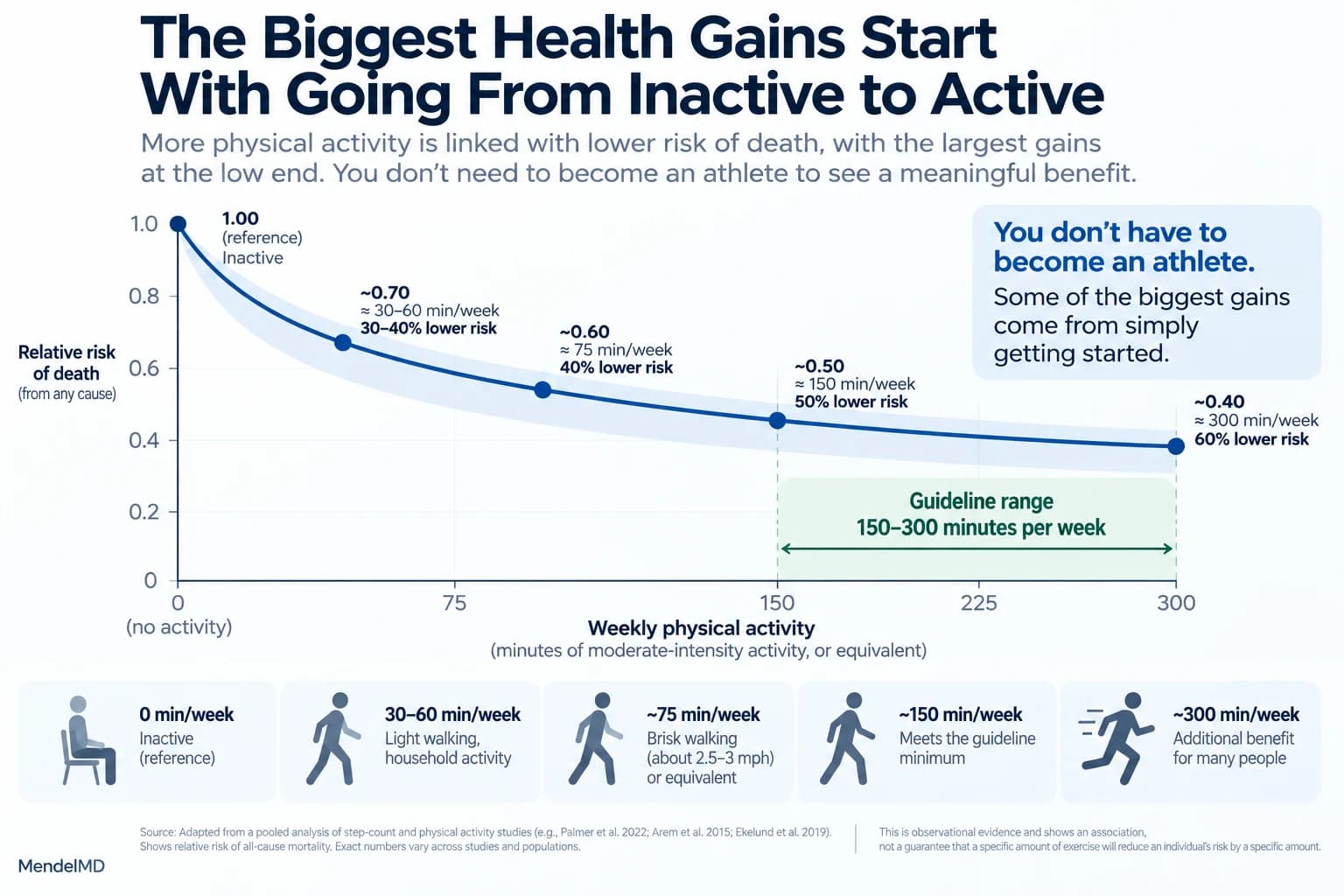
Every bout counts, including a ten-minute walk, and the biggest gains come from moving from no activity to some activity.
-
Activity is the habit; fitness is the result. Both are linked with longer life, and fitness improves within weeks of regular training.
Why Physical Activity Matters for Your Heart, Metabolism, and Longevity
Heart and blood vessels
Exercise does not just make you better at exercising. Over time, it changes how efficiently your heart and blood vessels work—even when you are not working out.
Blood pressure is one of the clearest examples. Blood pressure is simply the force of blood pushing against the walls of your arteries. When that pressure stays too high for years, it puts extra strain on the heart and blood vessels and increases the risk of heart attack, stroke, kidney disease, and other problems. Exercise can bring that pressure down.
In a large analysis combining 270 randomized trials and more than 15,000 people, regular aerobic exercise—things like brisk walking, jogging, swimming, or cycling—lowered blood pressure by about 4.5/2.5 mm Hg on average. Resistance training, such as lifting weights, produced a similar reduction of about 4.6/3.0 mm Hg.[4] Those numbers can look small. But blood pressure is acting on your arteries 24 hours a day, for decades. Lowering it by even a few points and keeping it there can matter over the long run.
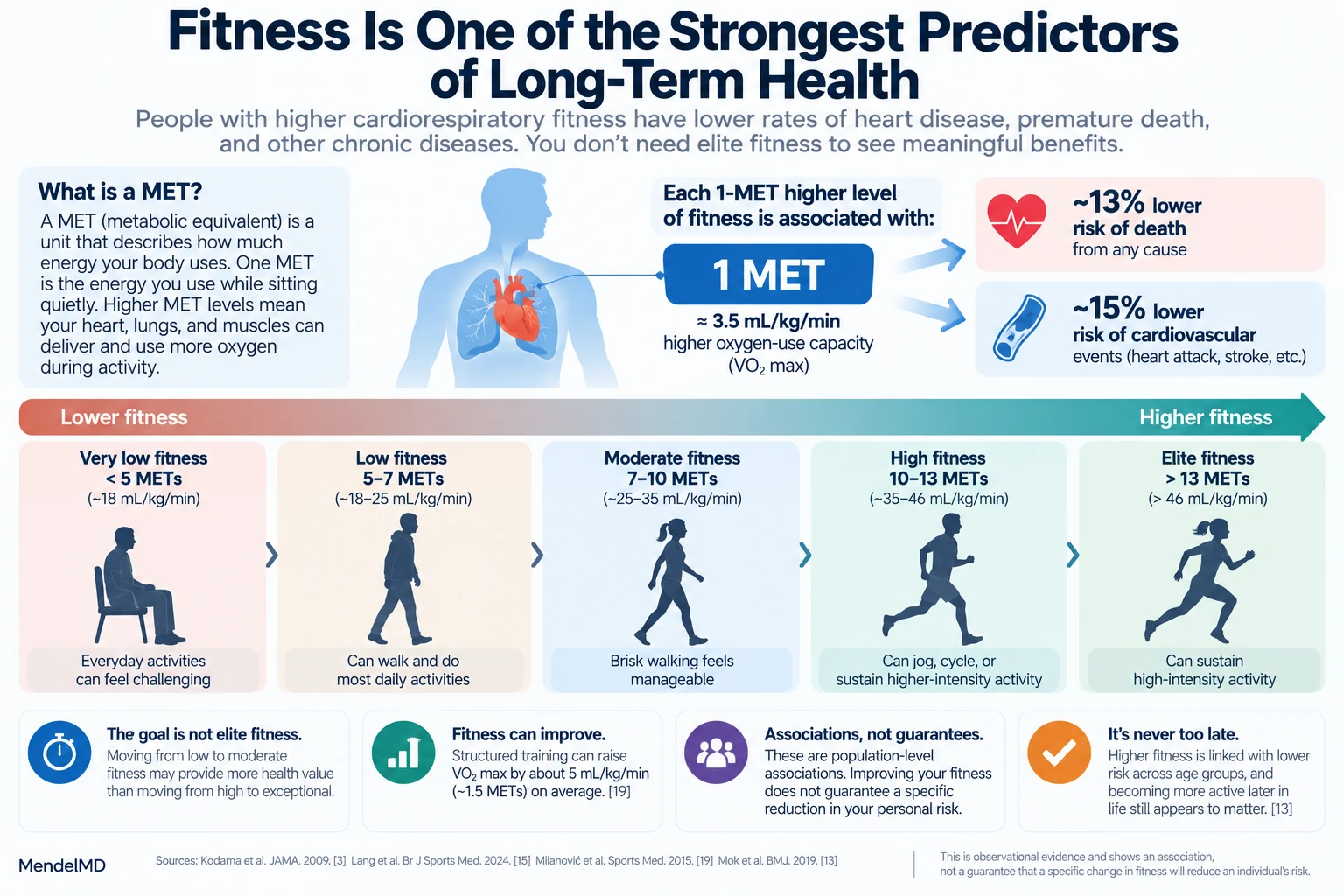
Exercise also improves cardiorespiratory fitness, which is essentially how well your heart, lungs, blood, and muscles work together to supply your body with oxygen during activity. Think of it as the capacity of your cardiovascular engine. Researchers often measure that capacity in METs. One MET is roughly the amount of energy your body uses while sitting quietly; higher MET capacity means your body can handle more demanding activity.
Across 33 studies involving more than 84,000 people, every 1-MET higher level of fitness was associated with about a 15% lower risk of coronary and cardiovascular events, such as heart attacks.[3] That does not mean increasing your fitness by exactly one MET guarantees that your personal risk will fall by exactly 15%. These studies observed differences between groups of people rather than randomly assigning people to different fitness levels. But the overall message is remarkably consistent: being able to do more physically is strongly linked with better cardiovascular health.
Blood sugar and metabolism
Exercise also changes how your body handles the energy in the food you eat. When you eat carbohydrates, your body breaks many of them down into glucose, a form of sugar that circulates in your blood and provides energy to your cells. A hormone called insulin helps move that glucose out of the bloodstream and into cells where it can be used or stored.
Your muscles are one of the biggest places that glucose can go. When muscles contract during exercise, they take up more glucose. With regular exercise, they also become more sensitive to insulin, meaning your body can control blood sugar more effectively. We can actually measure this effect.
One common blood test, called HbA1c, estimates your average blood sugar over roughly the previous two to three months. In 47 randomized trials involving people with type 2 diabetes, structured exercise lowered HbA1c by an average of 0.67 percentage points. Programs involving more than 150 minutes of exercise per week lowered it by about 0.89 percentage points on average.[6] To put that in ordinary numbers, someone starting with an HbA1c of 8.0% who experienced a 0.9-point reduction would end up around 7.1%. Individual results vary, but that gives a sense of the size of the change.
Exercise may be even more important before diabetes develops. The landmark Diabetes Prevention Program studied more than 3,200 adults with prediabetes—blood sugar that is higher than normal but not yet high enough to meet the definition of diabetes. Participants in an intensive lifestyle program aimed for at least 150 minutes of physical activity per week and about 7% weight loss.
Over the next 2.8 years, they developed diabetes 58% less often than participants assigned to placebo.[7] So exercise is not simply a way to burn off calories after you eat them. It can actually change how effectively your body handles and uses that energy in the first place.
Cancer
Exercise cannot make you cancer-proof. But regular physical activity is one of the lifestyle factors most consistently linked with a lower risk of developing several types of cancer.
The evidence comes from very large studies. In one analysis that followed 1.44 million adults, people who were more physically active during their free time had a lower risk of 13 of the 26 types of cancer studied. The associations included about a 16% lower risk of colon cancer, 21% lower risk of endometrial cancer (cancer of the lining of the uterus), and 10% lower risk of breast cancer among more-active adults.[8]
The National Cancer Institute has reviewed the broader evidence and considers it strongest for several cancers, including bladder, breast, colon, endometrial, kidney, and stomach cancers, as well as adenocarcinoma of the esophagus, a type of cancer that develops in the lower part of the swallowing tube connecting the mouth to the stomach. Across these cancers, the most physically active people generally have about a 12–21% lower risk than the least active.[9]
Why might moving your body affect cancer risk at all? There probably is not one explanation. Regular exercise can reduce excess body fat, improve how the body responds to insulin, affect levels of certain hormones, and influence inflammation and immune function. All of these may affect the environment in which some cancers develop.
There is also an interesting exception worth mentioning. In the 1.44-million-person study, more-active people had a higher rate of melanoma, a form of skin cancer.[8] One likely explanation is not exercise itself, but that active people may spend more time outdoors and therefore receive more ultraviolet exposure from the sun. Exercise does not replace sun protection. There is an important limitation to all of these numbers. We do not have enormous randomized trials in which people are assigned to exercise or not exercise and then followed for decades to see who develops cancer. Most of the evidence comes from observational studies, meaning researchers observe what happens to people with different activity levels. These studies can find strong associations, but they cannot prove that exercise alone caused the difference.[9]
That said, regular physical activity is consistently associated with a lower risk of several important cancers. It is one of the modifiable pieces of cancer risk you can actually do something about.
Brain health and dementia
Your brain benefits from many of the same things that protect your heart.
Regular exercise can improve blood pressure and blood-sugar control, and it can help with sleep, mood, cardiovascular fitness, and overall physical function. All of these become increasingly important as the brain ages. This has led to an obvious question: Can exercise actually prevent dementia?
The evidence is promising, but the answer is not yet that simple. The 2024 Lancet Commission identified physical inactivity as one of 14 potentially modifiable risk factors for dementia.[10] “Modifiable” simply means it is something we may be able to change, unlike factors such as our age or the genes we were born with.
Taken together, the Commission estimated that addressing all 14 of these risk factors—including things such as high blood pressure, hearing loss, smoking, diabetes, social isolation, and physical inactivity—could potentially prevent or delay about 45% of dementia cases worldwide.[10]
That number needs to be interpreted carefully. It does not mean exercise by itself prevents 45% of dementia. Physical inactivity is only one part of a much larger group of risk factors, and these estimates come primarily from population-level observational evidence.
When researchers have looked specifically at randomized trials—the kind of studies better suited to determining whether an intervention actually causes an outcome—the evidence is less certain. A National Academies review described the evidence that increasing physical activity can delay or slow age-related cognitive decline as “encouraging but inconclusive.”[11]
That distinction matters. We have good reasons to exercise for brain health. Exercise improves several cardiovascular and metabolic problems that are themselves connected with dementia, and being physically active helps preserve mobility and independence as we age.
Strength, balance, and independence
Living longer matters. But so does being able to keep doing things for yourself as you get older. That is where strength and balance become especially important.
Aerobic exercise—such as brisk walking, cycling, or swimming—primarily trains your ability to sustain activity. Strength training asks your muscles to work against resistance, whether that comes from weights, resistance bands, machines, or your own body weight. Those muscles become increasingly valuable with age. They are what allow you to get out of a chair without using your arms, carry groceries, climb stairs, pick something up from the floor, and catch yourself when you stumble.
And you do not necessarily need hours in the gym. In large observational studies, doing about 30–60 minutes of muscle-strengthening activity per week was associated with roughly a 10–20% lower risk of premature death, cardiovascular disease, and cancer. People who combined strength training with aerobic activity generally had lower risk than people who did neither.[5] Those studies cannot prove that strength training alone caused the difference. But randomized trials give us much stronger evidence for another benefit of exercise: preventing falls.
Across 108 randomized trials involving more than 23,000 older adults, exercise programs reduced the overall rate of falls by 23% and reduced the number of people who experienced at least one fall by 15%.[12] Programs that specifically trained balance and everyday functional movements were particularly effective. That matters because a fall at 75 is very different from a fall at 25. Falls can lead to fractures, hospitalization, loss of mobility, and sometimes a permanent loss of independence.
It is also why walking alone is not a complete exercise program. Walking is excellent for your heart and overall activity level, but it does not fully replace strength or balance training. The goal of exercise as you age is not simply to stay alive. It is to preserve enough strength, balance, and physical reserve to keep living independently.
Exercise and longevity
Eventually, all of these individual benefits lead to the biggest question: Do people who exercise actually live longer? The evidence strongly suggests that they do. Putting an exact number of extra years on any one person’s life is much harder.
One particularly useful study followed 14,599 adults in the United Kingdom, ages 40 to 79, and looked at what happened when their activity levels changed over time. People who became more active had lower mortality regardless of how active they were when the study began. Moving from being inactive toward the recommended amount of exercise over about five years was associated with a 24% lower risk of dying from any cause.[13]
That is an important finding because it suggests you have not necessarily “missed your chance” if you have spent years being inactive. Becoming more active later still appears to matter.
Step-count studies tell a similar—and very practical—story. In an analysis of 47,471 adults who actually wore step counters, the risk of death decreased as people accumulated more daily steps. Among adults 60 and older, the association appeared to level off around 6,000–8,000 steps per day. Among younger adults, it was closer to 8,000–10,000 steps.[14]
In other words, there is nothing magical about 10,000 steps. If you currently average 2,500 steps a day, moving toward 4,000 or 5,000 may be much more important than worrying about whether you can reach 10,000. Much of the apparent benefit occurs as people move out of the least-active group.
Fitness tells an equally interesting story.
Researchers measure cardiorespiratory fitness—how well your heart, lungs, blood, and muscles work together during exercise—in units called METs. One MET is roughly the amount of energy your body uses at rest; being able to reach higher MET levels during exercise reflects greater physical capacity. In one major analysis, every 1-MET higher level of fitness was associated with about a 13% lower risk of death from any cause.[3] A much larger review of 199 studies found a similar relationship, with each additional MET of fitness associated with roughly 11–17% lower mortality, although the certainty of the evidence ranged from very low to moderate.[15]
Those percentages should not be treated like a calculator. Improving your fitness by one MET does not guarantee that your personal risk of dying will fall by exactly 13%. These are observational studies: researchers measured people’s fitness and followed what happened to them rather than randomly assigning people to different fitness levels. And that brings up an important problem with studying exercise and lifespan.
To truly prove that exercise makes people live longer, researchers would ideally randomize thousands of people to different exercise programs and follow them for many years. That is extraordinarily difficult to do.
One study came remarkably close. The Generation 100 trial randomized 1,567 adults ages 70–77 to five years of supervised exercise or to a comparison group that was encouraged to follow Norway’s national physical-activity recommendations. After five years, mortality was 4.5% in the supervised-exercise groups and 4.7% in the comparison group—essentially no meaningful difference. The group assigned to high-intensity interval training had a lower mortality rate of 3.0%, but that difference was not definitive.[16]
At first glance, that might sound disappointing. But there is a catch: the comparison group was not told to sit on the couch. They were encouraged to exercise too. The trial was therefore comparing different approaches to being active rather than exercise versus no exercise, making a mortality difference much harder to detect. So the longevity evidence needs some humility. We cannot tell someone that exercising a certain number of minutes will add a certain number of years to their life.
Where Do You Stand?
Add up your minutes of moderate or vigorous activity in a typical week, counting each vigorous minute as two [17].
| Weekly moderate-or-vigorous minutes | Life's Essential 8 points | Where that puts you |
|---|---|---|
| 150 or more | 100 | Meeting the aerobic guideline |
| 120 to 149 | 90 | Almost there |
| 90 to 119 | 80 | Partway |
| 60 to 89 | 60 | Partway |
| 30 to 59 | 40 | Some activity |
| 1 to 29 | 20 | A start |
| 0 | 0 | Inactive |
To judge intensity, use the talk test [18]:
-
Moderate: you can talk, but not sing. Brisk walking at about 2.5 mph or faster counts for most people.
-
Vigorous: you cannot say more than a few words without pausing for breath, as when jogging or cycling faster than 10 mph.
-
Count the days you do muscle-strengthening work that covers the major muscle groups. The goal is two or more [2].
-
If you use a step counter, note your daily average. It is a useful second gauge, not a replacement for minutes.
How Life's Essential 8 Scores Physical Activity
Life's Essential 8 is the American Heart Association's measure of cardiovascular health. It scores eight factors from 0 to 100, and physical activity is one of them, based on the self-reported weekly minutes in the table above. An overall score of 80 to 100 counts as high cardiovascular health, 50 to 79 as moderate, and below 50 as low [17]. The score measures behavior, not fitness, and it does not count strength training, so treat it as one part of the picture. Points rise steeply at the low end: going from 0 to 30 minutes a week earns 40 points.
You can calculate all eight components with the free Life’s Essential 8 calculator.
What Should You Aim For?
-
Good: 150 minutes a week of moderate activity (or 75 vigorous) plus strength training on two days. This is the guideline minimum [2].
-
Better: Work toward 300 minutes of moderate activity (or 150 vigorous). The guidelines note additional benefits above the minimum [2].
-
Ideal: The "better" level, plus balance training if you are older, less sitting through the day, and fitness that holds or improves year to year [2].
-
Talk with your clinician if: you have heart or lung disease, chest discomfort or unusual breathlessness with effort, or a condition that limits how you can move. Your targets and starting point may need adjusting.
How to Improve Your Activity and Fitness
The steps are ordered by how much health benefit they are likely to add for a typical person, starting from the least active.
1. Get Out of the Least-Active Group
What to do. If you do little or nothing now, start with short walks, such as ten minutes on most days. Bouts of any length count; the 2018 guidelines dropped the old 10-minute minimum [2].
Why it works. The benefit curve is steepest at the bottom. The least active people gain the most from modest increases [2].
Expected benefit. In the step-counter cohorts, people in the second-lowest quarter of daily steps had a 40% lower risk of death than those in the lowest quarter (hazard ratio 0.60), the largest jump of any step up [14]. This is observational, so treat it as the size of the association, not a promise.
Common mistake. Waiting until you can do a "real workout." A walk you will repeat beats a hard session you will not.
2. Build to 150 Minutes of Aerobic Activity
What to do. Add five minutes to your walks every week or two until you reach 150 minutes of moderate activity a week, in whatever mix of days suits you [2].
Why it works. Sustained aerobic work trains the heart to pump more blood per beat, helps blood vessels relax, and improves how muscles use glucose.
Expected benefit. Aerobic training lowers blood pressure by about 4.5/2.5 mm Hg on average [4], and in type 2 diabetes, structured programs over 150 minutes a week lowered HbA1c by 0.89 percentage points [6].
Common mistake. Jumping straight from nothing to long or hard sessions. Increase gradually so your joints and tendons keep pace with your heart and lungs.
3. Strength Train Twice a Week
What to do. Work the major muscle groups (legs, hips, back, abdomen, chest, shoulders, arms) on at least two days a week [2]. Bodyweight moves, bands, and machines all work.
Why it works. Muscle preserves strength, function, and the body's ability to store glucose, none of which aerobic exercise fully replaces.
Expected benefit. In cohort studies, 30 to 60 minutes a week of muscle-strengthening was associated with 10% to 20% lower risk of death, cardiovascular disease, and cancer [5]. In trials, resistance training lowered blood pressure by about 4.6/3.0 mm Hg [4].
Common mistake. Assuming more is always better. In the cohort data the association was J-shaped, with the largest reduction at 30 to 60 minutes a week [5].
4. Add Some Harder Work to Raise Fitness
What to do. Once you are comfortable at a moderate level, add one session a week with short intervals of hard effort separated by easy recovery.
Why it works. Harder efforts push the heart and muscles closer to their limits, which drives fitness up.
Expected benefit. In controlled trials, high-intensity intervals raised VO₂ max by 5.5 mL/kg/min and continuous endurance training by 4.9 mL/kg/min, compared with no exercise [19]. That is roughly 1.5 METs. In cohort studies, each 1-MET higher level of fitness is associated with 13% lower all-cause mortality [3].
Common mistake. Making every session hard. Most of your weekly minutes should feel moderate.
5. Train Balance and Sit Less
What to do. If you are older or have fallen before, add balance and functional exercises (standing on one leg, sit-to-stand, heel-to-toe walking) or tai chi. Everyone benefits from breaking up long periods of sitting [2].
Why it works. Balance is a trainable skill, and falls are a leading threat to independence later in life.
Expected benefit. Exercise programs reduced the rate of falls by 23%, with balance and functional training the most effective. Walking alone has not been shown to prevent falls [12].
Common mistake. Relying on walking to protect against falls. It helps your heart, but balance needs its own practice.
Zone 2, VO₂ Max, and Wearables
"Zone 2" is a popular name for steady, moderate effort, the kind where you can still talk in full sentences. It is useful, but it is not uniquely powerful and you do not need to organize training around it. VO₂ max is the most direct measure of cardiorespiratory fitness. A laboratory exercise test measures it; watches estimate it from heart rate and other data. Use a watch's number to follow your trend over months, not as a diagnosis.
If you want to estimate or track fitness, use the VO₂ max calculator and age chart, compare field-test options, or read how to interpret a wearable VO₂ max estimate.
How Much Difference Can Exercise Make?
| Change | Approximate effect | Type of evidence |
|---|---|---|
| Aerobic training | Blood pressure 4.5/2.5 mm Hg lower | Meta-analysis of randomized trials [4] |
| Isometric training | Blood pressure 8.2/4.0 mm Hg lower | Meta-analysis of randomized trials [4] |
| Structured exercise in type 2 diabetes | HbA1c 0.67 points lower (0.89 with more than 150 minutes a week) | Meta-analysis of randomized trials [6] |
| Activity plus 7% weight loss in prediabetes | 58% fewer new cases of diabetes over 2.8 years | Randomized trial [7] |
| Balance and functional exercise in older adults | 23% fewer falls | Meta-analysis of randomized trials [12] |
| Interval or endurance training | VO₂ max 5.5 or 4.9 mL/kg/min higher | Meta-analysis of controlled trials [19] |
| Each 1-MET higher fitness | 13% lower all-cause mortality | Meta-analysis of cohort studies [3] |
| 30 to 60 minutes a week of strength training | 10% to 20% lower mortality | Meta-analysis of cohort studies [5] |
| High versus low leisure-time activity | Lower risk of 13 of 26 cancer types | Pooled cohort studies [8] |
Three cautions. First, the trial rows describe what exercise changes, such as blood pressure, blood sugar, falls, and fitness; the rows on death and cancer are associations from cohort studies and cannot prove that exercise alone caused the difference. Second, the percentages are relative reductions, so your absolute benefit depends on your starting risk. Third, these are averages, and people who start least active and least fit usually gain the most.
A Simple Plan to Start This Week
-
Today: Estimate your weekly moderate-or-vigorous minutes using the talk test, and take a ten-minute walk.
-
This week: Put three to five walks and two short strength sessions on your calendar. Chairs, walls, and resistance bands are enough.
-
This month: Add about five minutes per walk every week or two, and choose one aerobic activity you enjoy enough to keep doing.
-
Track: Weekly minutes, strength days, and, if you like numbers, average daily steps or a wearable fitness estimate taken under similar conditions.
When to Talk With Your Doctor About Exercise
Most people can start with walking. Stop and get prompt medical attention if you have chest pain, pressure, or tightness with exertion, fainting or near-fainting, or shortness of breath that is severe or out of proportion to the effort. Talk with your clinician before increasing your activity if you have:
-
Known heart disease, heart failure, or lung disease
-
New palpitations, especially with dizziness or breathlessness
-
Blood pressure that is not controlled
-
Diabetes with complications such as neuropathy or eye disease
-
Joint, back, or mobility problems that limit how you can move
-
Plans for very vigorous training or maximal testing when you have risk factors or symptoms
Frequently Asked Questions
Does walking count as exercise?
Yes. Brisk walking at about 2.5 mph or faster is moderate-intensity activity for most adults [18], and every minute counts toward the weekly target.
Do I need 10,000 steps a day?
No. In pooled step-counter studies, the risk of death stopped falling at about 6,000 to 8,000 steps a day for people 60 and older and 8,000 to 10,000 for younger adults [14]. Benefit starts well below those levels.
Do short bouts of activity count?
Yes. The 2018 guidelines removed the requirement that activity come in bouts of at least ten minutes; total weekly volume is what matters [2].
Is vigorous exercise better than moderate?
Minute for minute, vigorous activity counts about twice as much toward the guidelines [2][17]. Both work. Moderate activity is easier to sustain for many people, and a mix is fine.
How quickly will I see results?
Some benefits, such as a lower blood pressure reading, can appear on the day you exercise [2]. Fitness gains build over weeks of consistent training; in controlled trials, VO₂ max rose by about 5 mL/kg/min with regular training [19].
Am I too old to benefit?
No. In the UK cohort of adults aged 40 to 79, becoming more active was linked with lower mortality regardless of starting level [13], and exercise programs reduce falls in older adults [12].
How accurate is my watch's VO₂ max?
A watch estimates VO₂ max rather than measuring it, so a single value can be off. Compare readings taken under similar conditions over months and focus on the direction of the trend.
Can exercise prevent dementia?
Not proven. Inactivity is a recognized risk factor [10], but the trial evidence that exercise slows cognitive decline is "encouraging but inconclusive" [11].
The bottom line
-
Why it matters: Regular activity lowers blood pressure, improves blood sugar control, prevents falls, and is consistently linked with longer life and lower risk of heart disease and several cancers.
-
The target: 150 to 300 minutes a week of moderate activity, or 75 to 150 vigorous, plus strength training on two or more days.
-
What to do next: If you are starting from little, walk ten minutes today and build from there. If you already meet the minimum, add strength, some harder intervals, and balance work.
References
1. Centers for Disease Control and Prevention, National Center for Health Statistics. Exercise or Physical Activity. FastStats. Reviewed April 14, 2026. cdc.gov Source.
2. Piercy KL, Troiano RP, Ballard RM, et al. The Physical Activity Guidelines for Americans. JAMA. 2018;320(19):2020-2028. doi:10.1001/jama.2018.14854 Source.
3. Kodama S, Saito K, Tanaka S, et al. Cardiorespiratory fitness as a quantitative predictor of all-cause mortality and cardiovascular events in healthy men and women: a meta-analysis. JAMA. 2009;301(19):2024-2035. doi:10.1001/jama.2009.681 Source.
4. Edwards JJ, Deenmamode AHP, Griffiths M, et al. Exercise training and resting blood pressure: a large-scale pairwise and network meta-analysis of randomised controlled trials. Br J Sports Med. 2023;57(20):1317-1326. PMID: 37491419 Source.
5. Momma H, Kawakami R, Honda T, et al. Muscle-strengthening activities are associated with lower risk and mortality in major non-communicable diseases: a systematic review and meta-analysis of cohort studies. Br J Sports Med. 2022;56(13):755-763. doi:10.1136/bjsports-2021-105061 Source.
6. Umpierre D, Ribeiro PAB, Kramer CK, et al. Physical activity advice only or structured exercise training and association with HbA1c levels in type 2 diabetes: a systematic review and meta-analysis. JAMA. 2011;305(17):1790-1799. doi:10.1001/jama.2011.576 Source.
7. Knowler WC, Barrett-Connor E, Fowler SE, et al. Reduction in the incidence of type 2 diabetes with lifestyle intervention or metformin. N Engl J Med. 2002;346(6):393-403. doi:10.1056/NEJMoa012512 Source.
8. Moore SC, Lee IM, Weiderpass E, et al. Association of leisure-time physical activity with risk of 26 types of cancer in 1.44 million adults. JAMA Intern Med. 2016;176(6):816-825. doi:10.1001/jamainternmed.2016.1548 Source.
9. National Cancer Institute. Physical Activity and Cancer. Fact sheet, reviewed February 10, 2020. cancer.gov Source.
10. Livingston G, Huntley J, Liu KY, et al. Dementia prevention, intervention, and care: 2024 report of the Lancet standing Commission. Lancet. 2024;404(10452):572-628. doi:10.1016/S0140-6736(24)01296-0 Source.
11. National Academies of Sciences, Engineering, and Medicine. Preventing Cognitive Decline and Dementia: A Way Forward. Washington, DC: The National Academies Press; 2017. doi:10.17226/24782 Source.
12. Sherrington C, Fairhall NJ, Wallbank GK, et al. Exercise for preventing falls in older people living in the community. Cochrane Database Syst Rev. 2019;1:CD012424. doi:10.1002/14651858.CD012424.pub2 Source.
13. Mok A, Khaw KT, Luben R, et al. Physical activity trajectories and mortality: population based cohort study. BMJ. 2019;365:l2323. doi:10.1136/bmj.l2323 Source.
14. Paluch AE, Bajpai S, Bassett DR, et al. Daily steps and all-cause mortality: a meta-analysis of 15 international cohorts. Lancet Public Health. 2022;7(3):e219-e228. doi:10.1016/S2468-2667(21)00302-9 Source.
15. Lang JJ, Prince SA, Merucci K, et al. Cardiorespiratory fitness is a strong and consistent predictor of morbidity and mortality among adults: an overview of meta-analyses representing over 20.9 million observations from 199 unique cohort studies. Br J Sports Med. 2024;58(10):556-566. bjsm.bmj.com Source.
16. Stensvold D, Viken H, Steinshamn SL, et al. Effect of exercise training for five years on all cause mortality in older adults: the Generation 100 study, randomised controlled trial. BMJ. 2020;371:m3485. doi:10.1136/bmj.m3485 Source.
17. Lloyd-Jones DM, Allen NB, Anderson CAM, et al. Life's Essential 8: updating and enhancing the American Heart Association's construct of cardiovascular health: a presidential advisory from the American Heart Association. Circulation. 2022;146(5):e18-e43. doi:10.1161/CIR.0000000000001078 Source.
18. Centers for Disease Control and Prevention. How to Measure Physical Activity Intensity. Reviewed December 4, 2025. cdc.gov Source.
19. Milanović Z, Sporiš G, Weston M. Effectiveness of high-intensity interval training (HIT) and continuous endurance training for VO2max improvements: a systematic review and meta-analysis of controlled trials. Sports Med. 2015;45(10):1469-1481. doi:10.1007/s40279-015-0365-0 Source.
Continue exploring
Estimate and interpret cardiorespiratory fitness.
VO2 Max Field Tests →Compare Cooper, Rockport, running, and shuttle-test protocols.
How to Improve VO2 Max →Explore the existing eight-week training guide.
Wearable VO2 Max Accuracy →Understand what watch estimates can and cannot tell you.
Preventive Cardiology →
Mendel Jacobs, MD, MPH
Menachem "Mendel" Jacobs, MD, MPH is an Internal Medicine Resident at Yale School of Medicine pursuing academic cardiology. He publishes under Menachem Jacobs.
Connect on LinkedIn