Core internal medicine · 21 cards
Hypertension
Read a question. Commit to an answer. Then check what you recall.
Clinically edited 2026-11-20. Sources are linked on each card.
Opening flashcards…
Browse all 21 flashcards and references
01What is the correct technique and reading schedule to measure and confirm hypertension?
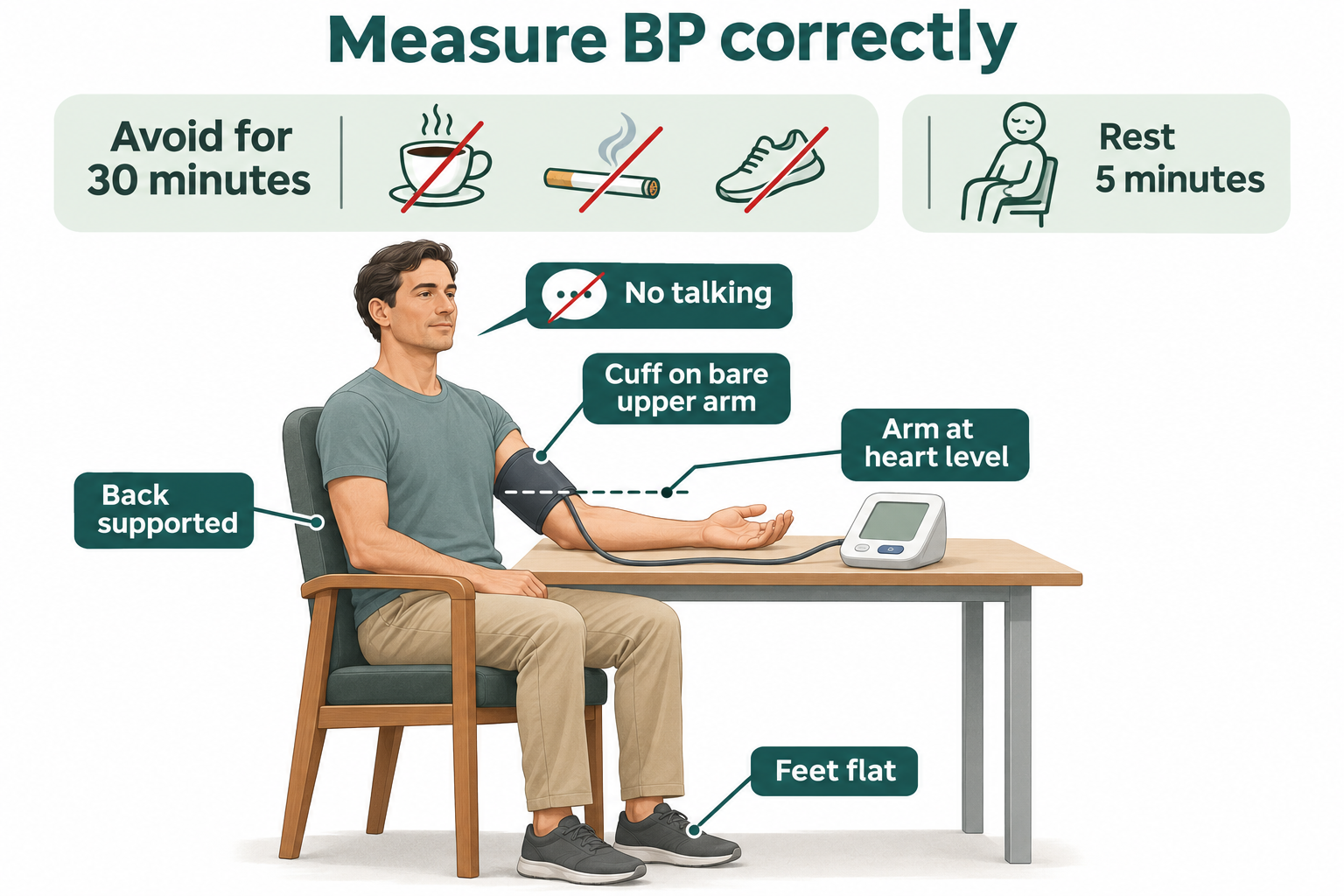
- Prepare: no caffeine, smoking or exercise for 30 minutes; empty the bladder and rest quietly for 5 minutes.
- Position: back supported, feet flat and legs uncrossed; bare upper arm supported at heart level. Use the correct cuff size and a validated upper-arm monitor. No talking.
- Office: check both arms initially, then use the higher-reading arm. Average ≥2 readings, ≥1 minute apart, on separate occasions.
- Home: 2 readings ≥1 minute apart each morning before medication/breakfast, and 2 each evening, for 7 days preferred (at least 3 days). Average the valid readings; use ABPM when needed.
02White-coat versus masked hypertension?
- White-coat: elevated in the office, normal outside it.
- Masked: normal in the office, elevated outside it.
03BP: stage 1 versus stage 2 hypertension?
- Stage 1: SBP 130–139 OR DBP 80–89 mm Hg.
- Stage 2: SBP ≥140 OR DBP ≥90 mm Hg.
04Newly diagnosed hypertension: what initial workup is recommended?
- Blood: CBC, BMP, lipid profile, A1c and TSH.
- Urine: urinalysis and urine albumin-to-creatinine ratio.
- EKG: baseline 12-lead EKG.
- History/exam: medications and substances, cardiovascular risk, target-organ disease and clues to secondary hypertension.
05Which lifestyle changes have the best evidence for lowering BP?
| Approach | Practical target | Approximate SBP reduction with hypertension |
|---|---|---|
| Weight loss | Sustained ≥5% loss when overweight or obese. | 6–8 mm Hg; roughly 1 mm Hg per kg lost |
| DASH-style diet | Fruit, vegetables, whole grains and low-fat dairy; less saturated fat. | 5–8 mm Hg |
| Less sodium | <2,300 mg/day; ideally <1,500 mg/day. | 6–8 mm Hg |
| Exercise | ≥150 minutes/week of moderate activity; resistance training ≥2 days/week. | 4–8 mm Hg for aerobic exercise |
| Less alcohol | Reduce or avoid alcohol; the reduction depends on baseline intake. | 4–6 mm Hg |
| Dietary potassium | Potassium-rich foods when appropriate; individualize for CKD or hyperkalemia risk. | About 6 mm Hg |
Approximate mean changes from the 2025 guideline, Table 12. Individual responses vary; these effects should not simply be added together.
Trials / evidence
- DASH and DASH–Sodium are foundational dietary trials. The table estimates summarize a broader evidence base, not a single trial.
06When should BP medication accompany lifestyle changes?
- SBP ≥140 OR DBP ≥90 mm Hg.
- SBP ≥130 OR DBP ≥80 mm Hg WITH CVD, prior stroke, diabetes, CKD, or 10-year PREVENT-CVD risk ≥7.5%.
Trials / evidence
- The PREVENT ≥7.5% treatment threshold is a 2025 guideline recommendation. Intensive-target trials inform the broader benefit of BP lowering; they did not directly test this exact risk cutoff.
07Stage 1 hypertension without CVD, stroke, diabetes or CKD, and PREVENT risk <7.5%: when add medication?
- If BP remains ≥130/80 mm Hg after 3–6 months of lifestyle changes.
Trials / evidence
- The 3–6-month lifestyle trial is a guideline recommendation, not a timing rule attributed to one randomized trial.
08What BP treatment targets do the major guidelines use?
- AHA/ACC 2025: generally <130/80 mm Hg; encourage SBP <120 when appropriate and tolerated.
- KDIGO 2021: SBP <120 in nondialysis CKD when tolerated, using standardized office measurements.
- ESC 2024: usually 120–129/70–79 mm Hg on treatment, if tolerated.
- ESH 2023: individualize by age and tolerance; generally avoid targeting <120/70.
- Individualize for symptomatic orthostasis, frailty and limited life expectancy.
Trials / evidence
- SPRINT: high-risk adults without diabetes or previous stroke; targeting SBP <120 versus <140 reduced cardiovascular events and mortality.
- BPROAD: adults with type 2 diabetes and elevated cardiovascular risk; the <120 target reduced major cardiovascular events.
- ACCORD BP: in type 2 diabetes, the primary cardiovascular composite was not significantly reduced, although stroke was lower. Trial populations, measurement and tolerability matter.
09First-line drugs for uncomplicated hypertension?
- Thiazide-type or thiazide-like diuretic.
- Long-acting dihydropyridine calcium-channel blocker.
- ACE inhibitor or ARB.
Trials / evidence
- ALLHAT compared chlorthalidone, amlodipine and lisinopril in older, high-risk hypertensive adults. The primary coronary outcome did not differ significantly. This is foundational class-comparison evidence, not a direct comparison of every first-line class.
10Stage 2 hypertension: what is the initial management?
- Lifestyle changes plus 2 first-line drugs from different classes, preferably in one combination pill.
- Low-dose combinations give complementary BP lowering and can avoid the dose-related adverse effects of maximizing one drug.
Trials / evidence
- ACCOMPLISH favored benazepril–amlodipine over benazepril–HCTZ in high-risk adults. It informs combination choice; it did not directly test the rule to start all stage-2 patients on two drugs.
11Amlodipine-associated ankle edema: what can help?
- Add an ACE inhibitor or ARB.
- Alternatively, reduce the amlodipine dose or switch drugs.
12Hypertension with gout: which ARB is especially useful?
- Losartan: it lowers BP and promotes urate excretion.
- Consider replacing hydrochlorothiazide when feasible.
13How can NSAIDs worsen hypertension?
- Prostaglandin inhibition reduces renal vasodilation and sodium excretion → sodium/water retention and higher BP.
- They can also blunt the effect of ACEi/ARBs and diuretics.
14What triggers renin release, and how does this raise BP?
- Low renal perfusion, reduced NaCl delivery to the macula densa, or β1-sympathetic stimulation → renin release.
- Renin activates angiotensin II and aldosterone → vasoconstriction and sodium/water retention.
15Retinal arteriolar narrowing and AV nicking suggest what?
- Chronic hypertensive retinal changes; these findings are not specific to hypertension.
16Markedly elevated BP: how do you distinguish and initially manage a hypertensive emergency?
- Emergency = acute target-organ injury. Warning symptoms include chest/back pain, dyspnea, confusion, focal deficits or visual changes; assess for cardiac, neurologic, renal or aortic injury.
- With acute injury: monitored, titratable treatment tailored to the affected organ.
- Without acute injury: confirm the reading, address contributors (pain, withdrawal, retention, missed medication or volume overload), adjust scheduled oral therapy and arrange follow-up.
- Do not reflexively give PRN IV labetalol/hydralazine for an asymptomatic number; symptoms prompt evaluation, but organ injury defines the emergency.
17Hypertensive emergency without a condition-specific target: how quickly should BP fall?
- First hour: reduce SBP by no more than 25%.
- Next 2–6 hours: if stable, lower to <160/100 mm Hg.
- Next 24–48 hours: cautiously approach SBP 130–140 mm Hg.
- Exceptions: acute aortic syndromes and stroke require their own condition-specific BP targets.
18Hypertensive emergency with acute pulmonary edema: initial treatment and beta-blocker considerations?
- Rapid afterload reduction: titrated IV nitroglycerin; selected alternatives include clevidipine or nitroprusside in a monitored setting.
- Support: noninvasive ventilation for respiratory distress/hypoxemia; a loop diuretic if volume overloaded.
- Do not start or escalate a beta-blocker for acute BP reduction during active pulmonary edema; hold/reduce it when shock or hypoperfusion requires.
- Low EF alone is not a contraindication to chronic beta-blocker therapy; reassess continuation according to stability.
19Why is nitroprusside less attractive in significant renal dysfunction?
- Thiocyanate, a metabolite, is renally cleared and can accumulate.
- Prefer alternatives when practical; if used, limit exposure and monitor for toxicity.
20Which cancer treatment can cause new or worsening hypertension, and how should you monitor it?
- VEGF inhibitors, including bevacizumab.
- Check BP during treatment; bevacizumab labeling recommends every 2–3 weeks.
- Treat the BP; withhold for severe uncontrolled hypertension and discontinue for hypertensive crisis or encephalopathy.
21Which BP medicines are used in pregnancy for maintenance versus acute severe hypertension?
- Maintenance: oral labetalol or extended-release nifedipine; methyldopa is an alternative.
- Acute severe hypertension: IV labetalol, IV hydralazine or oral immediate-release nifedipine under an obstetric protocol.
- Avoid ACE inhibitors and ARBs during pregnancy.