Core internal medicine · 22 cards
EKG fundamentals: rate and axis
Read a question. Commit to an answer. Then check what you recall.
Clinically edited 2026-11-22. Sources are linked on each card.
Opening flashcards…
Browse all 22 flashcards and references
01At 25 mm/s, how much time is one small box? One big box?
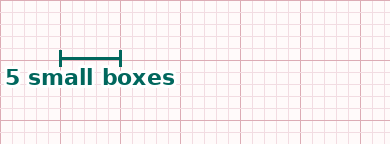
1 small box = 40 ms. 1 big box = 200 ms. A big box contains five small boxes.
02The rhythm is regular at 25 mm/s. Count the big boxes between R peaks. What is the rate?
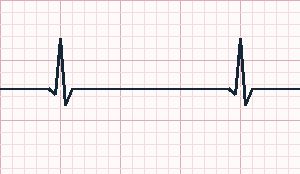
300 ÷ 3 = 100 bpm. Use the 300 rule for a regular ventricular rhythm at 25 mm/s.
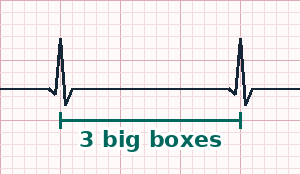
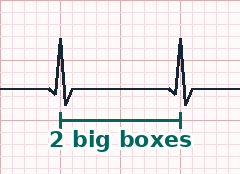
03The rhythm is regular at 25 mm/s. Count the big boxes between R peaks. What is the rate?
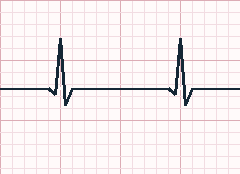
300 ÷ 2 = 150 bpm. Use the 300 rule for a regular ventricular rhythm at 25 mm/s.
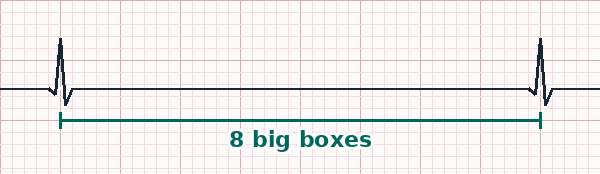
04The rhythm is regular at 25 mm/s. Count the big boxes between R peaks. What is the rate?
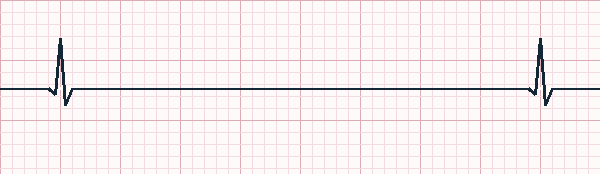
300 ÷ 8 = ≈38 bpm. Use the 300 rule for a regular ventricular rhythm at 25 mm/s.
05This strip is 10 seconds long. What is the approximate ventricular rate?

17 QRS complexes × 6 = 102 bpm. This estimates the average ventricular rate across the full 10 seconds.

06This strip is 10 seconds long. What is the approximate ventricular rate?

22 QRS complexes × 6 = 132 bpm. This estimates the average ventricular rate across the full 10 seconds.

07The machine reports a rate that seems wrong. Which waveform features can confuse QRS detection?
Very low-amplitude QRS complexes or unusually prominent T waves. Count QRS complexes manually to check the printed rate.
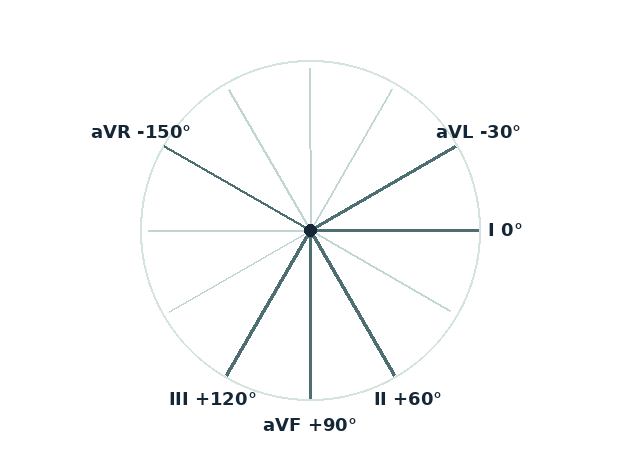
08What does the QRS axis represent? Where do lead I and aVF point?
The mean direction of ventricular depolarization projected onto the frontal plane. Lead I points leftward at 0°. aVF points inferiorly at +90°.
09Which QRS is predominantly positive, negative, and equiphasic?
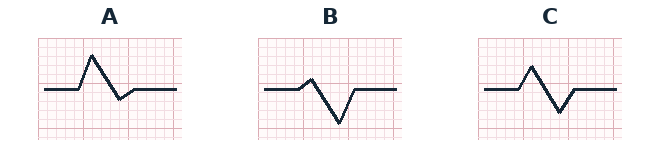
A positive. B negative. C equiphasic. Judge the balance of QRS area above versus below baseline.
10How is adult frontal QRS axis classified?
- Normal: −30° to +90°.
- Left axis deviation: below −30°, toward −90°.
- Right axis deviation: above +90°, toward +180°.
- Extreme axis: the superior quadrant between −90° and −180°.
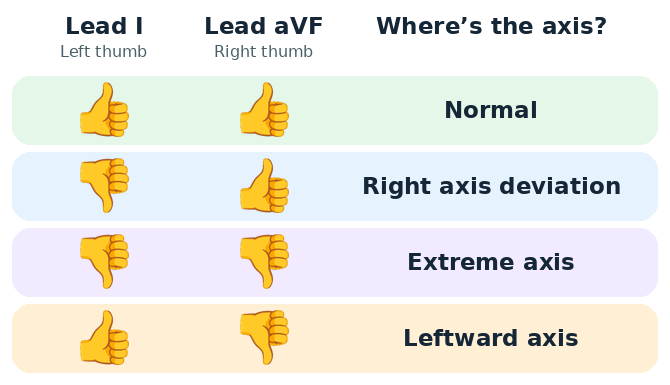
11Give each lead a thumbs-up or thumbs-down. Where does the axis land?
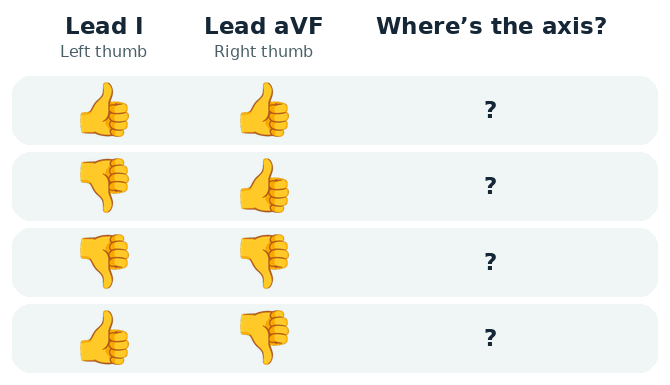
Left thumb = lead I. Right thumb = aVF. Thumbs up for net positive QRS, down for net negative. I up and aVF down means a leftward axis (−90° to 0°).
12Lead I gives a thumbs-up. aVF gives a thumbs-down. What does lead II say?
II positive: normal, between −30° and 0°.
II negative: left axis deviation, between −90° and −30°.
II equiphasic: approximately −30° given positive I.
13Use the limb-lead QRS polarities. What is the axis category?
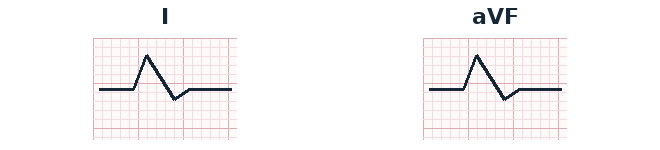
Normal, 0° to +90°.
14Use the limb-lead QRS polarities. What is the axis category?
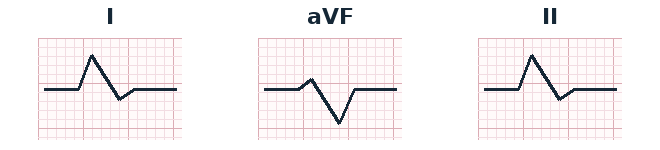
Normal, between −30° and 0°. Lead II is positive.
15Use the limb-lead QRS polarities. What is the axis category?
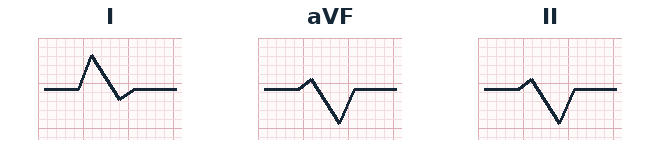
Left axis deviation, between −90° and −30°. Lead II is negative.
16Use the limb-lead QRS polarities. What is the axis category?
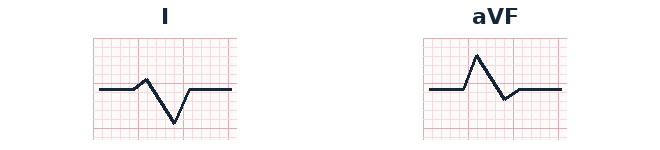
Right axis deviation, +90° to +180°.
17Use the limb-lead QRS polarities. What is the axis category?
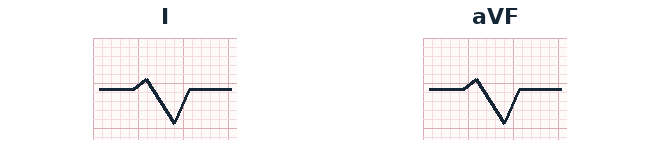
Extreme axis, −180° to −90°.
18How does the equiphasic (isoelectric) lead method estimate QRS axis?
- Find the limb lead with the most balanced positive and negative QRS deflections.
- The axis is approximately 90° perpendicular to that lead.
- Choose between the two opposite directions using another lead: toward a positive QRS, away from a negative QRS.
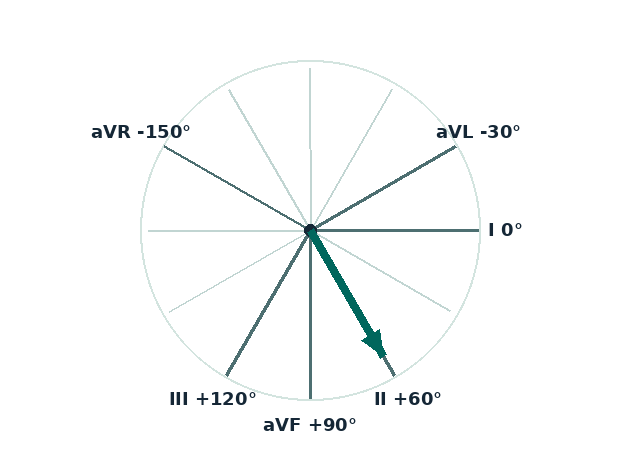
19The most equiphasic limb lead is aVL. Lead II is predominantly positive. Estimate the axis.
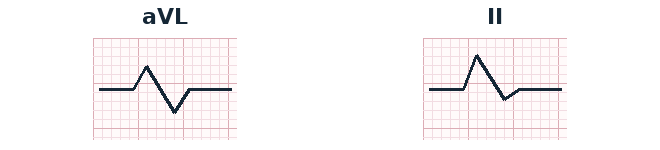
About +60°. The QRS axis is perpendicular to aVL (−30°). Lead II points at +60° and is positive, so choose its positive direction.
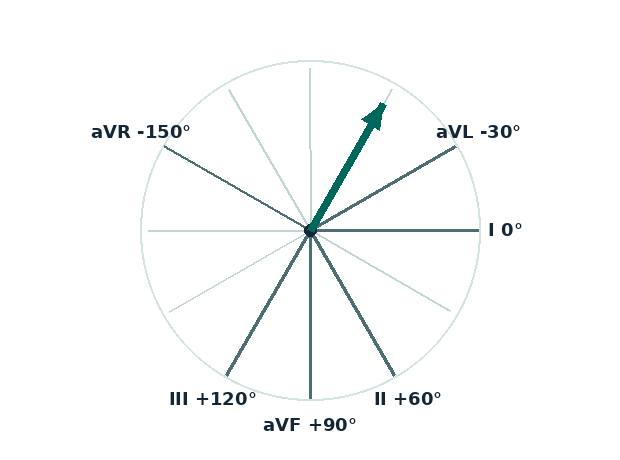
20The most equiphasic limb lead is aVR. Lead III is predominantly negative. Estimate the axis.
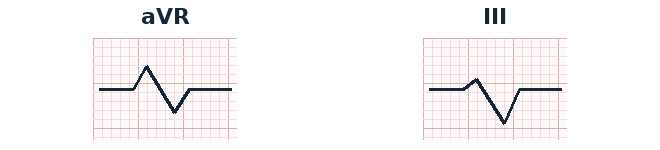
About −60°. Lead III (+120°) is perpendicular to aVR. The negative QRS in III points you 180° away from +120°.
21No limb lead is exactly equiphasic. Lead II is slightly positive, aVF clearly negative, and aVL positive. Where is the axis?
Between −30° and 0°, near −30°. Slightly positive lead II favors the normal side of −30°; negative aVF keeps the axis above the horizontal. The lecture’s example was −22°—the exact number is not determined by these qualitative polarities alone.
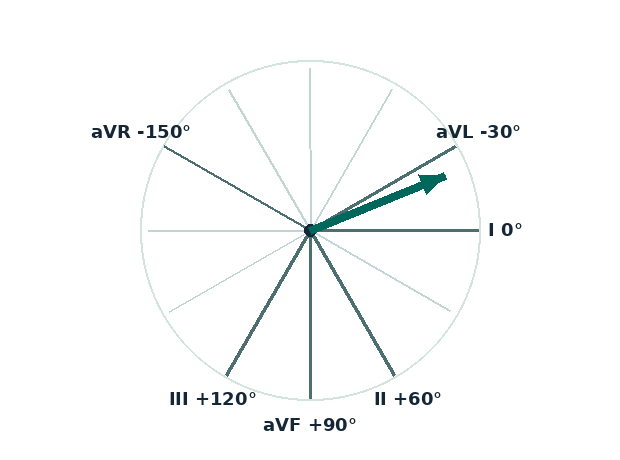
22All six limb leads appear nearly equiphasic. What can you conclude about the frontal axis?
Indeterminate frontal QRS axis. There is no reliable net polarity to choose a direction. A measurable extreme axis has predominantly negative QRS complexes in both I and aVF.