Core internal medicine · 14 cards
Acute kidney injury
Read a question. Commit to an answer. Then check what you recall.
Clinically edited 2026-11-05. Sources are linked on each card.
Opening flashcards…
Browse all 14 flashcards and references
01What defines AKI in adults?
Any one: creatinine rises ≥0.3 mg/dL within 48 hours; rises to ≥1.5× baseline within 7 days; or urine output is <0.5 mL/kg/h for ≥6 hours.
02Adult AKI: creatinine criteria for stages 1, 2, and 3?
1: 1.5–1.9× baseline or rise ≥0.3 mg/dL within 48 hours.
2: 2.0–2.9× baseline.
3: ≥3× baseline, an acute rise to ≥4.0 mg/dL, or initiation of kidney replacement therapy.
For the ≥4.0 criterion, the rise must meet the creatinine-based AKI definition: ≥0.3 mg/dL within 48 hours or ≥1.5× baseline within 7 days.
2: 2.0–2.9× baseline.
3: ≥3× baseline, an acute rise to ≥4.0 mg/dL, or initiation of kidney replacement therapy.
For the ≥4.0 criterion, the rise must meet the creatinine-based AKI definition: ≥0.3 mg/dL within 48 hours or ≥1.5× baseline within 7 days.
03Adult AKI: urine-output criteria for stages 1, 2, and 3?
1: <0.5 mL/kg/h for 6–<12 hours.
2: <0.5 for ≥12 hours.
3: <0.3 for ≥24 hours or anuria ≥12 hours.
Use the higher creatinine or urine-output stage.
2: <0.5 for ≥12 hours.
3: <0.3 for ≥24 hours or anuria ≥12 hours.
Use the higher creatinine or urine-output stage.
04New AKI: what should you assess first?
Baseline/trend in creatinine and urine output; perfusion and congestion; medications; electrolytes; urinalysis with sediment; and possible obstruction with PVR +- renal US
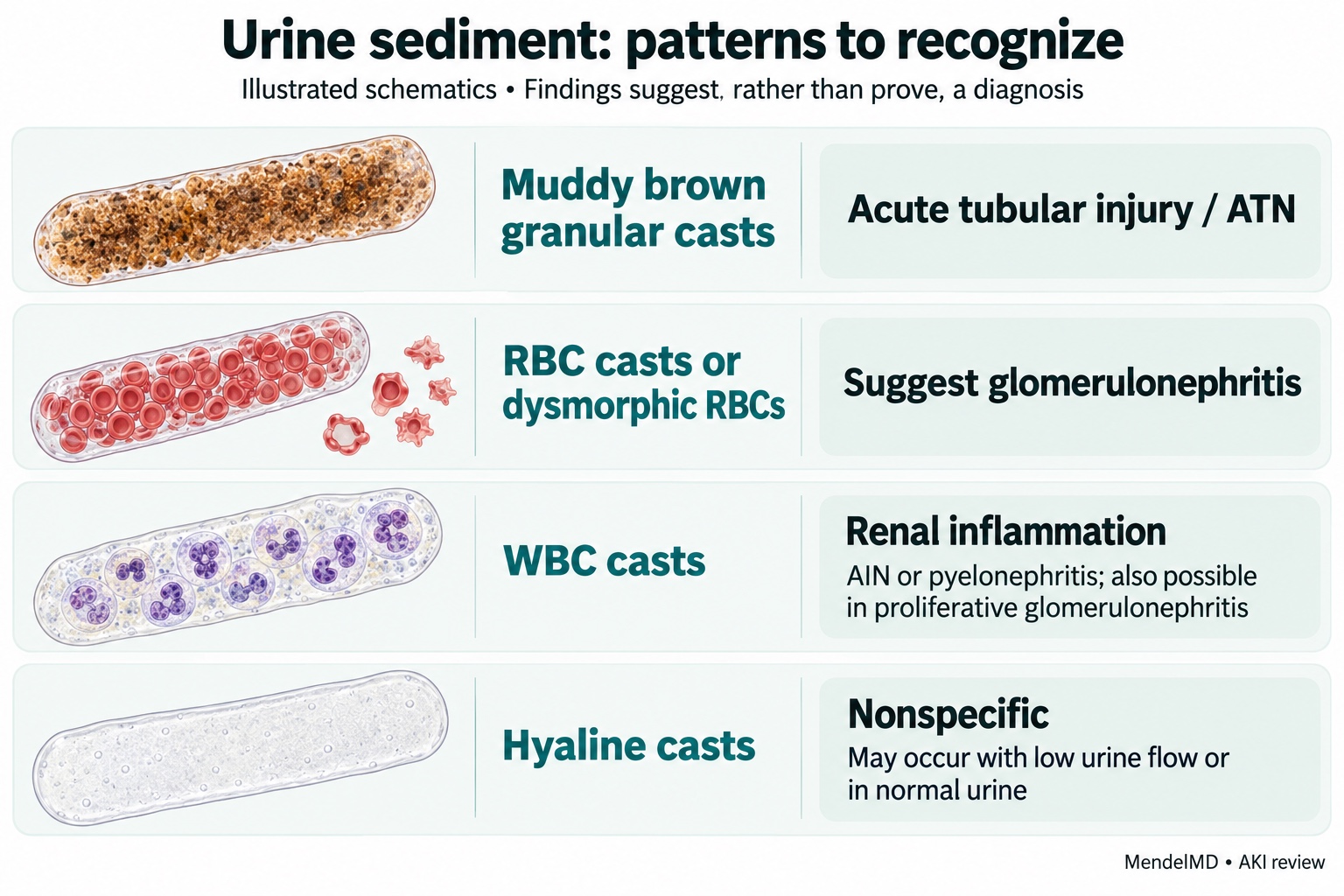
05Which sediment findings suggest tubular injury, glomerular disease, or kidney inflammation?
Muddy brown granular casts → acute tubular injury.
RBC casts or dysmorphic RBCs → glomerular disease.
WBC casts → kidney inflammation; not specific for AIN.
RBC casts or dysmorphic RBCs → glomerular disease.
WBC casts → kidney inflammation; not specific for AIN.
06Do FeNa <1% or FeUrea <35% prove prerenal AKI?
No. Tubular injury can occur with FeNa <1%. CKD and diuretics reduce FeNa reliability; diuretics can also alter FeUrea. Use the clinical picture and sediment.
07AKI: fluids or diuresis?
Hypovolemia → isotonic crystalloid, then reassess.
Congestion → decongest. A small creatinine rise alone is not a reason to stop effective diuresis.
Congestion → decongest. A small creatinine rise alone is not a reason to stop effective diuresis.
08Does ongoing urine output exclude obstruction—and when should you image?
No; partial obstruction can preserve urine output. Check for retention and obtain urinary-tract ultrasound when obstruction is possible or the AKI cause is unclear.
09Unexplained AKI: which common medications should raise suspicion for AIN?
Antibiotics, PPIs, and NSAIDs. Review the medication timeline and stop the suspected culprit when feasible.
10Why is the reported eGFR unreliable during evolving AKI?
Creatinine-based equations assume steady state. During a rapid rise, creatinine lags behind the fall in filtration.
11AKI + a heme-positive urine dipstick but few or no RBCs: think what?
Pigmenturia: myoglobin from rhabdomyolysis or hemoglobin from hemolysis. Check CK when rhabdomyolysis is suspected.
12Rhabdomyolysis: how do you reduce AKI risk?
Give isotonic crystalloid, titrated to perfusion, urine output, and congestion. Avoid fluid overload. Bicarbonate and mannitol have no proven benefit for AKI prevention and are not routine.
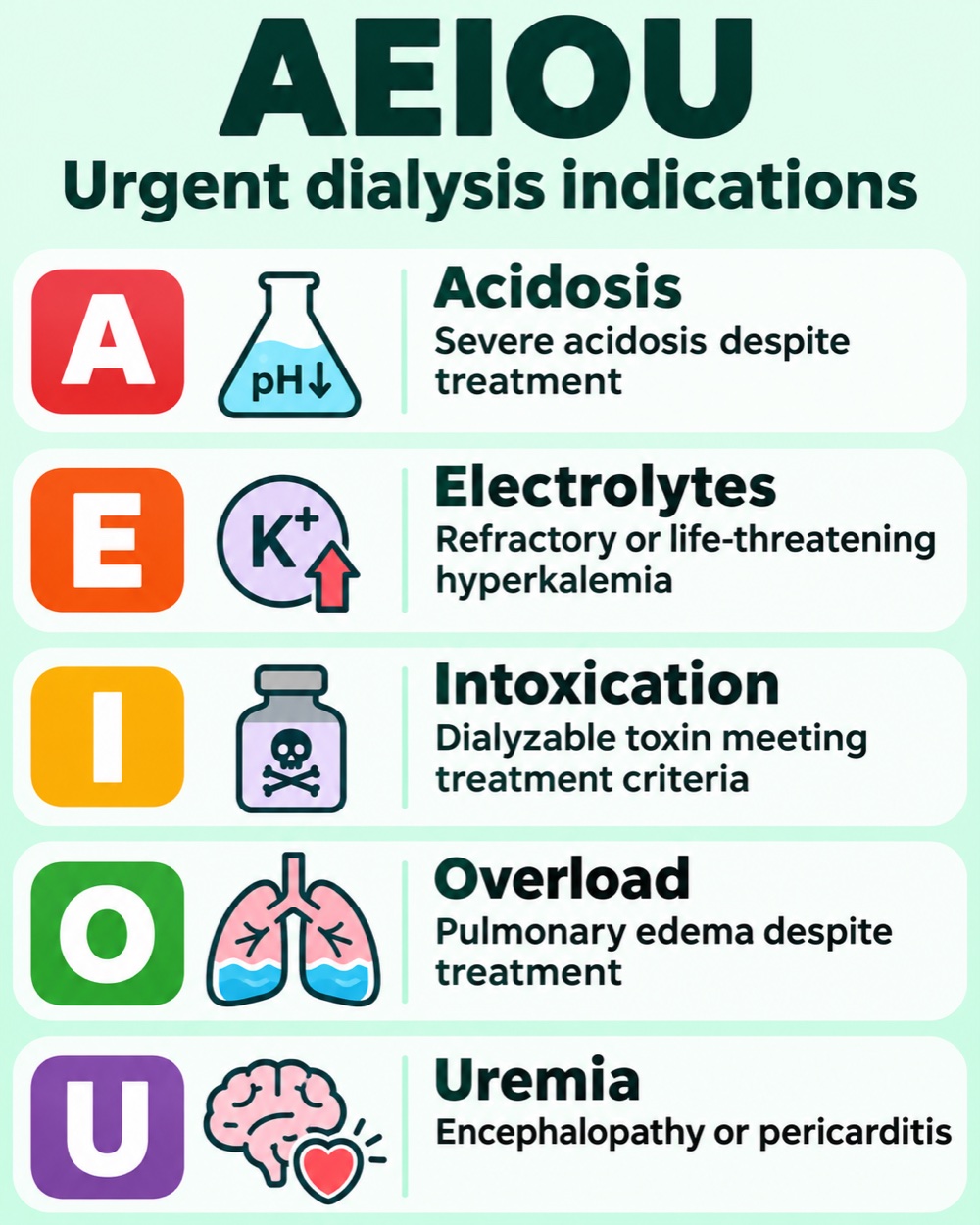
13AKI: when is urgent dialysis needed?
Hyperkalemia, severe acidosis, or pulmonary edema/volume overload not responding to medical treatment; uremic encephalopathy/pericarditis; or severe dialyzable poisoning when toxin-specific criteria are met. Use the clinical picture, not a creatinine or BUN cutoff.
14AKI requiring dialysis + hemodynamic instability: preferred modality?
Usually CRRT for hemodynamic tolerance. Intermittent hemodialysis may be chosen for faster solute removal when tolerated. Individualize with nephrology/critical care.